

Sumatra Mandheling Coffee Beans: Flavor, Roast and Origin
Dark roast doesn’t have to flatten a coffee’s character. Sumatra Mandheling coffee beans are commonly roasted medium-dark or dark to bring out sweet, earthy qualities. Mandheling takes its name from the Mandailing people of North Sumatra, not from a specific coffee-growing region.
You want to know what the name means in the cup, and whether a dark roast is the right fit. That’s the right place to start. This guide breaks down Mandheling’s flavor and aroma, where the coffee grows, and how its wet-hulling and sundrying process fits into its origin story. You’ll also get a clear picture of what to expect from a darker roast, so you can choose with purpose. No guesswork. Just the details that help you decide whether this bold, earthy profile belongs in your daily brew.
Key Takeaways
- Learn what gives Mandheling its sweet, earthy character and how that profile can come through in the cup.
- See how Sumatra’s growing conditions and coffee processing shape the beans’ distinctive origin story.
- Understand why a medium-dark or dark roast suits these beans, and what to expect from the roast.
- Use the article’s brewing and pairing guidance to decide how this coffee could fit your routine.
Mandheling coffee's flavor and aroma
Sumatra Mandheling coffee beans are known for sweet, earthy qualities, especially when roasted medium-dark or dark. Expect a grounded cup rather than one defined by bright, sharp notes. Aroma and taste shift with roast and brewing, so compare the same beans prepared in different ways. Try a lighter brew, then a darker roast, and notice which brings out sweetness and which deepens the earthy character.
Mandheling is best distinguished from other Sumatran or Indonesian coffees by its name and the cup you taste, not by a guaranteed flavor contrast. “Mandheling” refers to the Mandailing people of North Sumatra, not a specific growing region. Indonesian coffees vary by origin, processing, and roast, so compare labeled origins rather than assuming every Sumatran cup tastes alike.
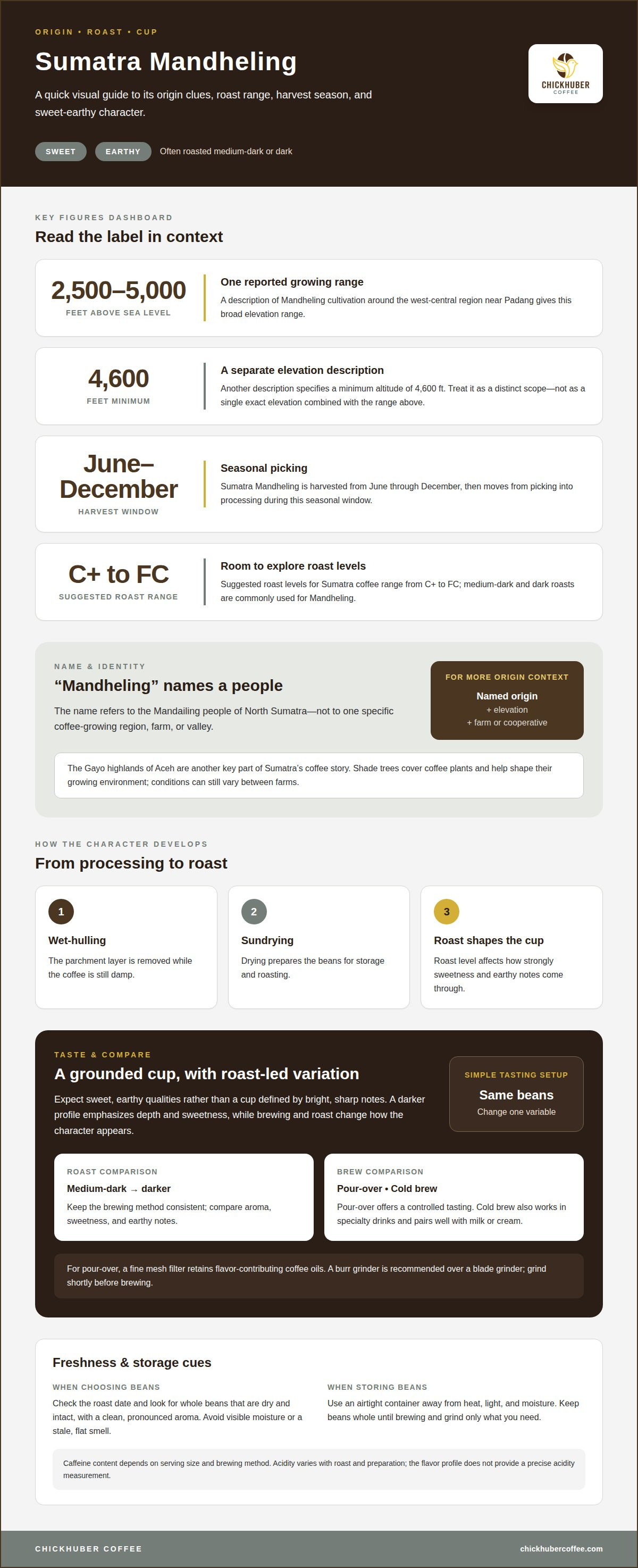
Wet-hulling is part of the processing associated with this coffee, followed by sundrying. In broad terms, wet-hulling removes the parchment layer while the coffee is still damp; drying then prepares the beans for storage and roasting. This processing contributes to the character associated with Sumatra, while roast level affects how strongly sweet and earthy notes come through.
To assess freshness, start with the roast date and choose whole beans with a clean, pronounced aroma. Look for beans that appear dry and intact; avoid packages with visible moisture or a stale, flat smell. Grind a small portion just before brewing and smell it. A clear coffee aroma is a more useful freshness cue than the origin name alone.
Caffeine content has no single fixed value for Mandheling: the amount in your cup depends on serving size and brewing method. Acidity also varies with roast and preparation; the characteristic sweet, earthy profile doesn’t provide a precise acidity measurement. Taste a small brewed cup and adjust the roast or method to suit your preference.
Store the beans in an airtight container away from heat, light, and moisture. Keep them whole until brewing, then grind only what you need. Coffee gradually loses aroma after roasting, but there’s no single freshness period for every bag. The roast date, storage conditions, and how often you open the container all matter.
Growing elevation and climate
Sumatra Mandheling is associated with the west-central region around Padang, but descriptions give different elevation scopes. One places cultivation between 2,500 and 5,000 feet above sea level; another specifies a minimum altitude of 4600 ft. Read these as distinct descriptions, not as a single exact growing elevation. For a bag, the stated origin and farm or cooperative details give more context than the regional name alone.
The Gayo highlands of Aceh are another key part of Sumatra’s coffee story. Coffee there is cultivated with shade trees, which cover the plants and help shape their growing environment. Elevation and shade work together: elevation affects local temperatures, while tree cover changes how much direct sunlight reaches the plants. Conditions can vary across farms, even within a broader highland origin.
Sumatra’s climate is not uniform. A coffee plot’s altitude, slope, surrounding vegetation, and exposure all influence its local environment. For example, two farms identified with the Gayo highlands may share a regional label but differ in shade and terrain. That variation is why origin names provide useful context without guaranteeing identical flavor in every harvest.
Use the location and elevation details as clues, not as a scorecard. A stated growing range can help distinguish highland coffee from beans grown elsewhere, while shade cultivation adds detail about farm conditions. The figures of 2,500 and 5,000 feet describe a broad range; 4600 ft appears as a separate minimum. Neither number alone tells you how a particular cup will taste.
For a more precise picture, read the label for three details: the named origin, any elevation statement, and farm or cooperative information. Gayo Aceh, shade-grown cultivation, and an elevation range together tell a clearer story than “Sumatra” alone. Use those details to compare coffees and connect their growing conditions with the character you may find in the cup.
Mandheling dark roast
Sumatra Mandheling is commonly roasted medium-dark or dark to highlight sweet, earthy qualities. Suggested roast levels for Sumatra coffee range from C+ to FC, with darker roasting also prized. Choose based on the cup you want: a darker profile emphasizes depth and sweetness, while the suggested range leaves room to explore.
Dark roasting changes how a coffee’s origin character comes through. It doesn’t erase every difference between beans, but it shifts attention toward the roasted profile. Start with a medium-dark cup, then try a darker roast. Compare aroma, sweetness, and earthy notes side by side, keeping the brewing method consistent so roast level is the main difference.
Pour-over works well for a controlled tasting. Use a fine mesh filter to retain flavor-contributing coffee oils, then notice how they shape the cup’s texture and aroma. A burr grinder is recommended over a blade grinder, which can produce less even grounds. Grind shortly before brewing to bring the roasted aroma into focus.
Cold brew is another option for Mandheling, including in specialty coffee drinks. Its concentrated format also pairs well with milk or cream, which can complement the beans’ sweet, earthy character. Try the coffee black first, then add milk or cream to compare the balance.
Keep the comparison simple. Brew the same beans as a pour-over and cold brew, or compare medium-dark and dark roasts using one method. Note which cup brings forward the qualities you enjoy. If a fine-mesh pour-over highlights aroma and oils while cold brew suits milk-based drinks, let the occasion guide your choice. One origin offers different roast directions and ways to serve it.
Sumatra Mandheling coffee
“Mandheling” comes from the Mandailing people of North Sumatra. It names an ethnic group, not a specific coffee-growing region. A bag labeled Mandheling therefore doesn’t identify one farm or valley. Look for details such as a named growing area or cooperative to learn more about the coffee’s origin.
Sumatra Mandheling coffee is harvested from June through December, then moves from picking into processing during this seasonal window. Wet-hulling and sundrying are associated with this coffee. These steps form part of its origin story, but the Mandheling name alone doesn’t reveal the specific farm conditions or handling behind every lot.
The Gayo highlands in Aceh offer a more specific place to look for provenance. The Koperasi Arisarina Cooperative was established in 2013 in the highlands of Gayo Aceh Province. Coffee from this cooperative has USDA Organic and Fair Trade certifications. These details apply to the cooperative’s coffee, not automatically to every bag sold as Mandheling.
Peaberries offer another useful point of distinction. They develop in under 10% of each coffee harvest, making them a smaller part of a crop than typical beans. Their presence describes bean form, not a separate growing region. If a bag identifies peaberries, treat that as a specific lot detail rather than proof of a particular flavor or quality level.
Build a clearer picture by reading the label in layers: Mandheling identifies the people behind the name; Aceh or Gayo narrows the origin; processing and cooperative details add context. For example, “Gayo Aceh” and “Koperasi Arisarina” tell you more than “Sumatra” alone. Use Mandheling as a starting point, then consider the lot’s origin and handling to distinguish one coffee from another.
Sumatra Mandheling coffee is recommended for cold-brew specialty coffee drinks, and it pairs well with milk or cream. These are practical options for serving the coffee: prepare it as cold brew, or combine it with milk or cream. The recommendation concerns drink use and pairing, offering another consideration alongside the origin and handling details that help distinguish one bag from another. These serving suggestions complement, rather than replace, the provenance information provided on a bag.
Chickhuber Coffee: 6 Bean Blend
Chickhuber Coffee’s 6 Bean Blend is a natural next step if you’re curious about coffee beyond a single origin. After exploring Mandheling’s origin, processing, and roast, try a blend to broaden your tasting routine. Choose Organic Honduras Coffee when you want to explore another named coffee offering, or French Vanilla Flavored Coffee for a flavored option. Each gives you a different direction for your next cup, without changing what Mandheling means.
Use your tasting notes to guide the choice. Prefer exploring a blend? Start with the 6 Bean Blend. Want to compare a named coffee or try flavoring? Consider Organic Honduras Coffee or French Vanilla Flavored Coffee. Chickhuber Coffee also offers Cowboy Blend for another blend option.
For help choosing what to try next, contact Chickhuber Coffee.
Make your next cup a deliberate choice
Let Sumatra Mandheling coffee beans be a starting point for refining what you enjoy, not a fixed standard for every cup. Notice which qualities stand out, then use those preferences to choose your next brew. A brief tasting note can help: describe the aroma, the first sip, and what lingers. Keep it personal. Your palate is the best guide to what you want in the cup.
For a useful comparison, change one brewing choice at a time and note what shifts. You’ll get a clearer sense of your preferences than by changing several things at once. Keep the routine simple, repeat what works, and stay curious about new coffees.
Ready to explore your next coffee choice? Contact Chickhuber Coffee to continue the conversation. Your next great cup starts with a choice made for you.
Frequently Asked Questions
What flavor notes and aroma are typical of Sumatra Mandheling coffee?
Sumatra Mandheling coffee typically leans sweet and earthy, with a bold aroma that becomes more pronounced in darker roasts. Don’t assume every cup will show extra notes like chocolate or spice; roast and brewing shape what you taste. For a focused tasting, take a small sip while the coffee is hot, then again as it cools. Notice whether sweetness or earthy depth stands out more.