

Peaberry Coffee: Why Its Shape and Price Stand Out
The premium starts with a bean that grows alone. To understand what peaberry coffee is, look inside the cherry: it comes from a single, rounded seed rather than the usual pair of flat-sided seeds. About 5-10% of coffee cherries produce one. That shape makes peaberry distinct, but rarity alone doesn’t explain every cup or every price.
A higher price can make you expect a dramatically different brew, but the reality is more nuanced. Some drinkers find peaberry coffee sweeter or more flavorful; others notice little difference from regular beans. What sets peaberry apart is how the bean forms, how it’s sorted, and the extra care needed to separate it from the rest of the crop.
Here’s the clear breakdown: how a peaberry develops inside a coffee cherry, how its rounded shape differs from a standard bean, and why limited supply and extra sorting can raise its price. With that in mind, you can decide whether this distinctive bean belongs in your coffee rotation.
Key Takeaways
- Expect a cup that may show brighter acidity and aromatic complexity, though tasting differences aren’t universal.
- A rounded bean behaves differently from flat-sided beans during roasting, making separation useful for an even roast.
- A peaberry develops when one ovule fails to pollinate, leaving a single seed to grow inside the cherry.
- Its premium reflects more than scarcity: extra selection work and the bean’s perceived flavor can also shape its value.
What Is a Peaberry Coffee & Why Is it Special?
A peaberry is a naturally occurring coffee seed with a rounded shape, unlike the two flatter seeds usually found together inside a cherry. Its shape can influence how it roasts, but it doesn’t guarantee a dramatically different cup. Flavor still depends on the coffee variety, growing conditions, and processing method.
Compared with regular beans from the same batch, peaberry coffee is often described as brighter in acidity, more complex in its higher aromas, and lighter in body. That can make the cup feel lively without feeling heavy. Tasting notes vary by crop, so the shape alone doesn’t promise a particular flavor, such as citrus, chocolate, or berry.
Opinions about peaberry flavor vary. Some drinkers describe peaberries as sweeter and more flavorful than standard beans; others notice little difference in a side-by-side tasting. Treat “sweeter” as a personal impression, not a guaranteed flavor. Comparing beans from the same crop helps distinguish the bean’s character from differences in origin or processing.
Is peaberry coffee stronger or higher in caffeine? Its rounded shape doesn’t make it inherently stronger or higher in caffeine. Perceived strength depends more on factors such as the coffee-to-water balance and brewing method than on bean shape.
How should you brew peaberry coffee? Start with your usual method, such as pour-over or French press, and taste the result. If the cup seems too light or sharp, adjust the grind or coffee-to-water balance gradually. Keep your method consistent when comparing peaberry with regular beans.
Think of peaberry as a distinct bean shape, not a promise of a particular flavor. Its brighter acidity and lighter body may stand out, but the final cup reflects the crop and brewing method. The useful takeaway: judge the coffee by its taste, not by the peaberry label alone.
Peaberry shape compared with regular coffee beans
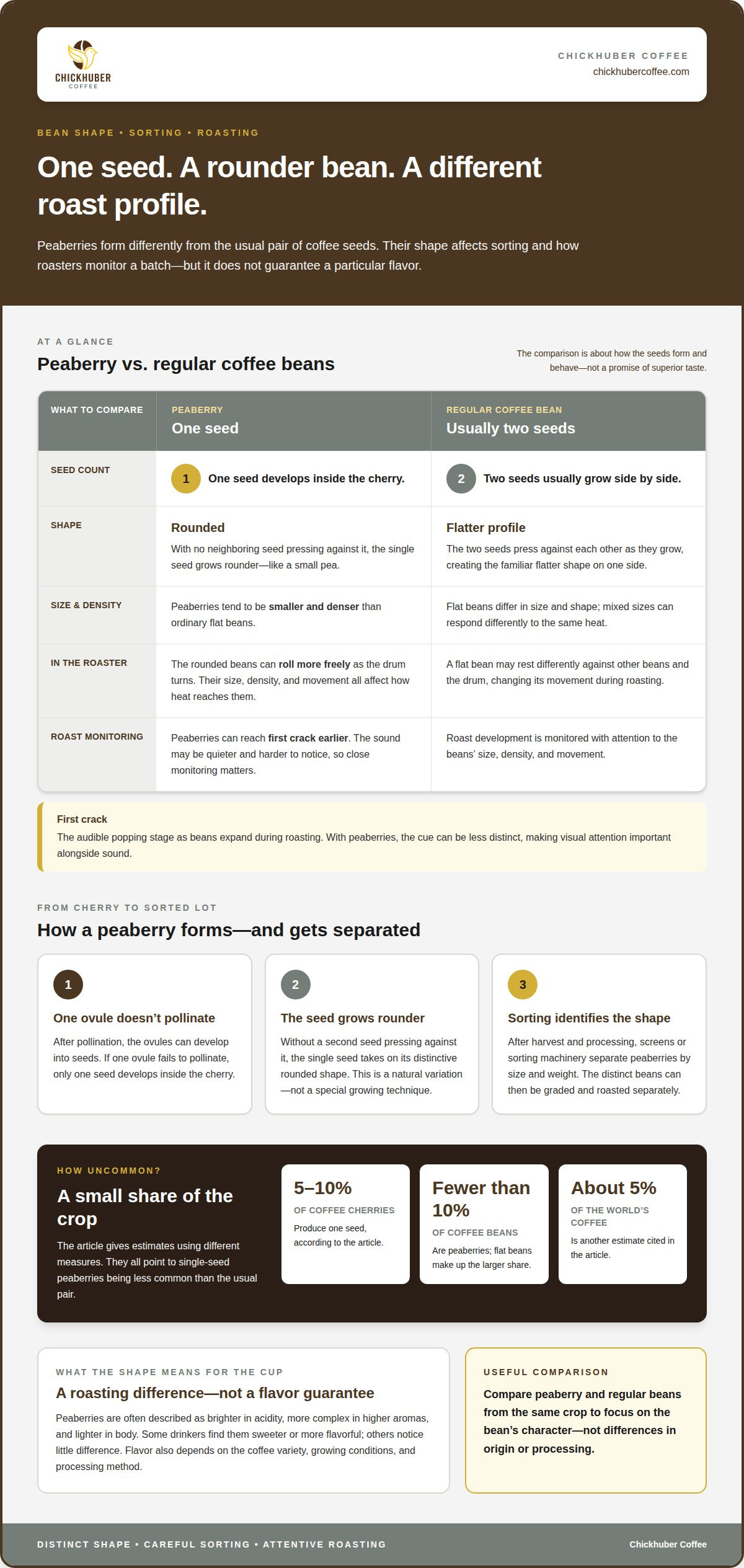
A regular coffee bean usually has a flatter profile, while a peaberry is rounded, almost like a small pea. That compact shape changes how the bean sits beside others in a roasting drum. Rather than resting flat, peaberries can roll more freely as the drum turns, creating a different pattern of movement during roasting.
Peaberries tend to be smaller and denser than ordinary flat beans. Those differences matter because a batch of mixed sizes and shapes can roast unevenly: smaller beans and larger beans may not respond identically to the same heat. For that reason, high-grade coffee producers often separate peaberries from flat beans before roasting. Sorting helps create a more consistent batch, though shape alone doesn’t determine the finished flavor.
Heat transfer is part of the picture, but it’s too simple to say that round beans roast faster. Bean size, density, and movement all affect how heat reaches the coffee. A rounded peaberry can roll through a drum roaster, while a flat bean may rest differently against other beans and the drum. Roasters account for these differences by handling peaberries separately and monitoring their roast development closely.
Roasting also brings a specific challenge: peaberries can reach first crack earlier, and its sound may be quieter and harder to notice. First crack is the audible popping stage as beans expand during roasting. When the cue is less distinct, timing can be harder to judge, so visual attention and careful monitoring matter alongside sound. Separating the beans helps roasters manage their distinct profile.
How common is peaberry coffee compared with regular coffee beans? Fewer than 10% of coffee beans are peaberries, so flat beans make up the much larger share. That rarity begins with the bean’s shape and continues through sorting, where peaberries are separated from the standard crop.
How peaberries form inside coffee cherries
Most coffee cherries develop two seeds side by side. As they grow, each seed presses against the other, creating the familiar flatter shape on one side. The cherry protects both seeds as they mature. Their shape forms before harvest, long before drying, sorting, or roasting begins.
A peaberry develops differently. After pollination, the ovules in a coffee cherry can develop into seeds. If one ovule fails to pollinate, only one seed develops inside the cherry. With no neighboring seed pressing against it, that single seed grows rounder. This is a natural variation in fruit development, not a special growing technique.
About 5-10% of coffee cherries grow only one seed, producing a peaberry. Another estimate describes about 5% of the world’s coffee as peaberries. These figures refer to different measures, cherries and coffee, but both show that single-seed development is less common than the usual pair.
A coffee cherry can rarely contain three mature beans, but the usual comparison is two seeds versus one. Growers can’t easily identify a peaberry by looking at an intact cherry before processing. The outer fruit doesn’t reliably reveal whether it contains one seed or two. The difference becomes clear only after processing exposes the beans.
After harvest and processing, screens or sorting machinery separate peaberries by size and weight. This step identifies the rounded seed among the flatter coffee beans. The peaberry is then kept apart for grading and roasting instead of being treated as though its shape matched the rest of the batch. From pollination to sorting, each stage helps explain how a coffee cherry can produce a distinct bean.
Reasons for peaberry coffee's premium price
Peaberry coffee can command a premium because of its limited supply, extra sorting, and perceived flavor, not its shape alone. The rounded seed is separated from flat beans after processing, creating a distinct lot that can be sold separately. Growers may hand-select peaberries for separate sale. Each step adds labor before the beans reach a roaster, while the smaller supply limits how much can be offered.
The yield shows why scarcity matters. Sorting 1,000 lb of green coffee can produce just 50 lb of peaberries. The remaining beans aren’t peaberries, so the separated lot represents only a small portion of that batch. This doesn’t mean every peaberry crop has the same yield, but it illustrates how selection can leave a comparatively limited quantity for sale.
Processing and sorting bring practical costs. Workers or machinery must distinguish rounded beans from flat ones, then keep the selected lot separate during handling. Hand selection adds direct labor; mechanical sorting still requires equipment and careful lot management. These tasks help explain a premium without implying that rarity automatically makes every batch exceptional.
Perceived sweetness and flavor can also affect what buyers are willing to pay. Some drinkers value peaberries for their distinct cup profile, while others find little difference from standard beans. The premium reflects both the work of separating this less common form and the value people place on its taste. Coffee variety, growing conditions, and processing also shape quality, so shape alone can’t guarantee a superior cup.
Use the practical test: decide whether the separate lot and its flavor appeal justify the premium for your own routine. If you want to explore other coffee styles, browse coffee options and choose a profile that fits your cup.
Chickhuber Coffee
Chickhuber Coffee helps you put your knowledge of peaberries into practice by exploring different coffee profiles. Peaberry describes a bean type, while origin and blend also shape a coffee’s flavor. Comparing those details can help you find a profile that suits your cup.
For a single-origin option, try Organic Honduras Coffee. For a different direction, 6 Bean Blend and Cowboy Blend offer blend choices, while French Vanilla Flavored Coffee adds a flavored option. These selections let you explore coffee preferences without treating peaberry shape as a guarantee of a particular taste.
If you’re ready to choose your next coffee or have a question about the available options, contact Chickhuber Coffee.
Choose Your Next Cup with Purpose
Now that you know what peaberry coffee is, turn your curiosity into a more deliberate tasting habit. Focus on what you want from your next cup: a crisp start, a rounded finish, or a profile you’ll want to revisit. Let your palate set the standard, not the label or the price.
Try one change at a time. Notice the aroma before sipping, then pay attention to how the flavor develops as the cup cools. A few simple notes can help you recognize your preferences and make your next coffee choice with confidence. You don’t need an elaborate tasting setup, just attention, a fresh cup, and a moment to enjoy it.
Ready to explore a coffee that fits your taste? Contact Chickhuber Coffee and take the next step toward a cup you’ll look forward to.
Frequently Asked Questions
What Is a Peaberry & How Does It Form?
A peaberry is a single, rounded coffee seed that develops inside a cherry instead of the usual pair. It forms when one ovule fails to pollinate, leaving one seed to grow without a second seed beside it. Because the outer fruit doesn’t reliably show how many seeds are inside, growers identify peaberries after processing, when the beans can be sorted.
Why Are Peaberries Considered Superior?
Peaberries aren’t automatically superior. The label describes bean shape, not a guaranteed quality grade. Some drinkers prefer their taste, while others notice little difference. To judge one for yourself, compare it with regular beans from the same crop, prepared using the same brewing method and coffee-to-water balance. This keeps the comparison focused on the coffee rather than a changed recipe.
What is peaberry coffee?
Peaberry coffee is made from peaberry beans, the rounded single seeds found in some coffee cherries. The word “caracol,” another name for a peaberry, means “snail” in Spanish and refers to its curved form. It doesn’t identify a particular origin, roast level, or flavor; those details depend on the coffee itself.
How does peaberry coffee form inside a coffee cherry?
A peaberry develops when one ovule in a coffee cherry fails to pollinate and only one seed grows. Without a neighboring seed pressing against it, that seed takes on a rounder form. A cherry can rarely contain three mature beans, but the familiar contrast is one rounded seed versus two seeds growing side by side.
How is peaberry coffee sorted and processed?
Peaberries are separated from other beans after harvest and processing, commonly by screens or machinery that sorts by size and weight. The rounded beans are then kept apart from flat beans before roasting. Since intact cherries don’t clearly reveal their seed shape, sorting takes place after the beans are exposed, rather than by selecting fruit based on appearance.
Does peaberry coffee taste different from regular coffee?
Peaberry coffee can taste different, but the contrast isn’t universal. Compared with regular beans from the same batch, it is often described as brighter in acidity, more complex in its higher aromas, and lighter in body. For a useful comparison, brew both coffees using the same method and recipe, then notice which cup’s aroma, acidity, and texture you prefer.