

Impact of Altitude on Coffee Beans and How to Choose
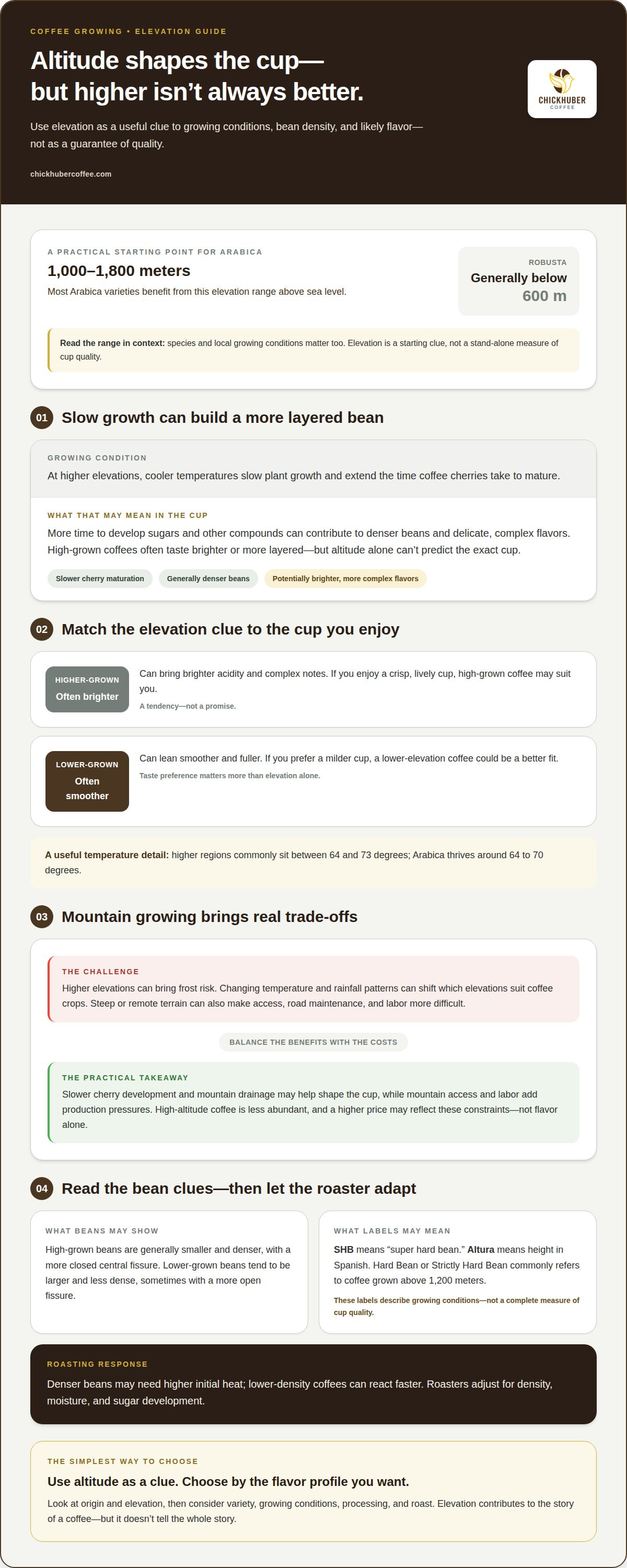
The impact of altitude on coffee beans is real, but higher isn’t automatically better. Most Arabica varieties benefit from elevations between 1,000 and 1,800 meters above sea level, where slower growth can support denser beans and more developed flavors. Expect tendencies, not guarantees: higher-grown coffees often taste brighter and more complex, while lower-grown coffees can lean smoother and fuller.
If you already look for the roast or tasting notes that match your routine, altitude gives you another useful clue. This guide breaks down the growing range that suits Arabica, explains how elevation can shape acidity, body, and flavor, and shows what to look for when choosing single-origin high-altitude beans. You’ll get a practical way to read origin and elevation information, then connect those details to the cup you want: crisp and lively, sweet and balanced, or mellow and smooth. Use the label as a starting point. Flavor also reflects the coffee’s variety, growing conditions, processing, and roast.
Key Takeaways
- Match the growing elevation to the coffee species; Arabica and robusta favor different conditions.
- Learn how cooler growing conditions and slower cherry maturation can influence bean density and flavor.
- Weigh the potential flavor benefits of high-grown coffee against the extra challenges of mountain production.
- Use origin and elevation details to narrow your search for single-origin coffee that fits your taste.
What is the ideal altitude for growing coffee?
For most Arabica varieties, a useful range is 1,000 to 1,800 meters above sea level. Robusta generally favors lower elevations, so the best fit depends on the coffee species.
Growing Elevations for Arabica and Robusta
Arabica commonly grows around 2,000 to 6,500 feet, while robusta typically grows around 600 to 2,500 feet. Most Arabica varieties benefit from elevations between 1,000 and 1,800 meters above sea level; robusta generally benefits below 600 meters. These ranges give you a practical starting point when comparing origins. Altitude plays a role, but species and local growing conditions matter too.
Slower Cherry Development at Higher Elevations
At higher elevations, cooler temperatures slow plant growth and extend the time coffee cherries take to mature. This longer development can give beans more time to build sugars and other compounds, contributing to delicate, complex flavors. Bean density may also increase with elevation. That helps explain why some high-grown coffees taste brighter or more layered, though altitude alone can’t predict a cup’s exact flavor.
Elevation and Coffee-Growing Conditions
Elevation changes growing conditions by influencing temperature, sunlight, and oxygen levels. Higher regions commonly sit between 64 and 73 degrees, while Arabica thrives around 64 to 70 degrees. Mountain slopes also help water drain away from coffee trees. Elevation is reported as a height above sea level, commonly in meters or feet. For roasters, denser beans and differences in moisture and sugar development call for adjustments to roasting parameters.
High-Altitude Growing Risks
Higher elevations can bring a risk of frost, which may damage coffee plants and cherries. Climate change can also shift temperature and rainfall patterns, changing which elevations suit coffee crops. These pressures matter because coffee depends on conditions such as temperature, humidity, and water availability. High elevation isn’t automatically an advantage: growers must balance slower cherry development and drainage against cold and changing weather.
Does Altitude Affect Coffee Beans?
Yes. The impact of altitude on coffee beans can be seen in their density, maturation, and response to roasting. Cooler growing conditions may slow development, while denser beans generally respond differently to heat. Elevation is a useful clue to how a coffee may behave, but it doesn’t determine every detail of the finished cup.
Temperature, Maturation, and Bean Density
At higher elevations, cooler temperatures slow coffee plant growth and cherry development. This longer maturation gives beans more time to develop sugars and other compounds. High-grown beans are generally denser, which can influence their roast response and flavor. For drinkers, this helps explain how growing conditions can contribute to a layered profile. Floral notes may appear, but they also depend on origin and other growing conditions.
Altitude and Bean Maturation
Elevation affects maturation through conditions around coffee plants, including temperature and water availability. Mountain slopes may drain more readily, shaping the environment in which cherries develop. High-grown beans are generally smaller and denser, with a more closed central fissure. Lower-grown beans tend to be larger and less dense, sometimes with a more open fissure. These visible differences give roasters practical clues about a lot before roasting.
Bean Density and Quality Classifications
Some labels connect growing elevation with bean hardness. SHB means “super hard bean,” while Altura is Spanish for height. Hard Bean or Strictly Hard Bean commonly refers to coffee grown above 1,200 meters. These labels describe growing conditions, not a complete measure of cup quality. Understanding the impact of altitude on coffee beans also means considering roasting: dense beans may need higher initial heat, while lower-density coffees can react faster. Roasters adjust for density, moisture, and sugar development. For another origin to explore, Organic Honduras Coffee offers a named-origin comparison.
Do the best coffees grow better at higher altitudes?
Higher altitude can support a distinctive flavor profile, but it doesn’t make every coffee better. Coffee experts consider beans grown at 4,500 feet or higher among the best, yet preference still matters. High-grown coffees often bring brighter acidity and complex notes; medium-altitude coffees can balance sweetness and body. Choose the cup you appreciate, not elevation alone.
Production per acre isn’t determined by elevation alone. Coffee variety, local growing conditions, and the demands of mountain terrain all affect a farm’s output. High-altitude coffee is less abundant, and steep or remote locations can complicate access, road maintenance, and labor. These pressures raise production costs. A higher price may reflect the work and constraints behind a crop, not just its flavor profile.
Pollination also differs by species. Arabica is self-pollinating, while robusta relies on insects and wind to move pollen between flowers. This affects how the plants reproduce, but it doesn’t determine which coffee produces more per acre. Output depends on the crop and its growing conditions. An elevation figure alone can’t tell you a farm’s harvest volume or how much coffee its mountain plots produce.
Think of elevation as one part of the production picture. Better drainage at higher elevations can leave less water in coffee beans and help concentrate flavors. But mountain access, road maintenance, and labor add practical costs. High-grown lots are also less abundant. Together, these factors shape what reaches a roaster, while origin and growing conditions influence the cup you brew.
Use altitude as a clue, then consider the flavor notes and origin. If you enjoy lively acidity and complex flavors, high-grown coffee may suit you. If you prefer a milder cup, coffee grown at a lower elevation could be a better fit. Choose the profile you want to drink, rather than the coffee with the highest number on its label.
Finding single-origin high-altitude coffee
Single-origin coffee comes from a shared origin, such as a country or region, rather than a blend of origins. To find a high-altitude option, look for both the named origin and a stated growing elevation. “High-grown” alone tells you less than a region and elevation in meters or feet.
Start with the origin, then compare its elevation range with the flavor profile you want. Ethiopia’s coffee-growing elevations are listed at 1,800-2,200 meters or higher, while Colombia’s range is 1,000-2,000 meters. Guatemala’s range is 1,300-1,800 meters. These country ranges show why origin can narrow your search, but they don’t identify the precise altitude of every farm or lot.
- Look for a specific region: a country name offers a starting point; a region or farm gives a more focused origin description.
- Find the elevation: note whether the label reports meters or feet, then compare like units.
- Read the tasting notes: floral, fruit, or wine-like notes can point toward a brighter cup; sweetness and body help complete the picture.
Use elevation as a clue, not a guarantee of quality. At higher elevations, slower cherry maturation can allow sugars and other compounds to develop. That may contribute to more complex flavor, while high-grown coffees are often brighter and more acidic. Smooth cups can come from different growing conditions, so consider the tasting notes alongside the elevation.
For a clear comparison, choose single-origin coffees with named regions and comparable elevation details. Then consider how each origin’s profile suits your preferences. If a label gives only a country, use the region’s known growing range as context, not as the exact altitude of that coffee. This distinction helps you make a more informed choice without treating every high-altitude cup as the same.
Chickhuber Coffee: 6 Bean Blend
Chickhuber Coffee’s 6 Bean Blend gives you a route to explore coffee beyond a single growing region. Use what you’ve learned about elevation to guide your choices, then compare how an origin-specific coffee and a blend fit your preferences. A blend isn’t a substitute for single-origin high-altitude beans, but it can broaden your tasting experience.
For a named-origin option, consider Organic Honduras Coffee. If you’re choosing by flavor preference instead, French Vanilla Flavored Coffee offers a flavored alternative. Each choice helps you focus on a different part of the coffee experience without assuming altitude alone determines quality.
Have questions about choosing among these coffees? Contact Chickhuber Coffee.
Choose Your Next Cup With Purpose
Let the impact of altitude on coffee beans spark your curiosity, not lock you into a rule. Your next cup can help you test a preference, explore an origin, or try something outside your usual rotation. Notice what you enjoy, then use that experience to guide your next choice.
Chickhuber Coffee offers 6 Bean Blend, Cowboy Blend, and Organic Honduras Coffee. These give you options to explore within its coffee selection as you decide what belongs in your routine. Keep your choice simple: start with the kind of coffee you want to drink, then let each new cup teach you more about your preferences.
Ready to choose your next coffee? Contact Chickhuber Coffee to take the next step. Stay curious, trust your taste, and keep exploring.
Frequently Asked Questions
But what causes these differences?
Temperature, sunlight, oxygen, humidity, and water availability all shape coffee plant growth. Elevation changes some of these conditions, but farms at the same height can still have different environments. Shade and rainfall, for example, affect the conditions around the trees. That’s why origin and growing details help explain a coffee’s character beyond elevation alone.
What are physical differences between high and low grown beans?
High-grown beans are generally smaller and denser, and their central fissure is often more closed. Lower-grown beans are typically larger and less dense, and may have a more open fissure. These are tendencies, not a score for cup quality. For roasters, density is a practical clue: denser beans can respond differently to heat, so it’s useful to consider appearance and roast response together.
Why is high-grown coffee so expensive?
High-grown coffee can cost more because mountain production brings practical challenges, including access, road maintenance, and labor. It’s also less abundant. These pressures can affect production costs before the beans reach a roaster. Elevation alone doesn’t explain the cost of a particular coffee; the origin and the work involved in producing and moving the crop matter too.
How does growing altitude affect coffee bean flavor and acidity?
Growing altitude can influence acidity and flavor, giving you a useful clue when choosing a cup. Beans grown above 1,300 meters (4,500 feet) tend to be more acidic and may show fruit or berry notes. Lower-grown coffees tend toward lower acidity and heavier body. If you enjoy a lively, fruit-forward cup, look for those tasting notes alongside origin details.
What altitude ranges are best for growing Arabica and Robusta coffee?
Most Arabica varieties benefit from elevations between 1,000 and 1,800 meters above sea level. Robusta generally benefits from lower elevations, ideally below 600 meters above sea level. These ranges are a starting point, not a universal cutoff for every farm. Use the species and stated origin together when interpreting an elevation label, rather than comparing numbers without context.
Why do coffee cherries ripen more slowly at high altitudes?
Cooler temperatures at higher elevations slow coffee plant growth, extending the time cherries take to mature. This longer development gives beans more time to form sugars and other compounds that contribute to flavor. A high-grown coffee, for example, may develop a more layered profile. Maturation is only one part of the story, alongside variety, local growing conditions, and processing.