

English Breakfast Tea vs Irish Breakfast Tea: Taste and Strength
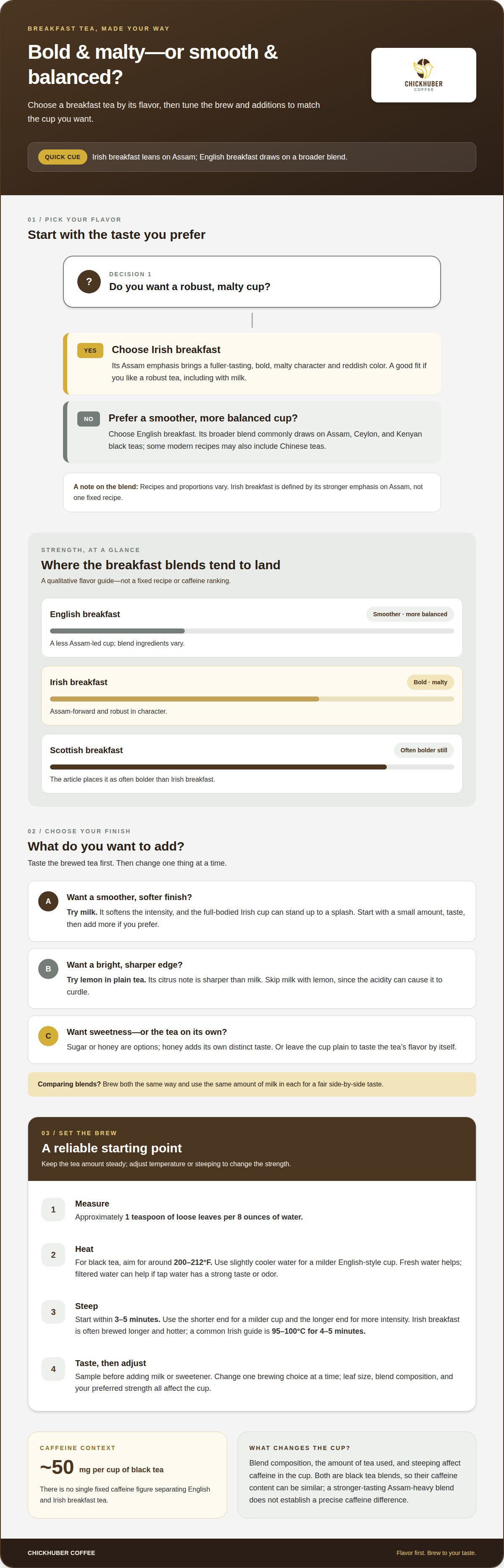
Irish breakfast tea usually makes a bolder, maltier cup, while English breakfast tea tends to taste smoother and lighter. In the English breakfast vs. Irish breakfast tea comparison, the main difference is Irish blends’ stronger emphasis on Assam. Scottish breakfast tea is often bolder still.
Choose Irish breakfast if you like robust tea with milk. Prefer a smoother, more balanced cup? English breakfast is a solid choice. The right one depends on the flavor and strength you want, not just the name on the tin.
Learn the practical differences and brew with confidence. This guide compares taste, strength, milk, and steeping to help you choose a breakfast tea and make each cup your way.
Key Takeaways
- Learn how Assam and other regional teas shape the difference between a bold, malty cup and a smoother blend.
- Choose whether to add milk based on the tea’s strength and the flavor you prefer.
- Use a reliable starting point for tea quantity, water temperature, and steeping time, then adjust to taste.
- Place Irish breakfast tea on the strength scale alongside English and Scottish varieties to find your ideal cup.
Irish Breakfast Tea vs English Breakfast Tea: What’s the Difference?
Both are black tea blends, but their typical ingredients give them different flavor profiles. Assam is central to Irish breakfast tea, while English breakfast blends draw on a broader mix.
English Breakfast Blend and History
English breakfast tea is commonly blended from Assam, Ceylon, and Kenyan black teas, though recipes vary. Its history has more than one account: the style is linked to Queen Anne’s reign in the early 1700s, while New York tea merchant Richard Davies is credited with popularizing a blend called English Breakfast in the 1840s. That broader blend profile can taste smoother than an Assam-focused Irish cup.
Irish Breakfast Blend Composition
Irish breakfast blends usually combine several black teas, with Assam as a key component. Assam’s bold, malty character gives the blend its robust taste and reddish color. Kenyan tea may also appear, but the defining distinction is the emphasis on Assam, not a fixed recipe shared by every maker. Irish breakfast is a good fit if you want a fuller-tasting cup.
Tea Origins and Typical Leaves
English breakfast blends commonly combine Ceylon from Sri Lanka with Indian Assam and Kenyan teas. Modern recipes may also include Chinese teas; the original English breakfast blend used Chinese teas. Irish breakfast blends lean more heavily on Assam, a tea from India. Both use black tea, and proportions vary by recipe. Either can work in a recipe calling for breakfast tea, though an Assam-forward Irish blend will bring a bolder, maltier note.
Caffeine in Both Breakfast Teas
A cup of black tea contains about 50 mg of caffeine. There isn’t a single fixed caffeine figure separating English and Irish breakfast tea: blend composition, the amount of tea used, and steeping affect what ends up in the cup. Since both are black tea blends, their caffeine content can be similar, while an Assam-heavy Irish blend may taste stronger. Flavor strength alone doesn’t establish a precise caffeine difference.
| Tea | Typical blend | Flavor cue | Best fit |
|---|---|---|---|
| English breakfast | Assam, Ceylon, Kenyan, or Chinese teas | Smoother, more balanced | A less Assam-led cup |
| Irish breakfast | Several black teas, especially Assam | Bold, malty | A robust cup |
Choose the profile you prefer, then adjust your brewing to match.
Should you drink Irish breakfast tea with milk?
Milk is a classic match for Irish breakfast tea. Its full-bodied flavor stands up to a splash, while milk softens the cup’s intensity. In Ireland, people enjoy tea throughout the day, not just in the morning, so there’s no need to reserve this pairing for breakfast. Try it plain first, then add milk to see which version you prefer. Tasting English and Irish breakfast tea side by side shows how milk changes each cup.
Choose by flavor. If you enjoy Assam’s bold, malty notes, Irish breakfast tea with milk makes a satisfying, rounded drink. Prefer a lighter taste? Try English breakfast, which often includes Ceylon alongside other black teas. Milk can suit either style, but the amount is up to you: start with a small splash, taste, and add more if you want a softer finish. For a fair comparison, use the same amount of milk in both teas.
Sweetener is optional. Some Irish tea drinkers enjoy their cup plain or add sugar without milk. If you want sweetness, stir a little into the brewed tea, taste, then decide whether to add more. This lets the tea’s flavor come through instead of letting sugar take over. Honey is another option, though it adds its own distinct taste.
Lemon gives tea a sharper flavor than milk. Add a slice to plain English or Irish breakfast tea for a bright citrus note; skip milk, since lemon’s acidity can cause it to curdle. For a simple comparison, brew both teas the same way. Taste each plain, then add milk to one and lemon to the other. The contrast can help you decide which you prefer.
Use this simple guide: choose milk for a smooth, classic cup, sugar for sweetness, lemon for a brisk citrus edge, or nothing to taste the tea’s flavor on its own. Start with what suits your mood, especially if you want a strong morning brew. Change one thing at a time and let your palate guide you.
Brewing temperature, amount, and steeping time
A controlled brew helps you make a lighter or stronger, more robust cup. Start with the same leaf-to-water ratio for English and Irish breakfast tea, then adjust the steep to suit your taste.
For loose-leaf tea, use approximately one teaspoon per 8 ounces of water. Heat fresh water to around 200-212°F for black tea. If tap water has a strong taste or odor, filtered water can help keep those notes from competing with the tea. Measure the leaves and water consistently when comparing blends.
Steep either breakfast tea for three to five minutes as a practical starting range. English breakfast tea is typically brewed for less time and with slightly cooler water, which produces a milder flavor. Irish breakfast tea is often brewed longer and with hotter water, bringing out its robust character. For Irish tea, a common guide is 95-100°C and four to five minutes.
- Measure: Add approximately one teaspoon of loose leaves for each 8-ounce cup.
- Heat: Use fresh water; aim for around 200-212°F for black tea, adjusting cooler for a lighter English-style cup.
- Steep: Begin within the three-to-five-minute range. Use the shorter end for a milder cup and the longer end for more intensity.
- Taste: Sample the tea before adding milk or sweetener, then adjust the next brew rather than changing several variables at once.
These are starting points, not fixed recipes. Leaf size, blend composition, and your preferred strength all affect the cup. In Ireland, a longer, hotter steep suits drinkers seeking a fuller taste; for a lighter English breakfast beverage, reduce steeping time and use slightly cooler water. Scotland’s breakfast teas may also taste bold, so apply the same controlled approach: keep the amount steady, then change one brewing choice at a time.
Irish breakfast tea’s strength compared with English and Scottish varieties
For flavor strength, the usual order is English breakfast, Irish breakfast, then Scottish breakfast. English blends tend to be milder; Irish blends have more body and a stronger, maltier flavor. Scottish breakfast tea is commonly the boldest. This ranking describes taste, not a guaranteed measure of caffeine.
Irish breakfast sits between the other styles for drinkers who want more presence than a typical English blend without the intensity associated with Scottish breakfast. Its emphasis on Assam gives it a rich, malty character. English breakfast can taste smoother because its blends often balance Assam with Ceylon, Kenyan, or Chinese teas. These are broad patterns, not fixed recipes, so the cup can vary by maker.
Scottish breakfast blends tend to rely mostly on Assam and Kenyan black teas. Scottish tea makers developed a stronger breakfast blend to address Scotland’s soft water. That background helps explain why these varieties often taste especially full-bodied. Each blend can differ, but this is a useful guide when choosing among breakfast teas.
Use the strength scale to match the tea to your preference. Choose English breakfast for a gentler, more balanced taste. Pick Irish breakfast for a bolder, Assam-led cup with a clear malty flavor. Choose Scottish breakfast for the most forceful profile. If your cup tastes too strong, steep it for less time next time; if it tastes too light, steep it longer within the recommended range. Keep the amount of tea steady as you adjust, so you can tell what changed.
For a direct comparison, brew English, Irish, and Scottish teas with the same water and amount of tea. Taste each plain before adding milk. This separates the blend’s natural flavor from the effect of additions. The takeaway: Irish breakfast is stronger than English breakfast, but usually less intense than Scottish breakfast.
Chickhuber Coffee
Now you know how blend character, milk, and brewing choices shape a cup. Chickhuber Coffee offers loose leaf tea blends for putting those preferences into practice. Use what you’ve learned to guide your next tea choice, whether you want a bolder, fuller taste or a smoother cup brewed your way.
Prefer coffee for your next morning instead? Chickhuber Coffee also offers blends and single-origin coffee options. Choose the drink that fits your routine, then make it your own. For a simple next step, contact Chickhuber Coffee.
Make Your Next Cup Your Own
Let your taste guide your next choice. Use what you’ve learned about English breakfast versus Irish breakfast tea to shape a brewing routine for mornings, afternoon breaks, or slower evenings. Note the leaves and brewing approach you enjoy, then make small adjustments over time. Your preferred cup is the one you’ll look forward to making.
If your next craving shifts from tea to coffee, Chickhuber Coffee offers options including 6 Bean Blend, Cowboy Blend, and Organic Honduras Coffee. Each gives you another direction to explore, whether you want a blend or a single-origin coffee. Choose by the flavor experience you want next, and keep your routine fresh without overthinking it.
Ready to explore what suits your cup? Contact Chickhuber Coffee and take the next step toward a drink you’ll enjoy making. Stay curious, trust your palate, and keep moving with a cup that fits your day.
Frequently Asked Questions
First Things First: What Is Breakfast Tea?
Breakfast tea is a style of blended black tea, not one fixed recipe or a single tea origin. A blend may combine leaves from India, Sri Lanka, Kenya, or China. “Breakfast” describes a traditional style and serving occasion, but these teas can be enjoyed throughout the day. Check the blend description to see which leaves shape its flavor.
What does Irish breakfast tea taste like, and how much caffeine does it have?
Irish breakfast tea typically tastes bold and malty, with a rich, full-bodied character. A cup of black tea contains about 50 mg of caffeine, but that figure doesn’t establish a fixed caffeine difference between Irish and English breakfast blends. The amount of tea used and brewing choices affect the cup. For a gentler taste, add milk or brew a less concentrated cup.
What is the difference between the most popular breakfast teas?
English, Irish, and Scottish breakfast teas are commonly compared by flavor strength and blend composition. English blends are generally milder, Irish blends emphasize Assam for a more robust cup, and Scottish breakfast is often the boldest. Treat these as broad style cues, not strict formulas. If you’re choosing your first cup, decide whether you want a smooth, malty, or especially intense flavor.
What is English breakfast tea?
English breakfast tea is a robust-style black tea blend associated with British breakfast traditions. Common blends draw on Assam, Ceylon, and Kenyan teas, while some recipes use Chinese leaves. Proportions vary, so the name alone doesn’t tell you exactly how the cup will taste. Look at the ingredients if you want a blend with a particular origin or flavor profile.
What are the differences in flavor between English and Irish breakfast tea?
English breakfast tea usually tastes smoother and more balanced; Irish breakfast tea tends to be stronger and maltier. The difference comes through in tea-based recipes: Irish breakfast can make the tea flavor more prominent, while English breakfast may keep it gentler. Either can work as a substitute, but the blend will affect the finished taste.
Which tea is stronger or more robust: English or Irish breakfast?
Irish breakfast tea is generally more robust than English breakfast tea because its blends tend to emphasize Assam. That describes flavor intensity, not a guaranteed caffeine advantage. Choose Irish for a punchier-tasting cup or English for a less forceful profile. The exact result still depends on the blend and how you prepare it.