

Different Types of Tea: How Caffeine and Flavor Differ
Tea doesn’t always contain caffeine. An introduction to different types of tea starts with this key distinction: black, green, and oolong teas come from the Camellia sinensis plant and contain caffeine, while herbal infusions such as chamomile and peppermint aren’t technically tea and offer caffeine-free alternatives. The name on the cup matters.
It’s easy to assume every tea tastes gentle, brews the same way, or gives the same lift. Not so. Black tea is bold, green tea is fresh and grassy, and oolong can fall somewhere between them, with floral or fruity notes. Herbal infusions bring different flavors and ingredients to the mix. This guide explains how processing shapes true teas, what sets herbal infusions apart, and how caffeine varies from cup to cup. Learn the basics, then choose a tea that suits your taste and the kind of boost you want.
Key Takeaways
- Use oxidation as a guide to understanding why tea leaves develop distinct flavors and styles.
- Compare black, green, and oolong tea to find a taste profile that fits your preference.
- Tell true tea from herbal infusions by looking at the plant each drink comes from.
- Adjust steeping time by tea type to help bring out its best flavor.
Black tea
Black tea is fully oxidized during processing, giving it a darker character than green or white tea. Steeping it for 3 to 5 minutes brings out its flavor.
Black Tea Oxidation
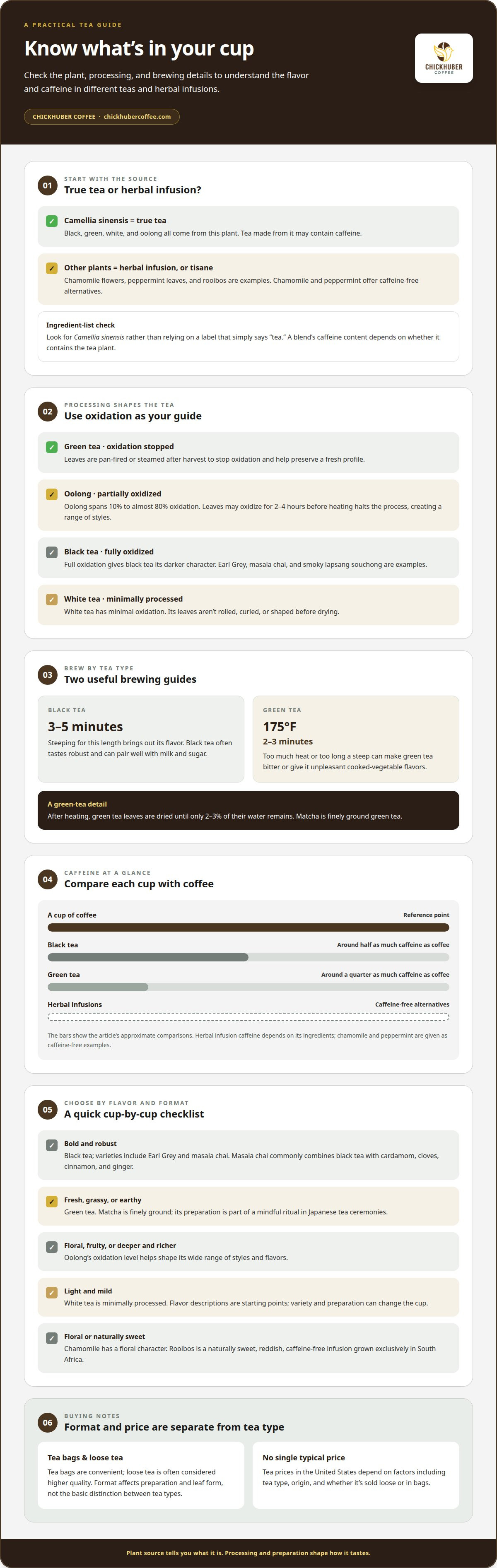
Oxidation is a process that changes tea leaves after harvesting and helps determine whether they become black, green, or oolong tea. Black tea leaves are fully oxidized, while green tea leaves are heated to stop oxidation and oolong leaves are partially oxidized. White tea is minimally processed, with minimal oxidation. These differences help explain why the teas look and taste distinct.
Black tea varieties include Earl Grey, masala chai, and smoky lapsang souchong. Earl Grey was created in the 1800s; masala chai commonly combines black tea with cardamom, cloves, cinnamon, and ginger. Chinese Assam-type tea may have origins in Southern and Western Yunnan, China, according to the U.S. National Library of Medicine.
Flavor and Caffeine
Black tea often tastes robust and can pair well with milk and sugar. Green tea tends to taste fresher, oolong can be floral or fruity, and white tea is light and mild. Herbal infusions such as chamomile taste different because they aren’t made from the tea plant. Flavor varies with the variety and preparation, so these descriptions are starting points, not fixed rules.
Black tea contains around half as much caffeine as a cup of coffee. Green tea contains around a quarter as much caffeine as coffee, while herbal infusions provide a caffeine-free alternative. Choose black tea for a bolder taste and more caffeine than green tea, or chamomile if you’re avoiding caffeine.
Tea bags are convenient, while loose tea is often considered higher quality. The format affects preparation and the form of the leaves, not the basic distinction between tea types. Tea prices in the United States depend on factors such as tea type, origin, and whether it’s sold loose or in bags, so there’s no single typical price for every tea.
Differences between true teas and herbal infusions
Leaves from Camellia sinensis make true tea, including black, green, white, and oolong. Herbal infusions use other plants, such as peppermint leaves or chamomile flowers, so their processing and caffeine content depend on the ingredients.
Caffeine in Teas and Infusions
Tea made from the tea plant may contain caffeine. Herbal infusions made from ingredients such as chamomile or peppermint offer caffeine-free alternatives. If you’re choosing a drink by its caffeine content, check whether the ingredients include Camellia sinensis, rather than relying on a label that simply says “tea.”
Processing changes the character of true tea, but not its plant source. Green tea leaves are heated to stop oxidation; black tea leaves are fully oxidized. By contrast, a drink made from flowers, herbs, or other plants is an infusion, whatever its flavor or packaging.
Rooibos and Tisanes
Rooibos is a naturally sweet, reddish, caffeine-free infusion grown exclusively in South Africa. It comes from a different plant than Camellia sinensis, so it isn’t true tea in the botanical sense. This distinction helps explain why rooibos has a different flavor and caffeine profile from black or green tea.
“Tisane” is another name for an herbal infusion. Peppermint, chamomile, and rooibos are examples; each is made with ingredients other than leaves from Camellia sinensis. A tisane can use leaves, flowers, or other plant parts, and its taste reflects those ingredients. Chamomile has a floral character, while rooibos is known for its naturally sweet, reddish cup.
Check the ingredient list to identify the drink: Camellia sinensis indicates true tea, while named herbs or flowers indicate an infusion. Blends can combine tea leaves with botanicals, so their caffeine content depends on whether they contain the tea plant. This simple distinction helps you choose a cup by its source, flavor, and caffeine.
Green tea
Green tea comes from Camellia sinensis, the same plant as black tea. A useful introduction to different types of tea starts with how processing gives each style its character. After harvest, green tea leaves are pan-fired or steamed to stop oxidation and help preserve their fresh profile.
After heating, the leaves are dried until only 2-3% of their water remains. Varieties can differ in how their leaves are shaped: some are rolled, while others keep a different form. Matcha offers a distinct example. It’s prepared as a finely ground green tea, and in Japan, making it for a tea ceremony turns preparation into a mindful ritual.
For a balanced cup, heat water to around 175°F and steep green tea for 2 to 3 minutes. A second introduction to different types of tea can be practical: compare the same tea at its recommended steep and after a longer brew. Green tea can become bitter or take on unpleasant cooked-vegetable flavors when steeped too long or brewed too hot.
Green tea is often enjoyed without added ingredients, allowing its own flavor to take center stage. Depending on the variety, the cup can taste fresh, grassy, or earthy. Notice its aroma and finish as you taste. Herbal infusions such as chamomile are different drinks, made from plants other than Camellia sinensis.
Matcha also shows how preparation can shape the experience. In traditional Japanese tea ceremonies, it’s paired with delicate Japanese sweets. Try green tea plain first, then notice how its aroma, texture, and aftertaste change with a different variety or brewing time. Keep those impressions in mind as you explore the many styles made from tea leaves.
White tea is minimally processed before drying and packaging, with minimal oxidation. Its leaves have oxidation levels similar to green tea and aren’t rolled, curled, or shaped before drying.
Oolong tea
Oolong comes from Camellia sinensis and falls between green and black tea in processing. Its level of oxidation helps shape a cup that can taste floral, fruity, or deeper and richer.
Oolong Oxidation Levels
Oxidation is the processing change that gives oolong its range of styles and flavors. Oolong teas span 10% to almost 80% oxidation, creating plenty of variation within this tea type. Leaves may oxidize for 2-4 hours before heating halts the process. Use the oxidation level as a guide when choosing between a lighter or darker cup.
Oolong Styles and Varieties
Named oolong styles show how oxidation levels distinguish one tea from another. Bao Zhongs, also called Puchong, are lightly oxidised by 10-18%. Jade, or balled, oolongs are 20-30% oxidised, while traditional dark oolongs are 40-60% oxidised. These ranges make the style name useful: they indicate where a tea sits between greener and darker profiles.
Oxidation and Oolong Flavor
Oolong shares characteristics with both green and black teas, and oxidation helps shape its flavor. Some oolongs have floral or fruity notes, while a darker style offers a different experience from a lightly oxidized Bao Zhong. Taste the tea on its own to notice those nuances. Many oolongs can be steeped multiple times, with the flavor shifting from cup to cup.
For a straightforward brew, steep oolong for 3 to 5 minutes with water heated to 185-205°F. These guidelines give the leaves room to release flavor without relying on added ingredients. If you enjoy exploring distinct flavor profiles beyond tea, try French Vanilla Flavored Coffee as a separate, flavored coffee option.
Oolong is often enjoyed on its own so you can appreciate its nuanced taste and subtle qualities in each cup.
Chickhuber Coffee
Chickhuber Coffee gives you a way to turn what you’ve learned about tea into a cup you can enjoy. Explore its loose leaf tea blends when you’re ready to try tea beyond familiar black or green styles. If you’re choosing between tea and coffee, the range also includes 6 Bean Blend, Cowboy Blend, Organic Honduras Coffee, and French Vanilla Flavored Coffee. Pick the kind of drink that suits your taste and routine, then make it your next cup. For a fresh tea or coffee option, contact Chickhuber Coffee.
Make your next cup a deliberate choice
Make your next cup a small experiment rather than an automatic repeat. Choose a tea for its flavor, caffeine, or the moment you want it to suit. Then notice what stands out: aroma, body, and finish. That simple attention turns an introduction to different types of tea into a personal guide you can use beyond this article.
You don’t need to master every variety to find a favorite. Start with an unfamiliar option, taste it without rushing, and notice whether you’d choose it again. Preferences can shift with the day, the food beside your cup, or how you prepare it. Keep exploring. Each cup gives you another useful point of comparison.
Want to keep discovering drinks that match your taste? Share your questions with Chickhuber Coffee and take your next step toward a cup you’ll look forward to.
Frequently Asked Questions
Does All Tea Have Caffeine?
No. True teas made from Camellia sinensis contain caffeine, but many herbal infusions don’t. Rooibos and chamomile are caffeine-free examples; yerba mate is an infusion that does contain caffeine, at a level comparable to Arabica coffee. For a caffeine-free cup, check the ingredients rather than relying on the word “tea” on the package.
How is tea processed?
Tea processing begins after the leaves are harvested, and each step helps shape the finished style. Green tea leaves, for example, are pan-fired or steamed to stop oxidation, while black tea leaves are fully oxidized. Oolong leaves are partially oxidized before heating stops the process. Jasmine tea gets its aroma from being stored with jasmine flowers over several nights.
Is herbal tea actually tea?
Not technically, unless it includes leaves from Camellia sinensis. Chamomile, peppermint, and rooibos are infusions made from other plants, so “herbal tea” is a familiar everyday label rather than a precise botanical description. Yerba mate is another example: it’s an infusion from a South American holly tree, and it contains caffeine.
So if they all come from the same plant, why do they taste so different?
The plant is only part of the story. Cultivar, growing conditions, and processing all influence a tea’s aroma and flavor. How the leaves are handled also matters: green tea is heated to stop oxidation, while oolong processing allows some oxidation. Jasmine tea adds another layer, gaining floral aroma through contact with jasmine flowers.
What Is Tea?
In the strict sense, tea is a drink made by steeping leaves from Camellia sinensis in water. Black, green, white, and oolong are true teas because they come from this plant. Chamomile or peppermint steeped in water is an herbal infusion instead. In everyday conversation, people commonly call both drinks “tea.”
What’s the healthiest type of tea?
There isn’t one tea that’s healthiest for everyone, and a tea’s type alone can’t determine what’s right for you. Start with what you enjoy and consider whether you want caffeine: true teas contain it, while options such as rooibos and chamomile are caffeine-free. If you have a health condition or specific dietary needs, ask a qualified healthcare professional for personalized guidance.