

Compare Coffee Sampler Packs by Price, Size, Roast, and Grind
The best coffee sampler pack for variety isn’t necessarily the one with the most bags. Look for meaningful differences in roast and origin, a grind that suits your brewing setup, and enough coffee in each sample to compare flavors. Price matters, but value depends on what you get to taste.
Sampler packs can look similar until you compare what’s inside. Roast levels, origins, grind formats, and pack sizes all shape the tasting experience. This guide shows you how to weigh those details against your priorities, whether you want bold roast contrasts, easy brewing, or a broader taste of single-origin coffee. Compare the contents to find a pack that suits your tasting goals.
Key Takeaways
- Compare roast levels to choose whether you want a clear contrast in flavor or a sampler focused on one roast style.
- Match the grind format to your brewing setup: whole beans let you grind as needed, while ground coffee is ready to brew.
- Look beyond the total pack size. Compare how much coffee you get in each sample to judge how easily you can taste and compare options.
- Use a simple shortlist: roast variety, coffee origins, grind format, and sample size. The best fit depends on what you want to explore.
- Choose a blend-based option when you want to try a different direction from sampling single-origin coffees.
Light, medium, and dark roast sampler packs
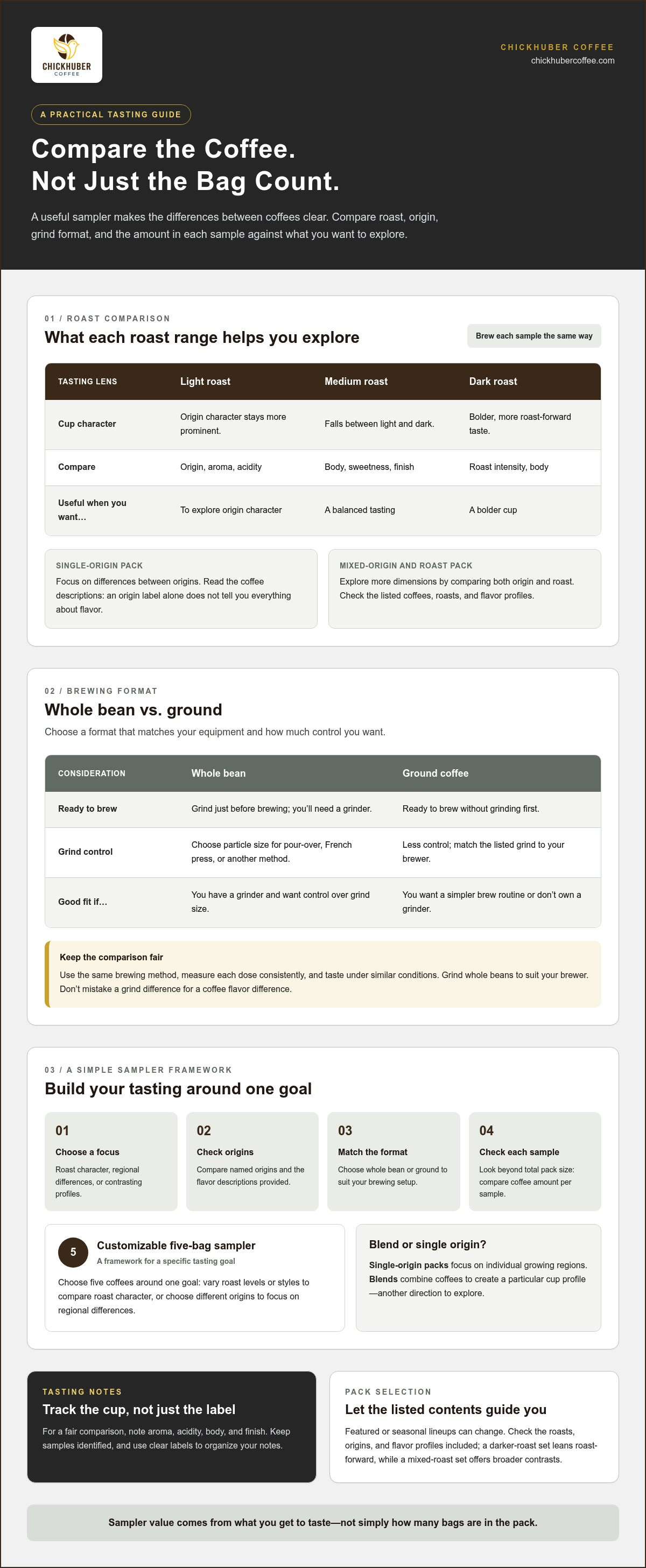
Compare light, medium, and dark roasts to explore how roast level affects a cup’s flavor. Light roasts keep more of the coffee’s origin character prominent, while dark roasts offer a bolder, roast-forward taste. Medium roasts fall between the two. For a fair comparison, brew each sample the same way and note its aroma, acidity, body, and finish.
Consider origin as well as roast. A pack listing coffees from Colombia and other regions gives you origins to compare, but an origin label alone doesn’t tell you everything about flavor. Read each coffee’s description and compare the stated profiles. Single-origin sample packs focus on differences between origins, while a pack combining origins and roasts gives you more dimensions to explore.
Sampler packs can make useful gifts or travel companions when their format suits the recipient or trip. For a gift, choose a range of roasts if the person enjoys tasting contrasts. For travel, consider how the pack fits your brewing routine and whether you prefer whole bean or ground coffee. Clear labels make it easier to keep tasting notes organized.
A customizable five-bag sampler gives you a simple framework: choose five coffees around one goal. Select different roast levels or styles to compare roast character, or choose different origins to focus on regional differences. This format suits you if you already know what you want to test, rather than wanting a preselected range.
Featured and seasonal sampler packs can introduce a changing lineup. Use the listed contents as your guide: check which roasts, origins, and flavor profiles are included before choosing. A set centered on darker roasts suits someone seeking roast-forward cups, while a mixed-roast set offers a broader tasting experience. Store opened coffee in an airtight container to help keep it fresh.
| Sampler option | Best for | What to compare |
|---|---|---|
| Light-roast selection | Exploring origin character | Origin, aroma, acidity |
| Medium-roast selection | Balanced tasting | Body, sweetness, finish |
| Dark-roast selection | Bolder cups | Roast intensity, body |
| Mixed or seasonal pack | Contrasting profiles | Roasts, origins, descriptions |
Start with your tasting goal, then match the roast range, origin labels, and pack format to it.
Whole-bean versus ground coffee samplers
Sampler packs may contain whole-bean or ground coffee, and some let you choose a format for each sample. To find one that offers both, look for product listings with grind choices or a format selector.
Whole-Bean Samplers
Whole-bean coffee arrives unground, so you choose the grind just before brewing. This gives you control over particle size for pour-over, French press, or another brewing method, but you’ll need a grinder. For a fair tasting, grind each sample immediately before brewing and use the same setting and method throughout.
Ground Coffee Samplers
Ground coffee arrives ready to brew, making it a practical choice if you don’t own a grinder. The trade-off is less control over grind size, so match the pack’s grind description to your brewing method. A French press, for example, calls for a different grind than many drip brewers.
Format affects how you explore flavors, not just how quickly you can start. With whole bean, you can adjust the grind when a cup tastes too weak or too intense. Ground coffee removes that step, which can make a busy morning simpler. For an origin coffee from Ethiopia, follow the pack’s suggested preparation, then record the aroma, body, and finish.
Keep your comparison fair: use the same brewing method for every sample, measure each dose consistently, and taste under similar conditions. If one sample is whole bean and another is ground, grind the whole beans to suit your brewer. Don’t mistake a difference in grind for a difference in flavor. Separate format and brewing choices from the coffee’s own profile in your notes.
- Choose whole bean if you have a grinder and want control over grind size.
- Choose ground if you want to brew without grinding first.
- Choose a format selector if you want the same sampler’s coffees in your preferred format.
For a holiday gift, ground samples can simplify preparation for a coffee lover without a grinder. Whole bean may suit someone who already grinds for each brew. Follow the packaging instructions for storage and keep each sample identified as you taste it.
Decide on format first: match whole bean or ground coffee to your equipment, then compare origins and flavors. That way, the sampler suits your brewing routine from the first cup to the last tasting note.
Coffee sampler pack product comparisons
Compare sampler packs by origin, roast range, and distinct flavor profiles, not bag count alone. Single-origin packs focus on individual growing regions; blends combine coffees to create a particular cup profile.
To find the widest variety, compare each listing’s named origins, roasts, and tasting notes. Customer reviews are most useful when they describe freshness, flavor differences, and value with specific examples. In the United States, compare product ratings and shipping charges on the seller’s own checkout pages, since shipping costs depend on the order and delivery details.
Wide-Variety Coffee Samplers
A varied sampler offers contrast across its coffees, such as different regions, roast levels, or flavor profiles. Compare the descriptions rather than assuming that more bags mean more variety. A curated pack with clearly distinct blends and origins may offer more useful tasting differences than several similar coffees. Notes about chocolate, fruit, or spice can help you plan a side-by-side tasting.
Origin and Roast-Level Variety
Samplers that vary by origin and roast let you explore how both shape a cup. Check whether the pack changes origins, roasts, or both, then note each sample separately. Coffees from different regions may vary in character, while light and dark roasts create another contrast. Keep your brewing method consistent to make the differences easier to judge.
Single-Origin Coffee Samplers
Single-origin samplers feature coffees identified with individual origins rather than blends of beans from multiple sources. They suit tasters who want to compare regional character. Check the origin and any tasting notes listed for each coffee. A pack featuring several origins makes for a clearer regional comparison than one repeating the same origin.
Coffee Blend Samplers
Blend samplers group coffees made by combining beans to create a particular taste. Unlike single-origin packs, they focus on each blend’s overall profile rather than the character of one region. Check whether the descriptions distinguish the blends through notes such as sweetness, body, or roast intensity. A French press can provide a consistent way to taste each option side by side.
Reviews can answer practical questions, but look for details rather than relying on a star rating alone. Check comments about sealed packaging, whether the flavors matched their descriptions, and whether the samples tasted meaningfully different. A review that names a coffee’s profile gives more useful tasting context than a general claim that it’s a favorite.
For a purchase in the United States, compare sampler descriptions, customer ratings, and shipping charges before placing an order. Shipping totals can change with destination, order contents, and delivery selection, so review the final checkout total. Choose the pack whose listed origins, roasts, and blends match the tasting experience you want.
Sample pack size and price
Compare the listed pack price with its total coffee weight, then calculate the cost per ounce. Add the weight of every bag before dividing. This gives you a consistent way to compare a compact tasting collection with a larger one. A lower checkout price may mean less coffee per sample, so consider both the total price and the amount available for each tasting.
Start with the package details: note the total weight, number of coffees, and weight of each bag. A pack with several distinct coffees in small bags offers more tasting choices; fewer, larger bags give you more coffee per selection. Neither format is automatically better. Choose according to whether you want to try new profiles or revisit favorites.
Ground coffee makes a sampler easier to brew without a grinder, while whole bean lets you choose the grind. This difference affects convenience as well as value. If you prefer ground coffee, match the grind description to your brewer. A French press and a drip brewer need different grinds, so a pack suited to your setup can help reduce waste.
Use these steps to compare value without relying on the headline price:
- Write down each pack’s listed total weight and bag count.
- Divide the total price by total ounces for a cost-per-ounce comparison.
- Compare how much coffee each distinct sample gives you to brew and retaste.
- Include shipping and any checkout charges in the final total.
Match pack size to your tasting pace. If you plan to brew one sample repeatedly, you may prefer more coffee per bag. If you want to explore a broad collection, you may value a wider selection even when each sample is smaller. Consider how often you brew, whether you share cups, and whether you’ll open the samples gradually.
Roast variety can also affect a pack’s value. Light, medium, and dark roasts create clear comparisons, while a set centered on one roast can help you study differences between origins. Check each bag’s description before choosing: a list of distinct coffees tells you more than total weight alone.
Freshness and storage matter once your pack arrives. Open one bag at a time, keep the others sealed, and follow the package’s storage guidance. If the pack contains ground coffee, plan your tasting order so opened samples don’t sit unused. This helps you use the collection rather than judging its value by weight alone.
Match the total weight to your tasting goal, then compare cost per ounce and the number of distinct coffees. Choose more samples for exploration or larger bags for repeated brewing.
What are the best coffee sampler packs for trying a wide variety of coffees?
The right choice depends on what you want to compare: origin, roast, flavor notes, or brewing formats. A sampler that names distinct coffees and explains their differences gives you a clearer tasting plan than one described only by bag count. Start with the pack details, then match them to the cups you want to explore.
For broad exploration, look for samples that vary in more than one way. A pack listing coffees from different origins and roast levels lets you compare regional character and roast influence. If every sample shares the same roast and origin, differences may be subtler. Read each description and note what changes from bag to bag.
A single-origin selection suits tasters who want to compare coffees by growing region. A blend-focused sampler shifts attention to the combined flavor of each coffee. Neither is automatically more varied, so compare the descriptions. Several distinct blends may offer broader taste contrasts than origins with similar stated profiles.
- For origin exploration: choose samples with clearly named, different origins.
- For roast comparison: look for a mix of roast levels, not repeated versions of one style.
- For flavor discovery: compare tasting notes and choose descriptions that differ.
- For brewing experiments: select formats compatible with your equipment.
Pack size affects how you taste, not just how much coffee arrives. Smaller samples can help you try more options, while larger samples allow you to brew each selection repeatedly. Consider whether you want one tasting per coffee or enough for side-by-side brewing. For careful comparison, a pack with fewer options may be more useful.
Use a consistent method to judge variety. Brew each sample with the same equipment and preparation, then record aroma, body, acidity, and finish. Changing the brewing method between cups makes it harder to tell whether a difference comes from the coffee or its preparation. A short tasting note for each bag keeps the comparison focused.
For a gift, use the recipient’s habits as your guide. Someone who enjoys trying unfamiliar regions may prefer a single-origin selection. Someone with a favorite style might enjoy contrasting blends or roast levels. Clear labels and tasting descriptions also make it easier to turn a gift into a deliberate tasting session.
Choose the best coffee sampler pack for variety by ranking your priorities: origins, roasts, flavor profiles, or repeat tastings. Then compare pack descriptions against that list. The best match provides the contrasts you want to taste in a format that fits your brewing routine.
Chickhuber Coffee: 6 Bean Blend
Chickhuber Coffee’s 6 Bean Blend is a next step if your sampler tasting has you ready to explore a blend. Choose it when you want to move from comparing coffees to settling into a named option. For a different direction, compare the Cowboy Blend, Organic Honduras Coffee, or French Vanilla Flavored Coffee. Each gives you another coffee option to consider alongside what you’ve tasted, without turning your choice into a complicated search.
Use your tasting notes to guide the next pick. If you enjoyed comparing blends, start with the 6 Bean Blend or Cowboy Blend. If you want to explore a named coffee origin, consider Organic Honduras Coffee. Prefer a flavored cup? French Vanilla Flavored Coffee offers that alternative.
Visit Chickhuber Coffee to explore the coffee options.
Choose Your Next Cup With Confidence
Your next coffee choice can turn tasting notes into a daily favorite. Choosing the best coffee sampler pack for variety is just the first step; next, decide which profile deserves a place in your routine. Follow the flavors you enjoyed, then explore a coffee that suits your preferences.
Chickhuber Coffee offers options for different directions. Try the 6 Bean Blend or Cowboy Blend if you’re curious about blends. Choose Organic Honduras Coffee to explore a named coffee origin. Each gives you a clear next step after comparing sampler coffees, without needing to repeat the tasting process from scratch.
Keep your notes nearby. Mark the aromas and flavors you want to find again, and use them to guide your next choice. Small decisions make the next cup more intentional. Build from what you liked, explore a new profile, and make your coffee routine your own.
Contact Chickhuber Coffee for help choosing what to try next. Your next great cup starts with a choice that fits you.
Frequently Asked Questions
How many coffees and how much coffee come in popular sampler packs?
Chickhuber Coffee’s listed sample packs contain six coffees, with each coffee in a 2-ounce bag. That makes 12 ounces total per pack. For example, the Best Sellers Sample Pack combines blends and single-origin coffees, while the Single Origin Favorites Sample Pack focuses on coffees from named origins. Compare the included coffee list as well as the total weight, especially if you want to share samples or brew each more than once.
What are the prices per sampler pack and per ounce for top coffee samplers?
Compare the current listed pack price with the total weight to work out a per-ounce figure: divide the pack price by its total ounces. For a six-bag pack with 2 ounces per bag, use 12 ounces as the denominator. Check the final order total as well, since shipping and other checkout charges affect what you pay. This calculation helps compare pack sizes on equal terms.
What are the best coffee sampler packs for light, medium, and dark roast variety?
The Best Sellers Sample Pack spans several roast styles, with a dark roast, a dark-and-medium blend, medium coffees, and a medium-dark single origin. For a lighter direction, the Single Origin Favorites Sample Pack includes medium-light coffees from Ethiopia and Tanzania, alongside medium and medium-dark selections. The best coffee sampler pack for variety depends on whether you want roast contrasts or a stronger focus on single origins.
Which coffee sampler packs offer subscriptions, custom selections, or gift packaging?
Subscriptions are offered for coffee products where available, with deliveries every four or six weeks; plans auto-renew and can be skipped or cancelled anytime. The listed sample packs have set contents, so compare their coffee selections to choose a fit rather than expecting a custom-built assortment. For gifting, select a pack based on the recipient’s interests, such as varied roasts, single origins, or flavored coffees.
What do customer reviews say about freshness, flavor variety, and value?
Reviews are most useful when they give specific examples of freshness, flavor differences, and value. Look for comments on sealed packaging, whether flavors match their descriptions, and whether samples taste meaningfully different.