

Bird Friendly Coffee Certification for Shade-Grown Farms
A bird-friendly label means more than coffee grown beneath trees. Bird Friendly certification requires coffee to be organic and meet habitat standards, making bird friendly coffee certification a specific choice for protecting wildlife on farms. The distinction matters: shade alone doesn’t tell you whether a coffee meets the program’s requirements.
You’re right to look beyond a label’s feel-good promise. The details explain what farmers must do, how shade and forest conservation can create bird habitat, and how Bird Friendly standards differ from simply choosing organic coffee.
This guide explains the certification requirements, the role of diverse tree cover, and what the label says about a farm. You’ll know what to look for and why the standards matter, while keeping the practical choice in your cup in view.
Key Takeaways
- Look beyond “shade-grown”: the certification combines organic standards with specific bird-habitat protections.
- Bird Friendly farms are 100% organically certified, according to Smithsonian's National Zoo and Conservation Biology Institute.
- Learn how diverse tree cover and agroforestry can make coffee farms more valuable as bird habitat.
- Separate organic certification from habitat standards so you can better understand what a coffee label actually signals.
What Is Bird Friendly Coffee?
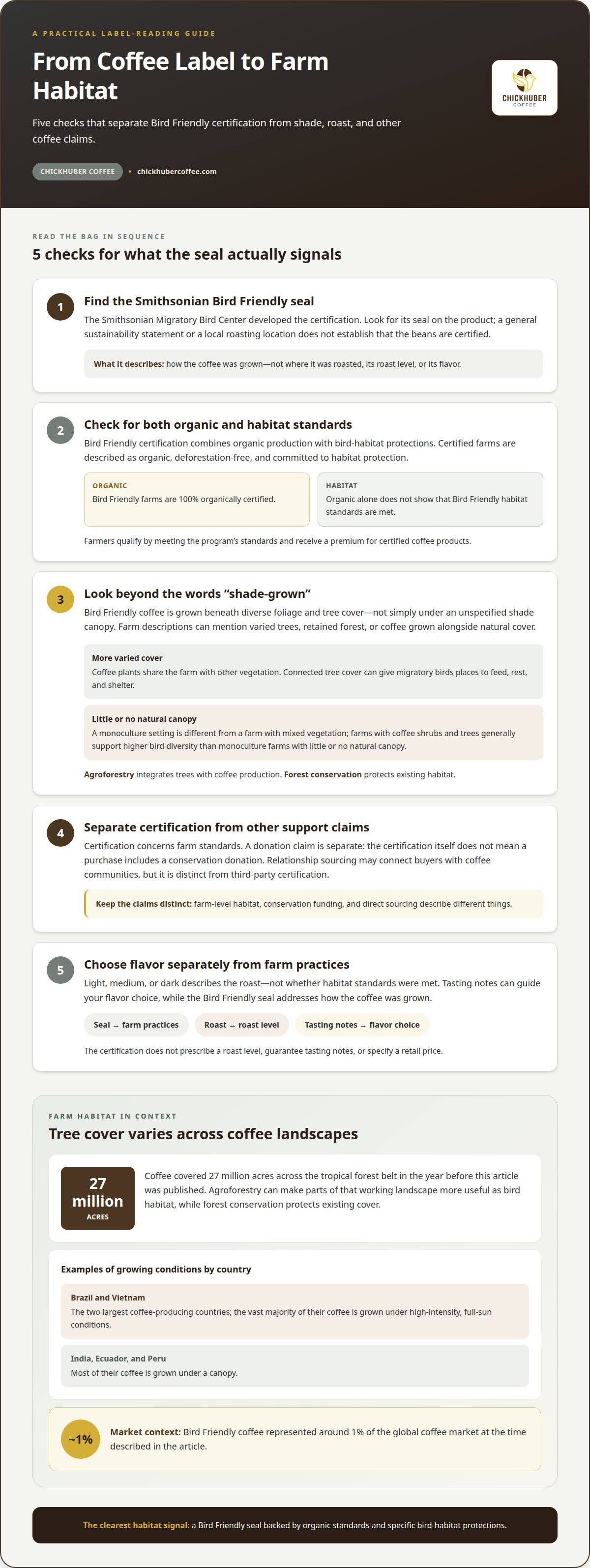
Bird Friendly coffee certification combines organic production with standards designed to protect bird habitat. Developed by the Smithsonian Migratory Bird Center, it signals how coffee was grown, not a particular roast or flavor.
Certification Across the Coffee Supply Chain
Farmers qualify by meeting the program’s organic and bird-friendly standards. The Smithsonian Migratory Bird Center developed the certification, and farmers receive a premium for certified coffee products. Roasters, importers, and distributors handle the coffee after it leaves the farm, so look for the Bird Friendly seal on the product rather than relying only on a roaster’s sustainability language. In the United States, specialty roasters and retailers are places to find certified coffee; the seal identifies products that meet the program’s standards.
A roaster can be local without sourcing certified beans. Roasting location describes where coffee is roasted; certification concerns how it was grown. Keep those claims separate when comparing bags.
Certification Limitations and Criticisms
The standard sets a meaningful habitat bar, but it doesn’t tell you everything about a coffee. It doesn’t prescribe roast level or guarantee tasting notes, so compare flavor descriptions separately. Bird Friendly coffee represented around 1 percent of the global coffee market at the time described, which can limit its visibility beside more common options. Certification also depends on farm practices, so an organic label alone doesn’t establish that a coffee meets Bird Friendly standards.
U.S. shoppers can look for the Smithsonian Bird Friendly seal at specialty coffee retailers and roasters. The certification’s premium supports farmers, but the label doesn’t specify a retail price or tasting profile.
Choose a roast level for your cup, not as a substitute for certification. Light, medium, or dark describes the roast, not whether habitat standards were met. Tasting notes can guide your flavor choice, while the Bird Friendly seal addresses farm practices. Consider both when comparing coffee.
Relationship coffee roasters can connect buyers with coffee communities through direct sourcing relationships. That connection may matter to you, but it’s distinct from third-party certification. For a clear decision, check whether the bag carries the Smithsonian Bird Friendly seal, then use the origin and roast details to choose a cup that suits your taste.
Agroforestry and forest conservation
Agroforestry integrates trees with coffee production, while forest conservation protects existing habitat. The Smithsonian’s National Zoo and Conservation Biology Institute describes Bird Friendly-certified farms as organic, deforestation-free, and committed to habitat protection.
Migratory Bird Habitat
For migratory birds, connected tree cover can provide places to feed, rest, and shelter along the way. Agroforestry keeps trees within working farms, bringing coffee production and habitat together. When assessing a conservation claim, look for a clear connection to farm habitat, not just a broad sustainability message. The Smithsonian Migratory Bird Center’s program focuses on supporting bird-friendly practices.
Environmental and Bird Conservation Benefits
Bird-friendly coffee supports conservation by linking production with habitat protection. Farms that retain forest or incorporate trees can preserve places for birds in agricultural landscapes and keep deforestation out of the production model. The benefit depends on farm practices, not flavor descriptions or roast choices.
These practices matter across the tropical forest belt, where coffee covered 27 million acres in the year before this article was published. Agroforestry can make parts of that working landscape more useful as habitat for birds, while forest conservation protects existing cover.
Certification and donations are different forms of support. Certification describes farm standards; it doesn’t, by itself, mean a coffee purchase includes a donation to conservation partners. If a product mentions a donation, read that statement separately from its habitat claims. Look for the named conservation partner and what the contribution supports, then assess the farm practices on their own merits.
Use this distinction to make a more informed choice: consider whether a coffee’s claims address farm-level habitat, conservation funding, or both. Migratory bird protection depends on habitat across landscapes, so tree cover and preserved forest are central to the picture.
Shade-grown coffee and diverse tree cover
Bird Friendly coffee combines shade with diverse foliage, rather than relying on a single canopy tree. The mix of coffee shrubs and trees is a useful detail when evaluating habitat claims.
Forest Canopy for Shade-Grown Coffee
A forest canopy can create layered cover above coffee plants. Bird Friendly-certified coffee is shade-grown beneath diverse foliage and tree cover, not simply labeled “shade-grown” without further detail. Look for descriptions of varied trees and retained canopy. A farm with mixed vegetation provides a different setting from a monoculture with little or no natural canopy.
The distinction matters because coffee farms with a mix of coffee shrubs and trees generally support higher bird diversity than monoculture farms with little or no natural canopy cover. Brazil and Vietnam, the two largest coffee-producing countries, grow the vast majority of their coffee under high-intensity, full-sun conditions. By contrast, India, Ecuador, and Peru grow most of their coffee under a canopy.
Growing Coffee Beneath a Tree Canopy
Under a tree canopy, coffee plants share the farm with other vegetation, creating more varied habitat for birds than rows of coffee shrubs alone. For a practical comparison, see whether a farm description mentions multiple tree types, existing forest, or coffee grown alongside natural cover. These details reveal more about the growing environment than “shade-grown” alone.
Species matter less than the farm’s growing conditions. Shade-grown robusta can support nearly equal bird diversity to arabica. If farm information is limited, arabica is a better clue for bird habitat because it is more commonly grown under at least partial shade. Treat that as a general indicator, not a substitute for farm-level details.
Use three cues when comparing bags: diverse tree cover, shade-grown production, and organic certification. Bird Friendly coffee combines these features with habitat standards; a generic organic label doesn’t describe canopy conditions. Check the package wording and distinguish a specific certification from broad claims about shade or sustainability.
Bird Friendly coffee certification requirements
Bird Friendly certification sets farm-level requirements for habitat, organic production, and coffee purity. Organic status alone does not qualify a farm.
Bird Friendly farms are 100% organically certified, according to Smithsonian's National Zoo and Conservation Biology Institute. The program also requires farms to be deforestation-free and protect habitat through agroforestry or forest conservation. Those requirements make the certification a specific sustainability standard, not a general promise about responsible coffee.
Smithsonian Bird Friendly focuses directly on bird habitat. Organic certification bans synthetic pesticides but doesn’t require canopy cover. Rainforest Alliance certification also requires maintaining or restoring canopy and prohibits harmful pesticides, while Bird Friendly has stricter requirements for canopy cover, pesticide use, and product purity. Fair Trade is separate, so its label alone doesn’t show that coffee meets Bird Friendly habitat standards.
Farm Application and Certification Cost
A farm seeking certification must meet the organic and habitat standards together. The Smithsonian Bird Friendly extension program works with producers, local extension agents, and industry to promote awareness and adoption of best management practices. This program helps farmers understand the practices involved and prepare their farms for certification.
There isn’t one cost that applies to every farm. Expenses depend on factors such as achieving organic certification, farm conditions, and the work needed to meet habitat requirements. A farm already using qualifying practices may have different preparation needs from one that must change its production approach.
Verifying Certified Coffee
Start with the package: look for the Smithsonian Bird Friendly seal and a clear certification claim. Then distinguish that claim from “organic” or “shade-grown,” because neither phrase alone establishes Bird Friendly status. A retailer’s sustainability description isn’t the same as the certification mark.
Compare the seal with the stated certification name and product details. A bag carrying only an organic claim, for example, doesn’t communicate that it meets canopy and habitat requirements. Choose based on the specific certification shown, not a nearby claim.
Use the seal as your practical buying check, then explore coffee options for your next cup.
Chickhuber Coffee: 6 Bean Blend
Chickhuber Coffee’s 6 Bean Blend is a coffee option to explore after learning how Bird Friendly standards differ from other labels. If your priority is certified bird habitat, choose a bag that clearly carries the Smithsonian Bird Friendly seal. If you’re also comparing everyday coffee options, consider the 6 Bean Blend or Cowboy Blend based on your own preferences.
Keep the decision clear: certification helps you assess farm practices, while choosing a blend is about what you want in your cup. Separate those priorities, then make each choice deliberately.
Visit chickhubercoffee.com to explore Chickhuber Coffee’s offerings or get in touch.
Make Your Next Coffee Choice Count
Let your next purchase reflect the kind of farming you want to support. Treat bird friendly coffee certification as one part of a deliberate buying habit: read the label, understand what its claims cover, and choose according to your priorities. A brief pause can make an everyday cup a more informed choice.
Then choose a coffee that fits your routine and taste. Chickhuber Coffee offers Organic Honduras Coffee, alongside options like its 6 Bean Blend and Cowboy Blend. These are choices for your cup, separate from a claim of Bird Friendly certification. Keep that distinction clear, and let flavor and farm standards guide different parts of your decision.
Ready to explore your next coffee? Contact Chickhuber Coffee and take the next step with confidence.
Frequently Asked Questions
What is bird-friendly coffee certification?
Bird Friendly certification identifies coffee grown under standards intended to protect bird habitat. Developed by the Smithsonian Migratory Bird Center, it combines organic certification with habitat-focused requirements, so an organic label alone isn’t equivalent. For shoppers, the practical distinction is the certification mark: it signals that the coffee meets a defined program standard, rather than relying only on a general claim about sustainability or shade.
Which organizations certify bird-friendly coffee, and what standards do they use?
The Smithsonian Migratory Bird Center developed the Bird Friendly program, which focuses on bird habitat. Rainforest Alliance certification also addresses canopy cover and pesticide use, but its requirements differ. Organic certification addresses production practices, not canopy protection. Fair Trade is a separate certification, so its label alone doesn’t demonstrate that coffee meets bird-habitat criteria. Read each seal as evidence of its own standard, not a substitute for another.
What shade and habitat requirements must coffee farms meet for bird-friendly certification?
Farms must provide bird habitat through agroforestry or forest conservation, alongside the program’s organic and deforestation-free conditions. In practice, assess whether the farm retains or integrates diverse tree cover among coffee plants, rather than assuming any shade is sufficient. The Smithsonian Bird Friendly standard also addresses canopy cover, pesticide use, and product purity, so a farm’s overall practices matter more than one isolated tree or claim.
How much does bird-friendly coffee cost compared with conventional and other certified coffee?
There isn’t a single retail price or fixed premium that applies across Bird Friendly coffees, so an exact comparison with conventional or other certified bags depends on the product. Origin, roast, processing, package size, and seller can all affect the shelf price. Farmers receive a premium for Smithsonian Bird Friendly-certified coffee products, but that farm-level premium isn’t the same as a set amount added to every retail bag.
Which coffee brands and retailers sell certified bird-friendly coffee in the United States?
Birds & Beans offers Bird Friendly coffee from family farms in Latin America. In the United States, specialty coffee roasters and retailers are places to look; check for the Smithsonian Bird Friendly seal.
Where can I buy bird-friendly coffee online or near me?
Look at specialty coffee retailers and roasters in the United States, and check for the Smithsonian Bird Friendly seal. Birds & Beans is one brand described as offering Bird Friendly coffee.