

What Is Coffee Bloom? The Science of Unlocking Peak Performance Flavor
Your premium beans are suffocating. It's killing your morning momentum. You invest in top-tier roasts, yet your cup still tastes thin, sour, or aggressively bitter. This inconsistency is a direct drag on your productivity. You need fuel for success. You need mental clarity. You need results. You've likely seen those bubbles during your pour over and wondered, what is coffee bloom? It's not a coffee-snob ritual. It's a chemical gateway. It stops trapped carbon dioxide from sabotaging your extraction and ruining your focus.
Mastering this 30 second step ensures every sip provides the high-octane clarity your daily grind demands. We'll help you eliminate sour notes and stop wasting your best beans. This guide breaks down the science of degassing, provides a foolproof technique for the perfect pour, and explains why complex roasts like our 6 Bean Blend need room to breathe. Stop settling for mediocre caffeine. Start brewing for peak performance. It's time to unlock the full potential of your morning ritual.
Key Takeaways
- Stop CO2 from sabotaging your cup. Understand what is coffee bloom to clear the path for total flavor extraction.
- Kill the sour notes. Purge trapped gases to eliminate the turbulence that causes thin, under-extracted coffee.
- Audit your beans instantly. Use the visual reaction of the bloom to verify freshness and demand higher quality from your roast.
- Master the tactical pour. Use a precise 2:1 water ratio and gentle agitation to ensure every ground is ready for peak performance.
- Unlock maximum complexity. Give high-performance blends like the 6 Bean Blend space to breathe so you can taste every origin.
The Science of the Bloom: Why CO2 is Your Brew's Gatekeeper
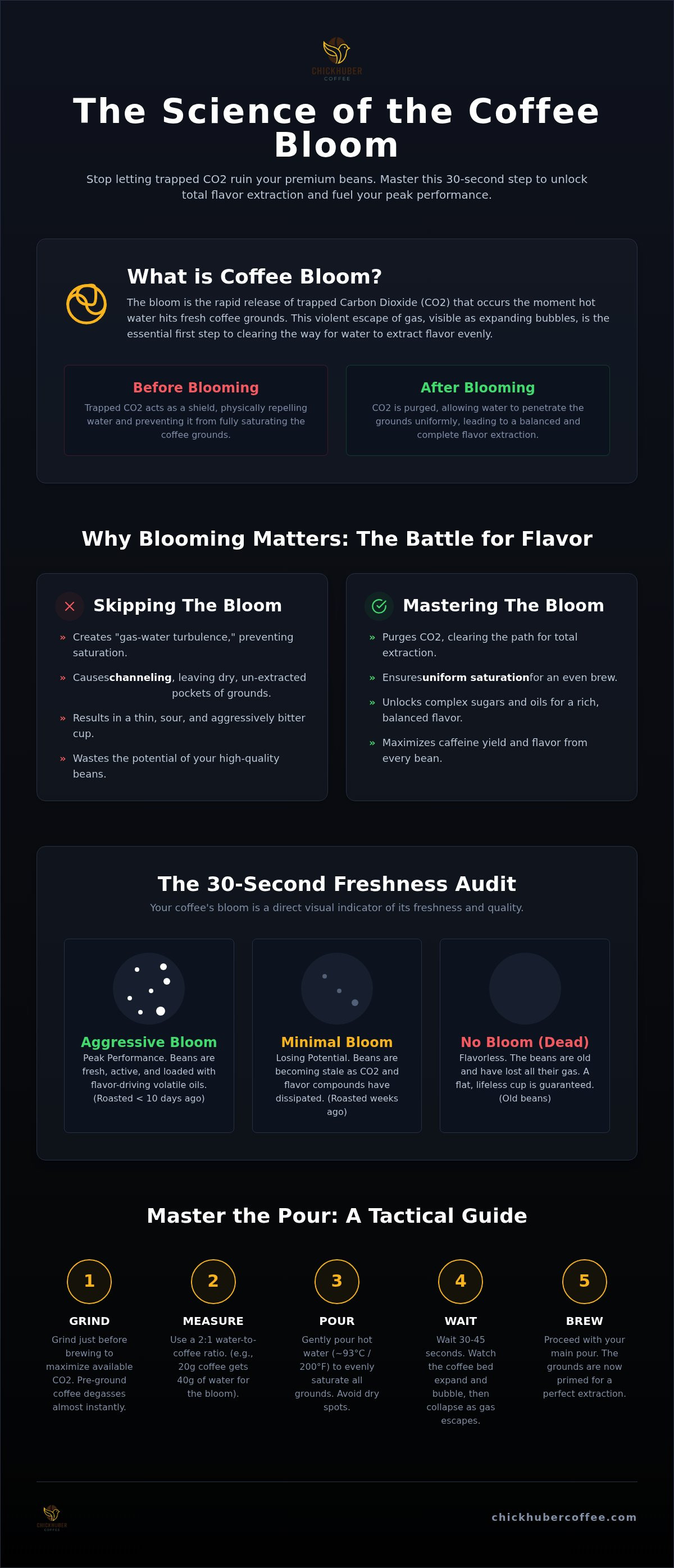
The coffee bloom is the sound of your morning potential being released. It is the rapid, violent escape of carbon dioxide gas that occurs the moment hot water hits fresh grounds. If you have ever asked what is coffee bloom, look for the rising, expanding bubbles in your filter. Those bubbles are the gatekeepers to your mental clarity. During the roasting process, beans undergo the Maillard reaction. This chemical transformation turns organic sugars into complex flavor precursors while trapping CO2 inside the bean's cellular structure. Fresh beans are active and loaded with this gas. Stale beans are dead and silent. Without an active bloom, your water cannot penetrate the grounds. It simply bounces off the gas. This is the first, essential step in any high-performance brewing sequence.
Understanding What is Coffee Blooming helps you identify the difference between a high-octane roast and a shelf-stable relic. When you see that expansion, you know the beans are still holding onto the volatile oils that drive flavor. If the water sits flat, you are working with a dead product. You can't extract what isn't there. High-performance coffee requires active chemistry. The bloom is the visual proof that your beans are ready to perform.
The Roasting Pressure Cooker
Roasting is a structural overhaul. High heat creates immense internal pressure that forces carbon dioxide into the bean's pores. Darker roasts, like our intense Cowboy Blend, spend more time in this high-heat environment. This results in more trapped gas and a more aggressive, visible bloom. To reach peak performance, you must time your brew with precision. Our beans are delivered during the peak window when flavor intensity is at its absolute maximum. Outside of this window, the beans lose their life. They go flat. They fail to perform. You need that 10-day peak window to ensure the gas is present and the flavor is sharp.
Degassing vs. Blooming
Do not confuse a slow leak with a controlled explosion. Degassing is the gradual release of CO2 from roasted beans over time. It happens naturally while the bag sits on your counter. Blooming is the accelerated version of this process triggered by hot water. When you pour, you force the gas out instantly to make room for extraction. This is why grinding seconds before you brew is a non-negotiable rule. Ground coffee has massive surface area. This means the gas escapes almost instantly. If you grind too early, you lose the bloom. You lose the flavor clarity. You lose your morning momentum. Mastering what is coffee bloom allows you to control the chemistry of your cup instead of just guessing.
Why Blooming Matters: Eliminating Turbulence for Peak Extraction
Gas-water turbulence is the invisible enemy of your morning momentum. When you skip the bloom, you allow carbon dioxide to physically repel water from your coffee grounds. It is a microscopic battle. The gas pushes out. The water pushes in. If the gas isn't purged first, it wins. This creates a barrier that prevents water from entering the bean's cellular structure. You end up with a cup that is half-extracted and fully disappointing. Understanding what is coffee bloom is about more than just watching bubbles; it is about clearing the path for total saturation. The Importance of the Bloom in Brewing cannot be overstated if you value consistency, intensity, and speed. A 30-second pause ensures every drop of water does its job.
The Barrier Effect
Visualize CO2 as a chemical shield. It protects the flavor oils from the water. When water hits un-bloomed grounds, it finds the path of least resistance. It flows around the gas pockets instead of through them. This is called channeling. It leaves dry pockets of wasted potential in your filter. A proper bloom "primes" the grounds for a uniform saturation. It collapses the gas shield and allows the water to flow evenly through the entire coffee bed. This is how you maximize your caffeine yield. Don't waste your premium beans on poor technique. Saturate the grounds. Wait for the gas to escape. Extract the results you deserve.
Sour vs. Balanced: The Flavor Stakes
Under-extraction is the hallmark of a rushed morning. It tastes thin. It tastes sour. It might even taste salty. These are the first compounds to dissolve; without a proper bloom, they are often the only ones that make it into your mug. You are missing the sugars and heavy oils that provide the bold, balanced profile you need for mental clarity. A properly bloomed 6 bean blend unlocks a massive spectrum of flavor that under-extracted coffee simply cannot touch. High-performance mornings require the balance of a complete extraction. If you want a brew that matches your drive, upgrade your daily fuel and respect the chemistry of the cup. That brief 30-second investment pays massive dividends in flavor and focus throughout your entire day.
The Freshness Audit: Using the Bloom to Verify Your Beans
Your coffee is either an asset or a liability. If it doesn't bloom, it is a liability. Use the bloom as an instant visual audit of your bean quality. Most people wonder what is coffee bloom when they see the bubbles, but you should see it as a freshness certificate. Grocery store coffee is often dead on arrival. It has sat in plastic bags for months. The gas is gone. The flavor is flat. Chickhuber uses a direct-to-consumer model. We ship beans that arrive during their peak degassing window. This ensures a violent, healthy bloom every single morning. If your coffee doesn't react, it isn't fresh. It is that simple.
Visual Cues of a High-Performance Bean
A healthy bloom is unmistakable. It is active. It is aromatic. It is intense. Look for these three indicators during your first pour to verify you are using high-performance fuel:
- The Rise: A fresh coffee bed should nearly double in size. This expansion proves the internal cellular structure is still holding the gas required for a bold extraction.
- The Bubble: Speed matters. Rapid, energetic bubbling tells you the beans were roasted recently. If the bubbles are sluggish or non-existent, your beans are past their prime.
- The Aroma: The bloom is the peak moment for sensory evaluation. The escaping CO2 carries the volatile oils and complex notes directly to you. If it doesn't smell intense now, it won't taste intense later.
What if Your Coffee Doesn't Bloom?
A flat brew is a diagnostic red flag. If your grounds sit there like wet sand, you have a problem. Usually, this means the beans are stale. Oxygen has already leached the life out of them. It could also mean your water temperature is too low to trigger the release. Regardless of the cause, dead beans cannot provide the complexity found in specialty coffee beans. They lack the chemical energy needed to drive your focus. Follow the Hustle Rule: if it doesn't bloom, it's not worth your time. Don't waste your morning on a flat cup. Demand a roast that shows signs of life and delivers the clarity you need to win the day.
Master the Pour: A Tactical Guide to the Perfect Bloom
Stop guessing. Start measuring. Tactical execution is what separates an amateur brew from a functional tool for success. You already understand what is coffee bloom from a chemical perspective. Now, you must master the mechanics. Use a strict 2:1 ratio. If you are brewing with 20g of grounds, use exactly 40g of water for your bloom. Precision matters. Heat your water to 195°F–205°F. This is your catalyst. Hot water at this range forces the carbon dioxide out with authority. Anything cooler is a waste of time. Give the grounds a rest window of 30 to 45 seconds. This pause is non-negotiable. It clears the path for the rest of your pour and defines what is coffee bloom in a high-performance kitchen.
The Pour-Over Protocol
Start in the center. Spiral outward. Saturate everything. Do not leave dry pockets in the bed. Use a gentle stir or the "Rao Spin" to ensure every ground meets the water. This level of manual control is why this technique beats the best coffee for drip coffee machine setups for pure clarity. You are in charge of the extraction. You are in charge of the results. Eliminate the air. Unlock the flavor. Win the morning.
French Press and Cold Brew Variations
The French press is not an excuse for a lazy brew. Pour your bloom water first. Stir it. Wait 30 seconds. Then fill the carafe. This prevents a gas crust from ruining your consistency. For cold brew, do not fall for the "cold bloom" myth. Cold water cannot trigger the rapid degassing you need. Use a hot bloom for 30 seconds before adding the cold water for the long steep. It is the only way to unlock the deep, complex notes in our roasts. Darker roasts like our Cowboy Blend need the full 45 seconds to settle. Lighter origins can finish in 30. Order our Cowboy Blend and perfect your pour today.
Fuel Your Grind: Why Chickhuber Beans Bloom Better
Your grind deserves better than stagnant, oxygen-starved beans. If your morning cup feels like a chore rather than a catalyst, your coffee is likely dead. When you ask what is coffee bloom, you are asking for a measurement of the life remaining within the bean. Our small-batch roasting process is designed to preserve that life. We prioritize the retention of carbon dioxide. We protect the cellular integrity of every roast. This ensures that when you pour, you get a violent, energetic reaction. Our 6 Bean Blend is a high-performance machine featuring six distinct origins. Each origin brings a unique chemical profile to your mug. These layers need to breathe to be tasted. Without a powerful bloom, those complex notes remain trapped and silent. Stop settling for the flat, lifeless experience of grocery store shelves. Demand a roast that fights back when the water hits.
Roast Freshness as a Competitive Advantage
Freshness is not a marketing buzzword. It is a technical requirement for peak performance. We ship our beans within days of roasting to ensure they arrive during the peak degassing window. This commitment protects the bloom potential during transit. You will notice the difference immediately in our Organic Honduras Coffee. It arrives with its gas content fully intact. This leads to a more aggressive expansion and a sharper flavor profile. We don't let our beans sit in warehouses for months. We don't use stale inventory. We provide the freshest fuel possible so you can maintain your mental edge. Results matter. Flavor follows. Technique wins.
The Chickhuber Challenge: See the Bloom for Yourself
Put our beans to the test. Line up a bag of Chickhuber against any mass-produced competitor. Use the same 2:1 ratio. Use the same water temperature. Watch the reaction. You will see the "moses" effect in our grounds. The coffee bed will part, expand, and bubble with intense energy. This is the visual proof of Chickhuber quality. If you don't see that expansion, you are drinking dead coffee. You are wasting your time. You are sabotaging your morning momentum. High-performance coffee requires high-performance beans. It is time to upgrade your ritual. Experience what is coffee bloom at its absolute peak with our single origin sample packs. Better prep leads to better results. Better results lead to a better day. Grab a pack, master the pour, and unlock the high-octane clarity you deserve.
Master the Bloom. Fuel the Hustle.
Execution is everything. You now understand what is coffee bloom and why it is the gatekeeper to your morning focus. By purging carbon dioxide, you eliminate the sour turbulence that ruins a high-performance brew. You have the tactical 2:1 ratio. You have the visual audit for freshness. Don't let your efforts go to waste on stale, dead beans from a grocery store shelf. You need fuel that fights back.
Chickhuber provides that edge. Our specialty grade beans are small-batch roasted and shipped direct-to-consumer. This ensures they arrive during the peak degassing window for maximum bloom potential. Every cup of our 6 Bean Blend is designed to provide the intensity your daily grind demands. Stop settling for mediocre caffeine. Start brewing for results. It is time to experience the clarity of a perfect extraction.
Unlock peak flavor—shop the Chickhuber 6 Bean Blend now
The grind never stops. Your coffee shouldn't either. Brew with precision and win the day.
Frequently Asked Questions
Does blooming coffee really make a difference in taste?
Blooming coffee creates a massive difference in the final profile. It removes the sour, metallic notes caused by trapped carbon dioxide. Without it, your water cannot penetrate the bean's structure. You end up with a thin, under-extracted brew. A proper bloom unlocks the heavy oils and sugars. It transforms your cup from a chore into a high-octane tool for success. Don't settle for flat flavor. Respect the chemistry. Win the morning.
How long should I let my coffee bloom for?
Aim for a 30 to 45 second window. This is the optimal time for the gas to escape without letting the grounds lose too much heat. Darker roasts often need the full 45 seconds due to higher gas content. Lighter roasts are usually ready in 30. Watch the bubbles. When the expansion stops, your rest window is over. Move fast. Your morning momentum depends on this precision. Don't linger. Get to work.
What happens if I don't bloom my coffee?
Skipping the bloom leads to immediate under-extraction. The escaping gas acts as a physical shield. It pushes water away from the grounds. This causes channeling where water flows around the coffee instead of through it. You get a cup that is sour, salty, and weak. It is a waste of premium beans. It is a waste of your time. Do the work. Purge the gas. Unlock the caffeine potential you deserve.
Why is my coffee not blooming even though it's fresh?
Your beans might not be as fresh as you think. If they were ground days ago, the gas is already gone. Oxygen is a silent killer of quality. Another culprit is low water temperature. If your water is below 195°F, it lacks the energy to trigger the release. Check your roast date. Check your thermometer. If you want to know what is coffee bloom at its peak, you need heat and whole beans.
Does the water temperature affect the coffee bloom?
Temperature is the ultimate catalyst for the reaction. Hot water between 195°F and 205°F forces the carbon dioxide out instantly. If the water is too cold, the gas stays trapped. If it is boiling, you risk scorching the delicate oils. Precision is non-negotiable here. Use a gooseneck kettle. Monitor the heat. Give your grounds the energy they need to release their full potential. Master the heat to master the brew.
Should I bloom coffee in an automatic drip machine?
Most automatic machines fail because they skip this step. You can fix this. Start the brew and then pause the machine after the first few ounces of water hit the grounds. Wait 30 seconds. Resume the cycle. This manual intervention ensures your drip coffee doesn't taste like paper and regret. It is a simple hack for better results. Take control of the machine. Don't let it settle for mediocrity. Demand intensity.
Can you bloom coffee for too long?
You can definitely overstay the window. If you wait longer than 60 seconds, the grounds lose too much heat. This drops your extraction temperature for the rest of the pour. Your brew will taste flat and muddy. Efficiency is key. Get the gas out. Move to the next phase. A successful bloom is about timing and speed. Hit the 45 second mark and keep moving. Respect the clock. Respect the grind.
Is a bigger bloom always better for flavor?
A violent bloom is a sign of extreme freshness. It proves the beans are active. However, a massive expansion doesn't guarantee a perfect cup if your technique is sloppy. You still need a steady pour and the right ratio. Understanding what is coffee bloom helps you verify bean quality instantly. Use the visual cues as an audit. Then focus on the execution to turn that freshness into mental clarity and focus.