

Shade-Grown Coffee Benefits: What the Canopy Does for Farms and Flavor
What if the trees above a coffee crop matter as much as the beans below? The shade grown coffee benefits can reach beyond the cup: a diverse canopy can provide wildlife habitat, protect soil, and help create a more resilient farm. But the words on a bag don’t tell the whole story.
If you’re wondering whether “shade-grown” is a meaningful farming claim or just appealing packaging, look beyond the label. Shade can support farms and ecosystems, but results depend on how the canopy is managed and what other practices are in place. Growing conditions can shape a coffee’s character, too, but shade alone doesn’t guarantee better flavor.
This guide explains how shade-grown systems work, where their potential benefits come from, and what trade-offs deserve attention. You’ll also learn how to assess labels, including what certifications such as Smithsonian Bird Friendly® and Rainforest Alliance can tell you. The goal is to judge the claim, not just the buzzword.
Key Takeaways
- Shade-grown coffee varies by canopy cover, tree diversity, and farm management, so the label alone gives only part of the picture.
- Shade can support wildlife, soil, and farm resilience, but those outcomes depend on local practices.
- Look for clear sourcing details, evidence of farm practices, and meaningful certification.
- Weigh potential environmental gains against farming constraints. Shade doesn’t automatically mean lower inputs or better flavor.
- Compare coffees by origin and cup profile while keeping farming claims grounded in the evidence provided.
What Is Shade-Grown Coffee, and Why Does the Growing Canopy Matter?
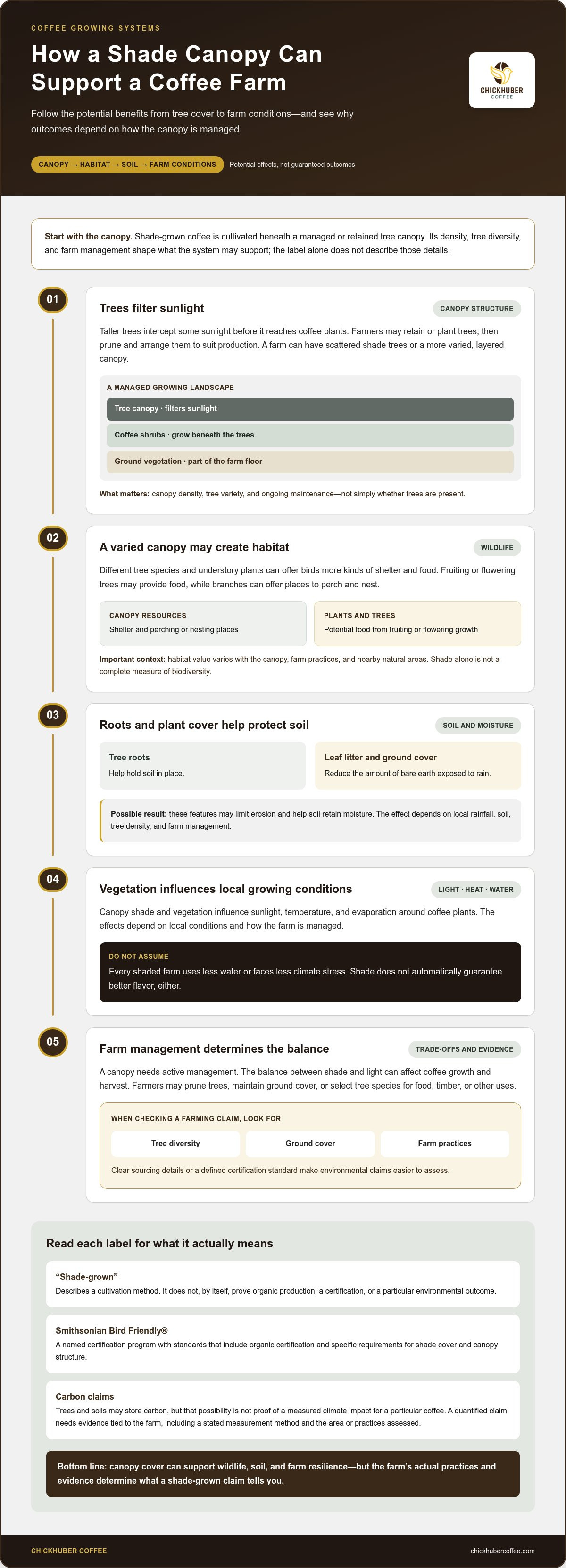
Shade-grown coffee comes from plants cultivated beneath a managed or retained tree canopy. The trees filter sunlight, and farmers decide how much canopy to keep and how to manage it. One farm may have scattered shade trees; another may grow coffee beneath a varied, layered canopy. The shade grown coffee benefits depend on these conditions, not just the words on a label.
Shade-grown describes how coffee is cultivated beneath trees; it doesn’t guarantee a particular environmental outcome, farming practice, or flavor. Canopy coverage, tree diversity, and farm management shape what the system actually supports.
How a coffee canopy works
Taller trees intercept some sunlight before it reaches coffee plants. Their branches and leaves create shade, while different tree heights can form layers with coffee shrubs and ground vegetation below. This managed landscape doesn’t have to resemble untouched forest. Farmers can retain or plant trees, then prune and arrange them to suit coffee production. Growing crops alongside trees in a deliberately managed system is one form of agroforestry.
A canopy isn’t simply present or absent. Its density, the variety of tree species, and the way the farm is maintained all influence the growing environment. A label that says only “shade-grown” may not reveal those details. The Shade-grown coffee overview provides broader context on the cultivation method and how it differs from sun-grown production.
Shade-grown, organic, and bird-friendly are not interchangeable
These terms answer different questions. “Shade-grown” describes a cultivation method. “Organic” refers to a production standard for how coffee is grown. A third-party certification means a program has set criteria for farms or products to meet. One label doesn’t automatically prove the others.
Smithsonian Bird Friendly® is a named certification program, not another way to say “shade-grown.” Its standards include organic certification and specific requirements for shade cover and canopy structure. That gives the certification a defined framework. By contrast, coffee described as shade-grown isn’t necessarily organic, certified Bird Friendly, or covered by any third-party standard.
Read each claim on its own terms. A bag might describe a farming method, display a certification, or provide details about the farm. Those are different kinds of information, and one shouldn’t be treated as proof of another. Understanding the shade grown coffee benefits starts with looking at the canopy, then checking what evidence supports the claims attached to it.
How Shade-Grown Coffee Can Support Wildlife, Soil, and Farm Resilience
A canopy can do more than filter sunlight. Depending on its structure and how the rest of the farm is managed, it can provide habitat, protect soil, and influence how water and heat move through a coffee plot. These are potential shade grown coffee benefits, not automatic results. A few scattered trees and a diverse, layered canopy don’t offer the same conditions.
Here’s how: a varied canopy can offer birds places to perch and nest, while fruiting or flowering trees and understory plants can provide food. Tree roots help hold soil in place, and fallen leaves add organic matter to the ground. The shade-grown coffee overview summarizes these ecological connections, though outcomes still depend on local conditions and farm design.
Biodiversity and habitat depend on the farm’s canopy
Tree diversity and understory vegetation can create more kinds of shelter and food than a simple, uniform planting. Migratory and resident birds may use these resources, but habitat value varies with the canopy, farm practices, and nearby natural areas. A shaded plot surrounded by other habitat may function differently from an isolated farm with limited tree diversity. Shade alone isn’t a complete measure of biodiversity.
Soil, water, and climate benefits need careful wording
Roots can stabilize soil, while leaf litter and ground cover reduce the amount of bare earth exposed to rain. Together, these features may limit erosion and help soil retain moisture. Canopy shade and vegetation also influence sunlight, temperature, and evaporation around coffee plants. The effect depends on local rainfall, soil, tree density, and management. Don’t assume every shaded farm uses less water or faces less climate stress.
There are farm-level trade-offs, too. A canopy needs active management, and the balance between shade and light can affect coffee growth and harvest. Farmers may prune trees, maintain ground cover, or select species for food, timber, or other uses. Those choices shape the system’s value and practicality. Look for details about what the trees do on the farm, not simply whether trees are present.
Shade trees can store carbon in their trunks, branches, and roots, while soils may hold carbon as organic matter. That makes carbon storage a possible benefit, not proof that a particular bag of coffee has a measured climate impact. A quantified claim needs evidence tied to the farm, such as a stated measurement method and the area or practices assessed. Without those details, treat broad climate language as a general possibility, not a verified result.
Look for sourcing information that connects the canopy to real management, such as tree diversity, ground cover, farm practices, or a defined certification standard. Those details make environmental claims easier to assess. You can also compare origins and cup profiles through single-origin coffee selections, without assuming a particular growing method.
Shade-Grown Coffee Trade-Offs: What the Label Does and Does Not Tell You
Shade can support useful farm and ecosystem functions, but shade systems aren’t all alike. A farm with a diverse canopy, ground cover, and careful management may differ sharply from one with sparse shade trees. Production choices matter, too. Shade-grown coffee isn’t automatically organic, bird-friendly, low-input, or superior-tasting. Treat the label as a starting point, not a complete farm report.
| Potential benefit | What it depends on | Evidence to look for |
|---|---|---|
| Wildlife habitat | Tree diversity, understory plants, and surrounding habitat | Details about canopy species and habitat practices |
| Soil protection | Root cover, leaf litter, ground vegetation, and farm management | Descriptions of ground cover and erosion control |
| Farm resilience | Local climate, crop choices, canopy management, and farm economics | Specific practices and context, not a broad sustainability claim |
| Carbon storage | Tree growth, soil conditions, and the boundaries of measurement | A stated measurement method and farm-level data |
Does shade-grown coffee taste better?
Not by definition. Canopy conditions can influence how coffee plants grow, but they can’t predict the flavor in your cup on their own. Variety, ripeness at harvest, processing, roasting, freshness, and brewing all shape the final profile. A shaded coffee may taste excellent, average, or simply different from another coffee. The growing method alone can’t settle the question.
Want to compare flavor without assuming anything about farm practices? Use this coffee variety pack guide to explore how coffees can differ in the cup. Keep sourcing claims separate from taste preferences.
What a shade-grown claim can and cannot establish
The phrase “shade-grown” isn’t a regulated certification by itself. It may tell you coffee grew beneath some tree cover, but it doesn’t necessarily say how much shade was present, which trees formed the canopy, or how the farm was managed. The claim also doesn’t prove that a farm meets organic or bird-friendly requirements. Those need their own standards and supporting evidence.
Production trade-offs deserve the same care. Canopy density and farm conditions can influence crop growth, disease pressure, and the work needed to manage trees, but no single outcome applies to every farm. Don’t assume shade always lowers yields or raises disease risk. Look for information about the specific growing system and its local conditions.
Use the shade grown coffee benefits as a prompt for better questions, not as a shortcut to a verdict. A credible sourcing description should clarify what the farm actually does and what standard, if any, verifies it. One label can’t prove every environmental benefit or tell you what the coffee will taste like.
How to Evaluate Shade-Grown Coffee Claims Before You Buy
Make the label earn your trust. A useful sourcing claim gives you something specific to assess, not just an appealing environmental promise. Use this checklist to separate farm details from broad marketing language and judge what the available evidence actually supports.
- Look for a description of the canopy. Does the source name tree species, describe canopy diversity, or explain how shade is managed? “Grown under shade” is a start, but it doesn’t tell you how much tree cover the farm has.
- Check for named farm practices. Details such as maintaining ground cover, retaining shade trees, or managing a layered canopy are more informative than an unsupported phrase like “wildlife-friendly.” Treat broad benefit claims as prompts to look for the practices behind them.
- Identify any certification. Find the program’s full name and the organization responsible for it. A general shade claim isn’t the same as independent certification, and a certification verifies only the criteria set by that program.
- Review the certifier’s current criteria. Standards can change, and a seal’s meaning depends on its published requirements. Use the certifier’s current information to understand what is assessed instead of relying only on a retailer’s summary.
- Match each claim to its evidence. Farm details may support a description of management; certification may support compliance with a defined standard. Neither automatically proves every claimed benefit, such as increased biodiversity or measured carbon storage.
A stronger sourcing claim names its practice or verification, not just its benefit. Keep that rule in view. For the shade grown coffee benefits you’re trying to support, look for a clear link between the claim, a stated farm practice, and evidence that can be checked.
Compare sourcing and flavor as separate questions
Keep environmental evidence separate from tasting notes. Origin, roast level, and flavor descriptions help you understand what a coffee may taste like; they don’t establish how it was grown. Likewise, a shade claim doesn’t predict whether you’ll prefer a coffee’s cup profile. Judge each type of information on its own merits.
A blend combines coffees, while a single-origin coffee is sourced from one origin. That distinction describes sourcing and composition, not farming impact. The 6 Bean Blend guide can help explain how a blend differs from single-origin sourcing without treating either as proof of shade-grown practices.
Keep your buying decision focused: identify the claim, find its supporting details, and note what remains unknown. Then explore coffees by origin and profile as a separate way to discover what you enjoy in the cup.
Put Shade-Grown Coffee Benefits in Context: Choose Your Next Cup
The strongest shade grown coffee benefits are tied to what the farm actually maintains: a canopy that can provide habitat, vegetation that supports farm ecosystems, and roots and ground cover that may help protect soil. These are potential outcomes, not guarantees. Canopy structure, local conditions, management choices, and the quality of sourcing evidence all matter.
A fast recap: benefits, conditions, and limits
Use this quick scan to keep the possibilities and their dependencies in view:
- Habitat: Diverse trees and understory plants can offer food and shelter for some wildlife. Value depends on farm design and the surrounding landscape.
- Vegetation: Retained trees and ground cover can add layers to the farm. Their benefits depend on what grows there and how it’s managed.
- Soil: Roots, leaf litter, and vegetation may help stabilize soil and retain moisture. Local soil, rainfall, and farming practices shape the result.
- Farm resilience: A managed canopy may influence growing conditions, but it isn’t a universal fix for production constraints or climate pressures.
The key is specificity. A farm with varied trees and consistent ground cover isn’t necessarily equivalent to one with sparse shade and little vegetation. Shade quality depends on canopy and management, not a single word on a bag. Look for descriptions of real practices and weigh them against the evidence provided. A certification can offer a defined standard, but “shade-grown” is a cultivation description, not a synonym for organic or bird-friendly certification.
Explore coffee with a sharper eye for origin
Keep three questions separate: How was the coffee grown? Where did it come from? What does it taste like? Origin and tasting notes can help you explore cup profiles, but they don’t verify environmental impact. A sourcing claim needs farm-practice details or a named standard before it can support a specific environmental conclusion. Separating these questions makes choices clearer and keeps broad promises from standing in for evidence.
Then put your palate to work. Chickhuber Coffee’s single-origin sample packs offer a way to explore different coffees and compare profiles by origin. This is a tasting opportunity, not a shade-grown sourcing claim. Notice what you enjoy, and look for clear sourcing details when environmental practices are part of your decision.
Bring a sharper eye to every label and a curious palate to every cup. Explore Chickhuber Coffee’s single-origin sample packs to compare coffees and discover the profiles you prefer.
Make Your Next Cup a More Curious Choice
Turn what you’ve learned into a simple habit: stay curious. Notice what a coffee’s sourcing information actually says, then taste it with an open mind. Keep track of origins and cup profiles you enjoy. Over time, you’ll build a clearer sense of your preferences without relying on one label to make the decision for you.
The shade grown coffee benefits are worth exploring, but thoughtful choices don’t require perfect certainty. Look for details, value clear evidence, and leave room for the complexity of farming and flavor. Each cup can be a chance to learn something new.
Ready to explore different origins and discover the profiles that fit your taste? Explore Chickhuber Coffee’s single-origin sample packs. Keep asking good questions, taste with intention, and enjoy the next discovery.
Frequently Asked Questions
What are the main benefits of shade-grown coffee?
Shade-grown systems can support habitat, maintain vegetation, and help protect soil, depending on how the farm is designed and managed. For example, a diverse mix of trees may offer food and shelter for wildlife, while roots and leaf litter can help limit soil loss. These shade grown coffee benefits are possibilities, not guarantees. To assess a specific coffee, look for details about farm practices rather than relying on the label alone.
Is shade-grown coffee better for the environment?
It can be, but the growing method alone can’t prove that a coffee has a lower environmental impact. A farm with varied trees and ground cover may offer ecological advantages over a cleared, sun-exposed plot, while a sparse canopy may provide fewer of them. Other farming practices and local conditions matter, too. Treat environmental language as a claim to investigate, and look for farm-level details or a certification with clear criteria.
Does shade-grown coffee taste different?
It may taste different from coffee grown in another system, but shade doesn’t dictate a particular flavor or guarantee a better cup. Coffee variety, harvest conditions, processing, roasting, freshness, and brewing all affect what you taste. For a fair comparison, brew coffees using the same method and recipe, then note differences in aroma, acidity, body, and finish. That lets you assess the cup without treating flavor as proof of growing practices.
Is shade-grown coffee the same as organic coffee?
No. Shade-grown describes a growing approach involving a tree canopy; organic refers to production requirements, including restrictions on synthetic chemicals. A farm can use shade without being certified organic, and organic certification doesn’t by itself establish how much shade or tree diversity a farm has. Read the claims separately. If both practices matter to you, look for evidence for each rather than assuming one label guarantees the other.
Does shade-grown coffee mean it is Bird Friendly certified?
No. Smithsonian Bird Friendly® is a specific certification, not an automatic result of growing coffee beneath trees. Its standards require organic certification and set canopy criteria, including at least 40% shade cover, 10 to 11 native tree species, and a canopy height of at least 12 meters. A general shade-grown description doesn’t show that a farm meets those requirements. Look for the named seal and check the program’s current standards.
Can shade-grown coffee have farming trade-offs?
Yes. Maintaining a canopy takes planning and labor, and trees can compete with coffee plants for light or other resources. Shade levels and local conditions may also influence crop growth and disease pressure, so farmers need to manage the system for their farm. The effects aren’t identical everywhere. A useful sourcing description explains the practices and context instead of suggesting shade always improves yields or reduces farming challenges.
How can I tell whether coffee is genuinely shade-grown?
Start by looking for more than the phrase on the package. Useful details may include the farm or origin, how the canopy is managed, and whether a named certification verifies specific practices. Since “shade-grown” alone isn’t a regulated certification, the wording doesn’t establish a precise canopy level. For a certified claim, check the certifier’s current criteria and verify that the seal or program applies to the coffee being sold.