

Master the Leaf: The High-Performance Tea Tasting Guide 2026
Stop drinking industrial dust and calling it tea. Most "premium" leaves on the market are just overpriced grass clippings disguised by flowery labels and vague descriptions. You're overpaying for mediocrity. You're settling for a boring caffeine routine that fails to sharpen your mental edge. This tea tasting guide is your weapon against the mundane. It's time to demand more from your mug and stop wasting money on leaves that underperform.
It's frustrating to drop cash on a product that doesn't deliver results. You want a reliable way to separate the high-grade fuel from the generic filler. This article provides a high-speed sensory audit designed for the modern achiever. You'll learn to evaluate tea like a pro with a direct, high-energy protocol that builds focus and refines your palate. We're stripping away the fluff to give you a repeatable system for identifying quality. We'll cover the specific steps to sharpen your sensory perception and help you select the best loose leaf tea blends to power your daily grind.
Key Takeaways
- Ditch the "tea dust" trap. Learn to audit your leaves for color and shape to ensure you are drinking functional fuel.
- Use this tea tasting guide to sharpen your sensory perception and master the 4-step quality protocol instantly.
- Decode flavor profiles like a professional. Match specific tea types to your productivity needs for better daily results.
- Stop killing your leaves. Master temperature control and water quality to unlock the full cognitive potential of every cup.
- Upgrade your beverage game. Put your expertise to work by selecting high-integrity loose leaf tea blends for a sharper mental edge.
Why Your Current Tea Routine Fails Your Palate
Most people drink tea to pass the time. You drink it to dominate. If your mug is filled with a generic grocery store bag, you aren't fueling your hustle; you're settling for industrial runoff. Real tea tasting is a high-speed sensory audit of the Camellia sinensis plant. It is a diagnostic tool. It is a way to ensure every drop of liquid entering your system is optimized for peak output. This tea tasting guide is your roadmap to sensory dominance. Stop settling for mediocre mugs and start auditing your intake. You need fuel, not filler.
Understanding the process of tea tasting allows you to identify chemical complexity that "tea dust" simply cannot provide. Mass-produced bags contain fannings and dust. This is the lowest grade of tea. This industrial debris lacks the essential oils and antioxidants required to fuel your focus. You're drinking the leftovers of a process designed for speed, not strength. By following this tea tasting guide, you transform a basic habit into a performance-enhancing ritual. High-intensity flavor leads to high-performance days. It's time to raise your standards.
The Difference Between Drinking and Tasting
Drinking is passive consumption. Tasting is an active sensory investment. When you engage your palate, you build a superior flavor library in your brain. This isn't just about taste; it's about cognitive calibration. Intentional tasting forces your mind to focus, scan, and categorize. Terroir matters. Processing matters. Results matter. Every region produces distinct energy profiles. A high-altitude green tea hits different than a sun-dried black tea. You must learn the difference to choose the right fuel for your specific goals.
Identifying Industrial vs. Artisanal Leaves
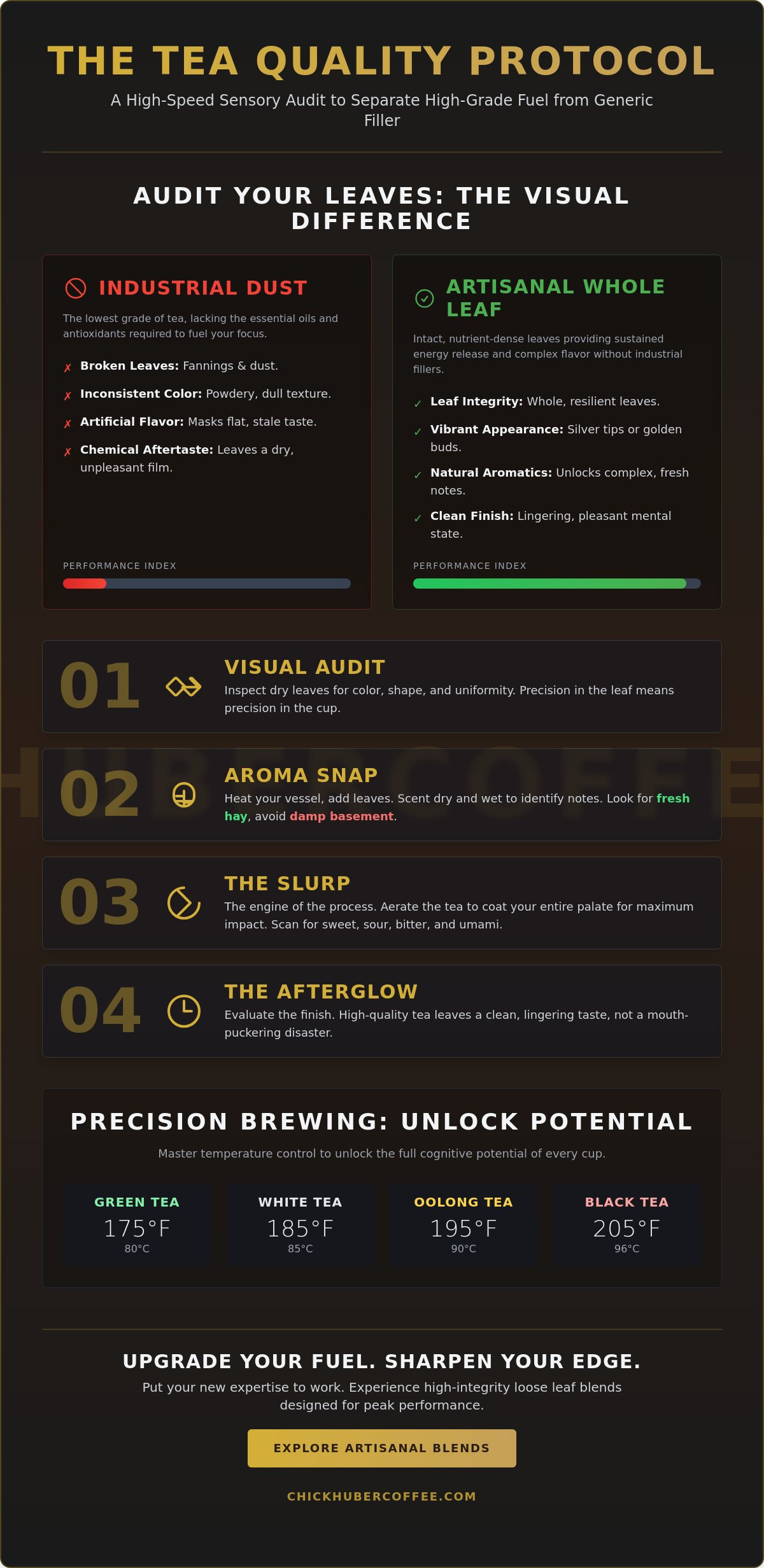
Whole leaf integrity is non-negotiable. If the leaf is broken, the energy is gone. Industrial tea relies on artificial oils to mask the flat taste of stale dust. It's a lie in a cup. You need to spot the red flags: inconsistent colors, powdery textures, and chemical aftertastes. High-quality leaves look like the plant they came from. They have shape, color, and resilience. Loose leaf quality is the standard of total leaf integrity where intact, nutrient-dense structures provide a sustained energy release and complex flavor profile without industrial fillers. Chickhuber demands this level of integrity in every blend. We don't do dust. Neither should you.
The 4-Step Protocol: How to Evaluate Quality Instantly
Execution over contemplation. You need a system that works at the speed of your schedule. This tea tasting guide provides a direct, high-energy protocol to audit your tea in under two minutes. Stop guessing. Start knowing. Use this four-step sensory audit to ensure your beverage matches your ambition. If the leaf doesn't perform, it doesn't belong in your cup. Follow these steps to sharpen your edge.
- Step 1: The Visual Audit. Inspect the dry leaves for color, shape, and uniformity. Precision in the leaf means precision in the cup.
- Step 2: The Aroma Snap. Heat your vessel. Add the leaves. Scent the dry and wet leaves to identify primary notes.
- Step 3: The Slurp. This is the engine of the process. Aerate the tea to coat your entire palate for maximum impact.
- Step 4: The Afterglow. Evaluate the finish. High-quality tea leaves a clean, lingering mental state, not a dry chemical film.
Visual and Olfactory Inspection
Look for the signal. Ignore the noise. High-performance leaves often feature silver tips or golden buds. These are the youngest, most nutrient-dense parts of the plant. They signal premium plucking and superior energy potential. Scenting the "warm vessel" is a critical step; it unlocks volatile aromatics before you even add water. If you smell fresh hay, you are on the right track. If it smells like a damp basement, discard it immediately. You need freshness, intensity, and sharpness to fuel your day.
The Mechanics of the Taste
Forget manners. Master the "professional slurp" to spray the tea across your tongue. This aeration is essential for detecting complexity. You are scanning for the five basic tastes: sweet, sour, salty, bitter, and umami. Use professional tea tasting techniques to calibrate your palate for these nuances. Pay attention to mouthfeel. Is it thin and watery? Is it creamy and substantial? Astringency should be a clean snap, not a mouth-puckering disaster. Once you've mastered the protocol, test your skills on our Loose Leaf Tea Blends to experience high-integrity flavor for yourself.
Every sip is a data point. This tea tasting guide isn't about being fancy; it's about being effective. When you master the mechanics of the taste, you stop being a consumer and start being a connoisseur of performance. Demand clarity. Demand intensity. Demand results. Your palate is a tool. Sharpen it.
Decoding Flavor Profiles: From Floral Notes to Earthy Intensity
Your palate is a precision instrument. To get the most out of it, you need to categorize what you taste. This tea tasting guide moves beyond simple "good" or "bad" labels. We look for specific chemical signatures that indicate how a tea will impact your mental state. Whether you need a sharp morning surge or a steady afternoon drive, the flavor profile tells you exactly what's under the hood. Stop guessing and start analyzing.
- Green Tea: Grassy, vegetal, and oceanic. This is your morning focus tool. It's clean, sharp, and cuts through brain fog instantly.
- Oolong Tea: Floral, honey-like, or roasted. This is the ultimate bridge. It offers a complex spectrum that transitions perfectly between light and dark profiles.
- Black Tea: Malty, chocolatey, and bold. This is high-octane fuel. When you hit the 2 PM slump, black tea provides the muscular intensity needed to finish the job.
- Herbal Blends: Functional recovery. Ingredients like ginger or hibiscus aren't just for flavor; they're for physical maintenance after a long grind.
The Performance Palette
Stop confusing astringency with bitterness. Bitterness is a flaw. It's often the result of poor processing or over-brewing. Astringency is a feature. It's that dry, puckering sensation on the tongue that provides structure and a clean finish. Use a tasting wheel to pinpoint specific fruit or nut notes. Identifying these markers isn't about being fancy. It's about auditing quality. Chickhuber favors bold, muscular flavor profiles in our blends because we know you don't have time for weak, watery infusions. We want intensity that matches your workload.
Tea for Coffee Drinkers
If you're coming from a coffee background, don't expect tea to be weak water. It's about the body. A roasted Oolong carries the same weight and depth as a medium roast coffee. You can map these profiles directly. Users of our coffee variety pack already know how to identify roast intensity. Apply those same skills here. Look for "body", which is the physical weight of the liquid on your tongue. A heavy, malty Assam black tea satisfies the same craving for depth as a dark roast. This tea tasting guide helps you transition without losing the intensity you crave. Find the weight that works. Fuel your hustle accordingly.
Precision Brewing: Technique for Maximum Clarity
Precision is the difference between a functional tool and a failed experiment. You've audited the leaves. You've decoded the profile. Now, you must execute the extraction. This tea tasting guide isn't just about observation; it's about control. If you fumble the brewing process, you waste the potential of high-integrity leaves. Get the variables right. Dominate the cup. Every second and every degree matters when you're brewing for peak performance.
Water is your foundation. Never use distilled water; it is flat, lifeless, and fails to extract the necessary compounds. Never use unfiltered tap water; it is cluttered with chemicals that mask the plant's true profile. Use filtered water to provide a clean, mineral-balanced canvas. This ensures the flavor you taste is the tea, not the plumbing. Precision starts with the solvent.
Heat is the engine of extraction. Boiling water destroys the delicate amino acids in green tea, leaving you with a bitter, scorched mess that ruins your focus. Conversely, lukewarm water fails to wake up the bold, malty intensity of black tea. You need specific ranges for specific results. Stop guessing and start measuring. Use the Golden Ratio: aim for 2 to 3 grams of leaf per 6 ounces of water. This creates a punchy, concentrated cup that fuels your hustle without the watery dilution of amateur brews. Set a timer. Over-steeping releases excess tannins, leading to a dry mouthfeel and a jagged caffeine crash. Precision steeping ensures a smooth, sustained energy release.
The Temperature Hierarchy
Different leaves require different thermal energy. Green and White teas thrive between 160°F and 175°F to preserve sweetness and delicacy. Oolong teas need a higher range, between 185°F and 205°F, to unlock complex aromatic layering. Black and Herbal blends require a full boil at 212°F for maximum extraction and body. Hit these targets to ensure you are getting every bit of value from your leaves.
Vessel Selection
Choose your tools for feedback. A Gaiwan is the professional choice for a reason. It allows for quick, multiple infusions and provides immediate sensory feedback. If you use a teapot, ensure the leaves have room to bloom. Cramped infusers are the enemy of clarity; they restrict water flow and prevent the leaves from fully expanding. Always pre-heat your gear. Pour hot water into your vessel and discard it before brewing. This maintains thermal stability so your audit stays accurate from start to finish. Ready to test your technique? Grab our Loose Leaf Tea Blends and apply these precision protocols today. Don't just brew. Perform.
Fuel Your Hustle with Chickhuber’s Artisanal Blends
Execution is everything. You've read the protocol. You've studied the profiles. Now, put this tea tasting guide into practice. Knowledge without action is just noise. Every high-performer knows that the quality of your input dictates the quality of your output. Stop settling for industrial dust that leaves you sluggish and uninspired. It's time to upgrade your daily fuel with high-integrity leaves that match your ambition. A sharp mind requires sharp ingredients. Don't compromise on the tools you use to build your success.
Chickhuber selects only the most resilient, nutrient-dense loose leaf tea blends. We don't do generic. We don't do fillers. Every batch represents our "small but mighty" spirit. It's a commitment to quality that mirrors your own work ethic. A refined palate isn't just a hobby; it's a competitive advantage. When you can distinguish between subtle nuances in your cup, you sharpen the same sensory perception you use to navigate complex business decisions. Focus is a muscle. Train it every morning. Every sip is an opportunity to calibrate your mind for the tasks ahead. Choose intensity. Choose clarity.
Our Signature Selection
Our artisanal loose leaf tea blends serve as the ultimate tasting lab for your new skills. These aren't simple infusions. They are complex profiles designed for depth and intensity. We value complexity in our tea just as much as we do in our 6 Bean Blend. You deserve a beverage that challenges your senses and rewards your attention. Stop settling for mediocre bags that taste like paper and disappointment. Our blends provide the heavy mouthfeel and bold aromatics that high-performers demand. Whether you're scanning for the grassy snap of a green tea or the malty weight of a black tea, our collection delivers the data points your palate needs to grow.
Your Next Step
Commit to one intentional tasting session this week. Don't just drink. Analyze. Use the 4-step protocol from this tea tasting guide to audit every sip. Look for the visual markers of quality. Master the slurp. Evaluate the afterglow. Order a sample pack to test your palate against different origins and processing styles. This is your chance to see how your skills stack up against the best leaves on the market. Don't let your routine go stale. Keep your senses sharp and your energy high. Elevate your grind. Sharpen your focus. Grab your next batch of Loose Leaf Tea Blends and dominate your day. The results will speak for themselves.
Master Your Input to Dominate Your Output
You now hold the blueprint for sensory dominance. You've learned to audit your leaves, master the 4-step protocol, and execute precision brewing. This isn't just about a beverage; it's about optimizing your mental clarity and sharpening your focus. By utilizing this tea tasting guide, you've graduated from passive drinking to active performance auditing. Don't let these skills sit idle. Put them to work every morning to ensure your fuel matches your hustle. You've seen the difference between industrial dust and whole leaf integrity; now, make the superior choice every time you brew.
Consistency is the mark of a pro. Mastery requires the right tools and the best ingredients. Chickhuber provides artisanal blends for peak performance delivered with direct-to-consumer freshness. We promise no fillers and no dust, just pure whole leaf power in every batch. It's time to take control of your routine and your results. Upgrade Your Grind: Shop Artisanal Loose Leaf Tea and experience the difference that high-integrity leaves make for your mental edge. You have the knowledge. You have the system. Now, take the final step and dominate your day.
Frequently Asked Questions
How long does a tea tasting session actually take?
An effective audit takes 10 minutes or less. You don't have time to linger over a cup all day. Focus on the 4-step protocol to get the data you need and get back to work. Speed is your ally when calibrating your palate for the day ahead. Efficiency in tasting ensures you spend more time performing and less time preparing.
Do I need expensive equipment to start tasting tea?
No, expensive gear is a distraction. You need a heat-stable vessel, a timer, and high-integrity leaves. A simple ceramic cup or a basic Gaiwan is sufficient for a professional-grade audit. Invest your capital in the product, not the accessories. Results come from the leaf, not the teapot. Focus on the input to maximize your output.
What is the difference between "tasting notes" and "added flavors"?
Tasting notes are the natural chemical signatures of the plant itself. Added flavors are external chemicals used to mask low-grade debris. Real quality doesn't need a disguise. This tea tasting guide helps you identify the malty, floral, or grassy notes that exist inherently in premium loose leaf tea blends. Demand the real thing and ignore the industrial fillers.
Can I taste tea if I usually put milk and sugar in my cup?
You can't perform an accurate audit if you're drowning the profile in additives. Milk and sugar mask the specific data points you need to evaluate quality. Taste the infusion black first to identify the true energy profile. Once you've audited the leaf, add what you want, but never skip the initial assessment if you want to gauge performance.
Why does my green tea always taste bitter when I brew it?
You are likely scorching the leaves or over-steeping the brew. Green tea is delicate and requires water between 160°F and 175°F. Boiling water destroys the amino acids and releases excess tannins. Use a thermometer and a timer to ensure you're extracting focus, not bitterness. Precision is the only solution to a bad flavor profile.
How many times can I re-steep loose leaf tea during a tasting?
High-integrity leaves can be re-steeped 3 to 5 times. Each infusion reveals new layers of the flavor profile. If your tea loses its punch after one steep, it's low-grade filler. Use this as a diagnostic tool to verify the value of your purchase. Quality leaves provide sustained returns on your investment. Don't settle for one-hit wonders.
What is the best time of day to perform a tea tasting?
Perform your audit in the morning before your palate is compromised by heavy meals or strong coffee. Your senses are sharpest when you first wake up. Use this time to calibrate your brain and set the tone for your day. A morning session ensures you're starting with the highest-grade fuel available to dominate your tasks.
Is there a specific "tasting wheel" for beginners?
Use a standard tea flavor wheel to categorize your findings. It provides a shared vocabulary for identifying vegetal, nutty, or spicy notes. This tea tasting guide encourages you to use these tools to build your internal flavor library. Categorization leads to better selection. Better selection leads to peak performance in every area of your life.