

Is Flavored Coffee Bad for You? What to Know in 2026
What if the flavor in your coffee isn’t the thing to worry about? If you’re asking “is flavored coffee bad for you,” the answer depends on the specific coffee and what goes into your cup. Flavored beans and a café drink made with syrup, sweetener, or creamer are different products.
It makes sense to wonder about flavoring oils, additives, sugar, and calories. But flavored coffee isn’t automatically unhealthy, and flavor alone doesn’t mean sugar has been added. Start with the product’s ingredient and nutrition details, then account for anything you add when brewing or serving it.
This guide explains how flavor is added to coffee, what flavoring oils mean, and how flavored beans differ from sweetened coffee drinks. It also offers a practical way to assess broad health claims and choose a cup that fits your routine. The key is to judge the product in front of you, not every flavored coffee by the same label.
Key Takeaways
- “Is flavored coffee bad for you?” can’t be answered by the flavor name alone. Look at the specific product and its ingredients.
- Flavored beans differ from prepared drinks, where syrups and other additions can change what ends up in your cup.
- Ingredient lists vary. Use product-specific details instead of assuming every flavored coffee uses the same ingredients or process.
- To make a practical choice, identify the product, read its details, separate the coffee from your add-ins, and decide whether you enjoy the taste.
- Chickhuber Coffee’s Flavored Coffees Sample Pack contains six 2 oz bags across six flavors. The coffees use high-quality natural flavoring oils and have no added sugar or calories.
Is flavored coffee bad for you? Start with what the term means
Flavored coffee can’t be judged by its flavor label alone. If you’re asking “is flavored coffee bad for you,” identify the product before drawing a conclusion. Flavored coffee generally means coffee with added flavor, but the ingredients and formulation can differ from one product to another. A claim about one formula doesn’t automatically describe them all.
A bag of flavored beans is not the same as a prepared drink with syrup, milk, or other additions. Those additions can change what’s in the finished cup. When comparing options, keep the coffee itself separate from the way it’s prepared: check the product details first, then consider what you add and how often you drink it.
How does coffee become flavored?
Flavor may be added to roasted coffee beans, but there isn’t one method or formula used for every product. Flavoring oils are one way to add a distinct profile, not a guarantee of what every flavored coffee contains. For background on the process and terminology, see this overview of coffee flavoring.
Use the product’s own ingredient details to understand a particular coffee. A name such as vanilla or caramel describes the intended taste, but it doesn’t tell you the full composition or how that taste was created.
Flavored coffee versus flavored coffee drinks
With flavored beans, the added flavor is part of the coffee product. A flavored café drink may instead start with brewed coffee or espresso and have ingredients such as flavored syrup or milk mixed in. The two can share a flavor name while containing different ingredients.
For example, brewed coffee with vanilla syrup contains syrup in the cup. The amount of added sugar or calories depends on what goes into that drink. Don’t assume a flavored bean product is equivalent. Check its own details, and consider any additions separately.
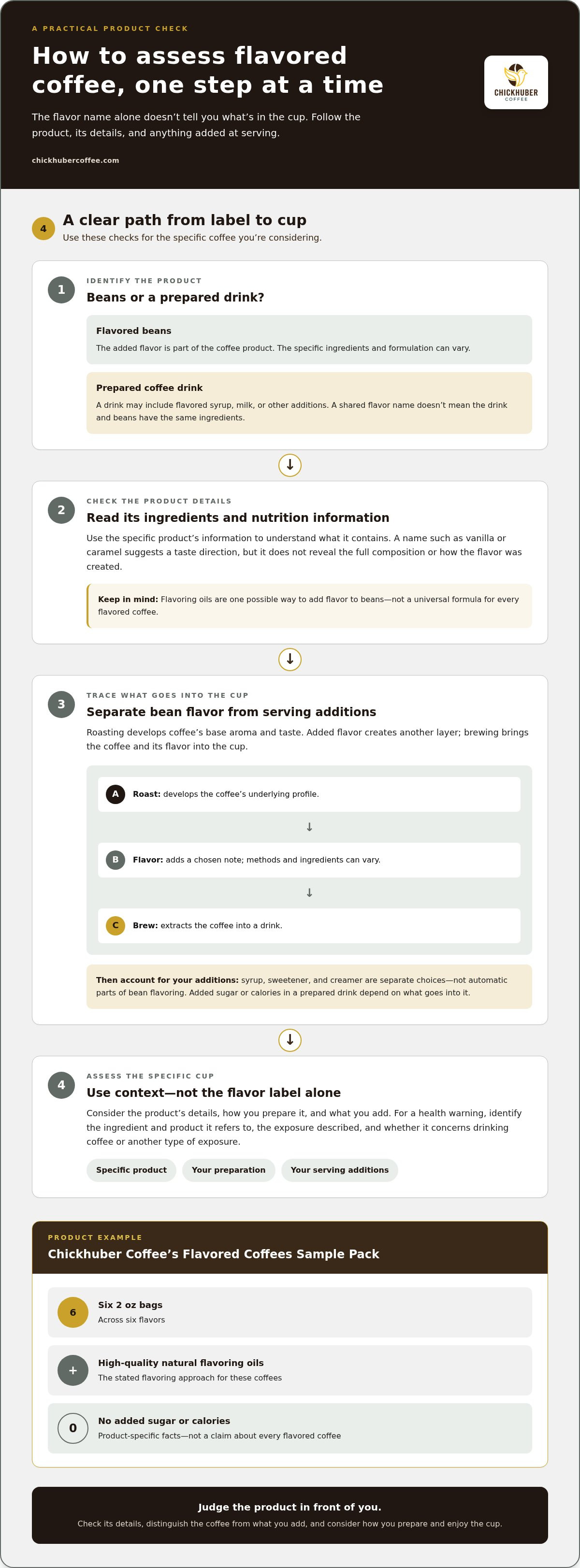
Use a simple check: identify whether you’re looking at beans or a prepared drink, read the product’s ingredient and nutrition information, then account for any sugar or creamer you add yourself. This prevents two common mistakes: assuming every flavored coffee has the same ingredients, or treating a syrup-sweetened drink as representative of all flavored beans. The product and your serving habits provide the useful context.
What happens during flavoring, roasting, and brewing?
Roasting develops coffee’s base aroma and taste. Added flavor creates another layer, but there isn’t one process that applies to every product. Flavor may be added to roasted beans, and the ingredients and formulation can vary. Brewing then brings the coffee and its flavor into the finished cup. The result depends on the product and how you prepare it.
Flavored coffee describes added flavor, not one standardized recipe. A flavor name suggests a taste direction, but it doesn’t tell you exactly how the coffee was made or what its ingredients are. Product-specific information is more useful than broad claims about all flavored coffees.
Roasting, flavoring, and brewing are related, but they are different steps. The roast contributes to the coffee’s underlying profile, flavoring adds a chosen note, and brewing extracts the coffee into a drink. Syrup, sweetener, and creamer are separate choices made during or after preparation, not automatic parts of bean flavoring.
Flavoring oils and ingredient lists
Flavoring oils are one possible way to add flavor to coffee beans. They aren’t a universal formula, so don’t apply one product’s ingredient details to another. Check the specific product information for what it contains. A flavor name by itself doesn’t identify an ingredient or prove which method was used.
Keep the check straightforward: focus on the package or product information for the coffee you’re considering. That gives you a firmer basis for understanding it than a broad claim about flavored coffee as a category.
Does flavored coffee automatically mean added sugar?
No. Flavoring and sweetening are not the same thing. Added sugar may come from a product’s ingredients or from what you mix into a prepared drink, such as syrup. For product-level details, consult the specific coffee’s ingredient and nutrition information. If you add creamer or sweetener at home, consider those separately.
Chickhuber Coffee’s flavored coffees provide a specific example: they use high-quality natural flavoring oils and have no added sugar or calories. Those are product facts, not medical proof or a claim about every flavored coffee. For a taste-focused option, explore Chickhuber’s flavored coffee options and consider the coffee itself separately from anything you add to your cup.
So, if you’re still asking “is flavored coffee bad for you,” don’t let the word “flavored” settle the question. Check the product details, then consider your brewing additions and serving habits. That gives you a clearer picture of what’s in your cup without treating bean flavoring and a sweetened coffee drink as the same thing.
Do flavored coffee health warnings apply to every cup?
No. A flavored-coffee label alone doesn’t establish a health risk. The label signals added flavor, not one recipe shared by every brand. To assess a warning, identify the ingredient and product it refers to, the exposure it describes, and whether it concerns drinking coffee or another type of exposure.
Assess a specific product by its listed ingredients, not by flavor alone. That’s a more useful starting point than treating every vanilla, hazelnut, or caramel coffee as interchangeable. It also keeps the focus on what the warning actually addresses.
Some ingredient warnings describe risks tied to particular conditions or exposure routes. For example, concerns about breathing certain compounds at high levels in workplace settings shouldn’t automatically be presented as proof that drinking every flavored coffee carries the same risk. Context matters. A finding about one substance, product, or exposure does not establish that all flavored coffees have the same formulation or effect.
How to read broad claims about flavored coffee
Pause before accepting a sweeping claim. Look for the exact ingredient, product, amount, exposure route, and a credible source. If a warning leaves out those details, it may not tell you whether it applies to the coffee you’re considering. One product’s formulation can’t stand in for an entire category.
Claims that flavoring always hides stale or poor-quality beans are also overgeneralizations. A flavor profile alone can’t establish the quality of the underlying coffee. Consider product-specific sourcing and roasting information separately from assumptions about why a producer adds flavor.
- Check whether the claim names a specific ingredient and product.
- Notice whether the evidence concerns drinking, inhaling, or another exposure.
- Separate a documented finding from a conclusion that extends to every flavored coffee.
This quick filter helps put alarming headlines in context. It doesn’t dismiss a well-supported concern. It asks whether the concern matches the evidence and the product being discussed.
When personal health needs change the answer
Flavoring isn’t the only factor in a coffee choice. Caffeine response and dietary needs are separate considerations, and people can respond differently to caffeine. If you have an allergy, sensitivity, or medical dietary requirement, don’t rely on a flavor name or a general article to decide whether a particular product suits you.
Use the product’s ingredient information to identify what’s stated, then seek guidance from a qualified health professional for questions tied to your individual needs. This section can help you separate broad claims from product details, but it can’t diagnose a condition or determine personal safety.
If you’re asking “is flavored coffee bad for you,” start with specifics. Identify the product, assess the claim’s evidence and context, then consider your own caffeine and dietary needs. Avoid blanket warnings that don’t explain how they apply to the cup in front of you.
How to choose flavored coffee that fits your routine
Make the choice in a few steps. First, identify whether you’re buying flavored beans or a prepared drink. Next, read the details for that specific product. Then separate the coffee from anything you add to the cup, and decide whether you like the taste. This helps you avoid treating a flavor name as a complete ingredient list.
If you’re asking “is flavored coffee bad for you,” use product-specific information rather than assumptions about vanilla, caramel, or another flavor. Check the ingredients and any nutrition details provided. If the information refers to a prepared drink, remember that milk, syrup, sweetener, and creamer can change what’s in your finished cup.
A quick label-reading checklist
Scan the product’s details for flavoring information, sweeteners, and other listed ingredients. Check what any nutrition information applies to: the coffee itself or a drink prepared with additions. Don’t infer ingredient quality or health effects from a flavor name alone. If you’re comparing sample options, the coffee variety pack guide can help you think through how to compare them.
Choose based on taste, additions, and needs
Decide whether you want flavor added to the beans or prefer to control flavor with separate additions in your cup. Either way, consider sweeteners and creamers as their own choices. If you’re unsure about a flavor, try a small serving first. You can judge the taste and how it fits your routine before making a larger batch.
Keep your individual needs in the decision, too. If you’re managing a dietary requirement or sensitivity, use the product’s ingredient information and seek qualified guidance when you need advice specific to you. For a different flavor direction, explore non-flavored options such as Chickhuber’s 6 Bean Blend.
A sample pack can make it straightforward to taste several options. Chickhuber Coffee’s Flavored Coffees Sample Pack contains six 2 oz bags in French Vanilla, Hazelnut, Cinnabun, Caramel, Mocha, and Cinnamon Hazelnut. The coffees use high-quality natural flavoring oils and have no added sugar or calories. Those are specific product details, not a promise about health effects. Explore Chickhuber’s flavored coffee options to compare flavors for your routine.
A clear example: Chickhuber Coffee's flavored coffees
Broad claims about flavored coffee can make it hard to judge what’s in a particular product. A useful way to cut through the noise is to look at a specific example and keep its stated facts separate from claims about the category as a whole. Chickhuber Coffee’s flavored coffees use high-quality natural flavoring oils, are roasted to a smooth medium, and have no added sugar or calories. Those details describe Chickhuber’s flavored coffees. They aren’t medical proof and shouldn’t be assumed to apply to every brand.
So, is flavored coffee bad for you? The flavor label alone can’t settle that question. Start with product-specific information, consider what you add when preparing the cup, and account for your own preferences and needs. That approach is clearer than treating one product’s ingredients as a verdict on all flavored coffee.
What is in the Flavored Coffees Sample Pack?
The Flavored Coffees Sample Pack contains six individual 2 oz bags. The listed flavors are French Vanilla, Hazelnut, Cinnabun, Caramel, Mocha, and Cinnamon Hazelnut. The sample format lets you compare several flavor profiles without treating the names as ingredient lists or health claims.
For this specific product, Chickhuber states that the coffees use high-quality natural flavoring oils and have no added sugar or calories. These facts describe the brand’s flavored coffees; they don’t establish how other flavored coffees are made or what those products contain. Keep the distinction clear: one product’s details belong to that product.
Make your next cup a deliberate choice
Choose with clarity. Check the specific coffee’s information, decide whether the flavor suits your taste, then consider what else belongs in your cup. Sweeteners and creamers are separate additions, so factor them in on their own rather than assuming they come with flavored beans. If you have a personal dietary concern, use product details alongside qualified guidance suited to your needs.
The practical takeaway is simple: read the product details, separate its flavor from your add-ins, and choose the cup you want. Chickhuber’s sample pack gives you a concrete example of stated flavoring, roast, and nutrition details without turning them into a universal health claim. Explore Chickhuber Coffee's flavored coffees to see the brand’s flavored options.
Make your next cup a choice that works for you
Turn your next coffee into a simple taste test. Brew it the way you usually do, notice the flavor, then decide whether you want anything extra. That pause helps you choose your own routine instead of letting a flavor name or a dramatic claim make the decision for you.
So, is flavored coffee bad for you? There’s no one-word answer for every product or every person. Make your choice with the product details, your preferences, and any personal dietary needs in mind. If you have a health concern, get guidance tailored to you. Then enjoy the cup you chose with confidence.
Ready to find a flavor that suits your daily rhythm? Explore Chickhuber Coffee's flavored coffees. Compare the options and choose a flavor for your next cup.
Frequently Asked Questions
Is flavored coffee bad for you?
Not automatically. The answer depends on the particular coffee, how you prepare it, and your individual needs. A flavored coffee brewed without extras is different from the same flavor served with sweetened syrup and creamer. When comparing products, focus on each one’s ingredient and nutrition details rather than judging by a flavor name or a broad claim about the whole category.
Does flavored coffee have sugar or calories?
Not necessarily. Added flavor doesn’t automatically mean a product contains added sugar or calories, and a sweetened drink may include additions that aren’t part of the beans. Chickhuber Coffee states that its flavored coffees use high-quality natural flavoring oils and have no added sugar or calories. For another product, check its own ingredient and nutrition information. Account separately for any sweetener, milk, or creamer you use to prepare it.
Are natural flavoring oils safer than artificial flavors?
The word “natural” alone doesn’t show whether a flavoring suits your individual needs, and it doesn’t make all natural or artificial formulations identical. Product details are the useful place to start. If you have an allergy, sensitivity, or medically required diet, review the information for the specific coffee and ask a qualified health professional how it applies to you. Don’t treat a broad label as individualized medical guidance.
Can flavored coffee cause an allergic reaction?
The flavor name alone can’t determine whether a product could trigger a reaction. A person’s response depends on their sensitivities and the ingredients in that particular product. If you have a known allergy or have reacted to a coffee before, don’t rely on a familiar flavor name to predict the formula. Review product-specific ingredient information and follow medical advice about avoiding ingredients or managing a previous reaction.
Is flavored coffee the same as coffee with flavored syrup?
No. Flavored coffee refers to flavor added to the beans, while syrup is mixed into a prepared drink. For instance, plain brewed coffee with vanilla syrup has an added ingredient that isn’t necessarily part of the coffee beans. To understand the finished cup, consider both the coffee product and what you or a café adds during preparation, including sweeteners and creamers.
Does flavored coffee use low-quality or stale beans?
You can’t tell a coffee’s freshness or bean quality from the word “flavored” alone. Claims that flavoring always hides stale or poor-quality beans turn a possible concern into a universal rule without establishing that it applies to every product. Look for product-specific sourcing and roasting information, and assess those details on their own. A flavor profile is not, by itself, proof of either high or low quality.
Can I drink flavored coffee every day?
Whether daily coffee fits your routine depends on your overall caffeine intake, personal response, and what else is in your finished drink. Notice how caffeine affects you and consider additions you use regularly, such as sweeteners or creamers. Flavor alone can’t determine whether daily coffee is right for you. If you have a relevant health concern or a medically guided diet, seek advice from a qualified health professional.