

How to Grind Coffee Beans for Drip Coffee
Stop treating your coffee grinder like a kitchen appliance and start treating it like a precision tool. You invest in high-octane beans like our 6 Bean Blend but end up with a bitter, muddy mess. It's frustrating. You want the fuel, not the waste. Learning how to grind coffee beans for drip coffee is the single most important skill to master for peak morning performance. Most people guess. They toggle settings and hope for the best. That ends today.
You know that inconsistent flavor is killing your momentum. One day it's sour. The next it's burnt. It's a waste of specialty grade Organic Honduras beans and a waste of your time. You deserve a cup that hits the mark every time you hit the power button. Precision isn't a hobby. It's a requirement for success. Focus. Execute. Repeat.
I'm going to show you how to master the precision of the medium grind. You'll transform your morning drip coffee into a high-performance fuel source that tastes exactly the same every single morning. We'll break down the technical jargon, explain the "why" behind particle size, and provide a repeatable process for the perfect cup. Stop guessing. Start grinding. Start winning.
Key Takeaways
- Master extraction by controlling surface area. It is the fundamental engineering requirement for high-performance coffee.
- Target a medium consistency. Aim for the texture of granulated table salt when learning how to grind coffee beans for drip coffee.
- Upgrade to a burr grinder. Precision tools create the uniform grounds necessary for consistent, high-octane results.
- Troubleshoot using your taste buds. Fix sour, under-extracted coffee by adjusting to a finer setting for your next brew.
- Start with elite raw materials. Use specialty grade beans like our 6 Bean Blend to maximize the impact of your precision grind.
Why Your Grind Size Dictates Your Daily Performance
Grinding is the bridge between raw potential and peak energy. You don't just break beans to make them fit in a filter; you engineer them to unlock the fuel inside. When you master how to grind coffee beans for drip coffee, you're manipulating physics to serve your morning routine. Precision is the difference between a muddy, wasted cup and a sharp, high-performance beverage that drives your day forward.
Inconsistent grounds are a productivity killer. If your grind is uneven, you're brewing two different cups at once. The small dust particles over-extract and turn bitter. The massive boulders under-extract and stay sour. The result is a confused, mediocre flavor that fails to provide the mental clarity you need. High-performance coffee requires uniform particles. It requires discipline.
The Science of Surface Area and Solubility
Think of a block of ice versus crushed ice. The crushed ice melts faster because more of it is exposed to the environment. Coffee extraction follows the same logic. Extraction is the process of water dissolving coffee solids. By grinding your beans, you increase the surface area available for water contact. Smaller particles release their flavor compounds rapidly, while larger particles require more time to yield their secrets.
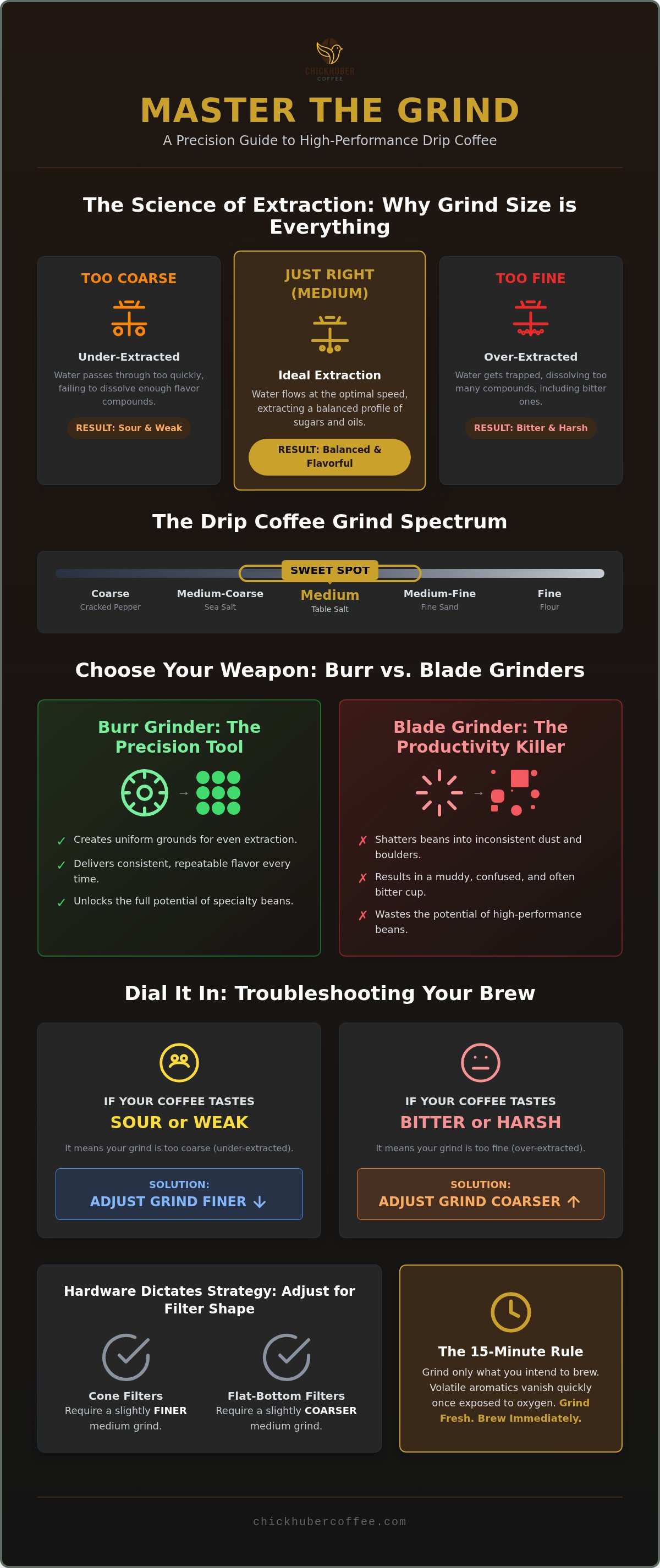
The "Goldilocks Zone" for drip coffee is the precise balance where water pulls the best flavors without the trash. If you grind too fine, the water gets trapped. It stays too long and pulls out harsh, astringent chemicals. If you grind too coarse, the water slides right past. You're left with a weak, tea-like liquid that lacks body. Finding the sweet spot ensures your 6 Bean Blend delivers the complex, high-octane experience it was designed for.
Freshness: The Non-Negotiable Rule of the Grind
Whole beans are protective vaults. They lock in volatile oils and aromatics that provide that sharp, focused kick. The moment you grind, that vault opens. Oxygen rushes in; flavor rushes out. Pre-ground coffee is a productivity bottleneck because it starts losing its edge the moment it's processed. By the time it hits your shelf, the intensity is gone.
Follow the 15-minute rule to maintain your edge. Grind only what you are about to brew. If your grounds sit longer than 15 minutes, the aromatic compounds vanish into the air instead of your cup. Treat your Organic Honduras beans with the respect they deserve. Grind fresh. Brew immediately. Conquer your day.
The Medium Grind: Finding the Drip Coffee Sweet Spot
Precision is power. Mediocrity is a choice. When mastering how to grind coffee beans for drip coffee, the "medium" setting is your non-negotiable target. It is the standard for a reason. This grind size provides the exact resistance needed for water to pass through the grounds at an optimal speed. Too fast and you get flavored water. Too slow and you get liquid charcoal. Neither will fuel your hustle.
Our 6 bean blend is a masterpiece of complexity. It brings together diverse origins that each require a specific extraction window. If your grind is off, you lose the subtle notes that make this blend a high-performance tool. You need a uniform medium grind to balance these flavors. Consistency is the only path to a repeatable, elite experience every single morning.
The Sand Consistency Test for Visual Verification
Forget vague descriptions like "sea salt." Sea salt varies too much to be a reliable metric. Instead, aim for the consistency of granulated table salt or dry, gritty sand. This is your visual and tactile benchmark. If it looks like flour, you've gone too far. If it looks like cracked peppercorns, you aren't there yet.
Use the pinch test to verify your results. Take a small amount of grounds between your thumb and forefinger. You should feel distinct, gritty particles, but they shouldn't be so large that they feel like pebbles. High-volume drip machines often require a slightly coarser lean to prevent the filter from overflowing. Single-cup brewers might need a slightly finer touch to ensure enough contact time. Adjust with intent.
Filter Shape and Its Impact on Grind Choice
Your hardware dictates your strategy. The shape of your filter basket determines how water interacts with the coffee bed. Do not ignore this variable. It is a fundamental engineering requirement for a perfect brew.
- Cone Filters: These require a slightly finer medium grind. The tapered shape forces water through a deeper bed of coffee. You need that finer texture to create the necessary resistance for full flavor development.
- Flat-Bottom Filters: These demand a slightly coarser medium grind. Because the coffee bed is wider and shallower, water can pool if the grounds are too fine. A coarser grit keeps the flow moving and prevents over-extraction.
Match your grind to your gear. If you want to maximize your results, start with the right raw materials and fuel your hustle with beans designed for peak performance. Execute the grind. Brew the fuel. Dominate the day.
Choosing Your Weapon: Burr Grinders vs. Blade Grinders
Gear up or get out. You wouldn't use a blunt axe for precision woodwork. Don't use a blade grinder for elite coffee beans. Mastering how to grind coffee beans for drip coffee requires a tool that respects the raw material. Blade grinders are essentially food processors for your counter. They don't grind; they shatter. This creates a chaotic environment that kills flavor before the water even hits the filter.
This shattering process produces a mix of "boulders" and "fines." Boulders are massive chunks that stay under-extracted and sour. Fines are microscopic dust particles that over-extract instantly, leaving a bitter, muddy aftertaste. This inconsistency ruins the potential of our signature 6 Bean Blend. You end up with a cup that is simultaneously burnt and weak. It's a waste of high-octane fuel and a waste of your morning momentum. Uniformity is the secret to a clean, professional-tasting cup that drives your day forward.
The Problem with Blade Grinder Inconsistency
Blade grinders rely on high-speed metal impact. This generates intense friction. Friction creates heat. This heat can actually pre-cook the volatile oils in your Organic Honduras beans before they even touch the water. You lose the intensity and sharpness before the brew begins. If you're currently stuck with a blade grinder, use the "pulse and shake" method. Pulse the button in short bursts while shaking the grinder vertically to redistribute the beans. It's a stop-gap measure. It is not a solution for someone serious about their daily performance.
Burr Grinders: Conical vs. Flat Plate
Burr grinders are the precision tools of the coffee world. They use two abrasive surfaces to crush beans to a specific, uniform size. You get consistency. You get control. You get results every single time. Investing in a burr grinder is the only way to truly master how to grind coffee beans for drip coffee. It shows you respect the quality of the specialty beans you buy.
Conical burrs are the industry workhorse for home-office productivity. They are efficient, durable, and perfect for the daily hustle. Flat plate burrs offer even higher levels of precision. They provide ultimate flavor clarity for those seeking a sharp, focused edge in their cup. For the high-performance traveler, a manual hand grinder is the answer. It's portable. It's precise. It ensures your Cowboy Blend tastes like victory, no matter where your mission takes you. Upgrade your gear. Own your grind.
Dialing It In: Troubleshooting Your Drip Extraction
Your tongue is the ultimate laboratory. It doesn't lie. If your morning cup tastes like battery acid or a burnt tire, your grind is the primary culprit. Learning how to grind coffee beans for drip coffee is not a "set it and forget it" chore. It's a continuous optimization process for those who demand peak performance. You aren't just making a drink; you're calibrating a functional tool for success.
The sweet spot is where the magic happens. It's the point where acidity, sweetness, and body hit a perfect equilibrium. Acidity should be bright and refreshing, not sharp or metallic. Sweetness should be present and lingering. Body should be rich and coating. This is the high-performance fuel your hustle requires. If you aren't hitting these marks, you need to adjust your variables immediately.
The Bitterness Fix: Going Coarser
Bitterness is the signature of over-extraction. It means the water spent too much time struggling through fine particles. It pulled out the harsh, astringent chemicals that should have stayed in the grounds. If your coffee leaves a dry, sand-paper sensation on your tongue, you've gone too far. You've over-engineered the extraction and ruined the profile.
The fix is immediate. Move your grinder two notches coarser for your next brew. Darker roasts like our Cowboy Blend are more porous. They yield their flavor compounds with less effort than lighter beans. They often benefit from a coarser touch to prevent that burnt, smoky edge from dominating the cup. Respect the roast. Adjust the gear. Win the morning.
The Weakness Fix: Going Finer
Under-extraction is a productivity killer. It occurs when water passes through "boulders" too quickly. It barely touches the surface of the bean before exiting into the carafe. You're left with a thin, salty, or sour profile that lacks any real punch. It's weak. It's ineffective. It won't get you through your first meeting, let alone your entire day.
If you taste sour grass, you must go finer. This increases the resistance in the filter bed and forces the water to extract more depth from the material. Lighter roasts, such as our Organic Honduras, are extremely dense. They are stubborn. They require a finer medium grind to unlock their hidden sweetness and complexity. Don't be afraid to tighten the settings once you master how to grind coffee beans for drip coffee. Force the extraction. Earn the flavor.
Stop wasting elite beans on mediocre settings. Order our high-octane blends and start your precision troubleshooting today.
Fuel Your Hustle with Chickhuber Specialty Beans
Precision is nothing without quality. You can master how to grind coffee beans for drip coffee with surgical accuracy. You can buy the most expensive burr grinder on the market. But if you're feeding it stale, commodity-grade "dust" from a grocery store shelf, you are wasting your time. Low-quality beans are a productivity bottleneck. They lack the volatile oils, the complex acids, and the clean caffeine kick required for peak performance. Garbage in, garbage out.
Our signature 6 Bean Blend is the ultimate canvas for your new skills. We designed this blend for complexity. It isn't a single note. It's a symphony of origins that rewards a precision medium grind. When you hit that sweet spot we discussed, you unlock a multi-layered fuel source. It provides the mental clarity you need to crush your goals. Don't settle for mediocre raw materials. Upgrade your input to maximize your output.
Why Specialty Grade Matters for Your Morning
Commodity coffee is built for volume, not victory. It's often roasted to death to hide defects. This destroys the natural flavor profiles and degrades the caffeine content. Chickhuber whole beans are different. We source specialty grade Organic Honduras and other elite origins. We roast to preserve intensity. We roast to fuel your hustle. Our process ensures that every bean retains its maximum potential for flavor and energy.
If you're ready to test your precision across different profiles, check out our coffee variety pack. It is the strategic way to see how various origins react to your grind settings. One size does not always fit all. Some beans are denser than others. Experiment with your settings. Dial it in. Find the specific profile that sparks your creativity and drives your results.
The Chickhuber Direct-to-Consumer Advantage
Freshness is a weapon. Most coffee sits in warehouses for months before it reaches you. By then, the oils have oxidized. The energy is gone. We skip the middleman. Our direct-to-consumer model ensures your beans are at peak potency when they hit your door. We roast. We ship. You grind. You win. It's an efficient system designed for people who value their time and their taste buds.
Empower your daily grind with coffee that works as hard as you do. You now have the technical knowledge of how to grind coffee beans for drip coffee. You understand the "why" behind the surface area. You know how to troubleshoot the flavor. Now, you just need the right fuel. Stop settling for average. Take action. Master your grind. Master your day.
Master Your Grind. Own Your Morning.
Precision is the bedrock of high performance. You've learned that a consistent medium grind is the only way to unlock the full potential of your beans. You know the difference between a precision burr tool and a chaotic blade. You have the diagnostic skills to fix bitter or sour cups on the fly. Mastering how to grind coffee beans for drip coffee is a commitment to quality that pays dividends every single day. It's about engineering a tool for success.
Don't let your new skills go to waste on stale, warehouse-grade coffee. You need high-performance fuel that works as hard as you do. Our specialty-grade artisanal roasts are designed for those who demand more from their morning routine. We ensure direct-to-consumer freshness so your beans arrive at peak potency. Stop guessing and start winning with a brew that hits the mark every time.
Upgrade your morning fuel with our Signature 6 Bean Blend. Execute with precision. Fuel your hustle. Conquer the day.
Frequently Asked Questions
What happens if I grind my coffee too fine for a drip machine?
Grinding too fine causes over-extraction and potential hardware failure. The water cannot pass through the dense, silt-like bed of coffee. This leads to a bitter, astringent taste that ruins your morning momentum. In extreme cases, the filter basket can overflow and create a massive mess in your kitchen. Stick to a medium grit to ensure the water flows at a high-performance pace. Control your variables or suffer the consequences.
Can I use a blender to grind coffee beans for drip coffee?
Don't use a blender unless you want a cup of inconsistent garbage. Blenders use high-speed blades that smash beans into uneven chunks and fine dust. This ruins the extraction process completely. You'll end up with a brew that is both sour and bitter at the same time. Treat your high-octane beans with respect. Invest in a precision burr tool to master how to grind coffee beans for drip coffee properly. Precision wins.
How many seconds should I grind coffee in a blade grinder for drip?
Aim for 10 to 15 seconds while using a pulse and shake technique. Hold the lid tight and shake the unit vertically to redistribute the beans. This helps minimize the boulders and fines that a blade grinder naturally produces. It is a desperate measure for those without a burr grinder. Check the consistency frequently. Stop when it looks like gritty sand. Consistency is the goal. Speed is just a side effect.
Is a medium grind the same for all drip coffee makers?
No, the specific machine dictates the exact setting. Cone-shaped filters require a slightly finer medium grind to create proper resistance. Flat-bottom filters need a coarser touch to prevent pooling and over-extraction. Understanding how to grind coffee beans for drip coffee means adjusting for your specific gear. Test your results. Taste the output. Calibrate your grinder based on the filter shape you use. One size does not fit all in a high-performance routine.
How much coffee should I grind for a standard 12-cup pot?
Grind approximately 80 to 100 grams of coffee for a full 12-cup carafe. This follows the standard golden ratio of 1:15 or 1:17 coffee to water. Use a digital scale for maximum accuracy. Eyeballing your measurements is a recipe for mediocrity. If you want consistent energy, you need consistent inputs. Measure the weight. Grind the dose. Execute the brew. Precision is the only way to ensure your 6 Bean Blend delivers results.
Should I grind my coffee beans every single morning?
Yes, grinding fresh is a non-negotiable rule for peak performance. Oxygen is the enemy of flavor. The moment you break the bean, the volatile oils begin to vanish. If you grind the night before, you're drinking stale, ineffective fuel by sunrise. Follow the 15-minute rule: grind only what you are about to brew immediately. Freshness ensures maximum flavor retention and the mental clarity you need to dominate your daily grind. No excuses.
Can I use espresso-ground coffee in a drip machine?
Never use espresso grounds in a drip brewer. Espresso requires a fine, powdery consistency that is designed for high-pressure extraction. In a drip machine, this fine dust will clog the filter and cause a bitter, over-extracted mess. You'll lose the complexity of specialty beans like our Cowboy Blend. Stick to the medium grind sweet spot. Respect the engineering of your machine. Use the right tool for the right job to get the right results.
How do I clean my grinder to keep the flavor fresh?
Clean your grinder every week to prevent rancid oil buildup. Old coffee oils stick to the burrs and spoil the taste of fresh beans. Use a stiff brush to remove visible dust and debris. For a deeper clean, use dedicated grinder cleaning pellets to pull out stubborn oils. A clean machine ensures your Organic Honduras beans taste sharp and focused. Maintenance is part of the hustle. Keep your tools sharp. Keep your flavor clean.