

Homemade Coffee Creamer Recipes: Easy Flavors to Make at Home
What if better coffee starts with one simple base, not a crowded fridge full of specialty ingredients? These homemade coffee creamer recipes start with familiar staples, then let you adjust the flavor and sweetness to suit your cup.
Store-bought creamers may not match your preferred flavor, and adding more cream doesn’t always improve a brew. Start with a flexible base, then adjust it to complement the coffee rather than cover it up. You’ll learn how to build that base, try six easy flavor ideas, and get the texture right.
You’ll also find practical mixing and storage tips, plus pairings to help each batch work with your coffee. Try a rich mocha-style creamer with Chickhuber Coffee’s 6 Bean Blend, or pair a lighter flavor with a single-origin coffee. Chickhuber’s flavored coffees use high-quality natural flavoring oils and have no added sugar or calories, offering another way to bring flavor to your cup. Start with the base, make it your own, and brew with purpose.
Key Takeaways
- Start with a simple base, then adjust flavor and sweetness to make homemade coffee creamer recipes that suit your taste.
- Choose milk, half-and-half, or cream for the texture you want, and test the balance in your coffee.
- Explore six flavor directions, from classic vanilla to chai spice, adjusting each in small steps.
- Use a repeatable mix, taste, adjust, chill, and label routine to make batches easier to prepare and manage.
- Match the creamer’s flavor and intensity to the coffee, so neither overwhelms the cup.
Homemade Coffee Creamer Recipes: Why Make Your Own?
Your coffee should taste the way you want it to. Homemade coffee creamer recipes give you control over flavor, sweetness, and richness, so you can tailor each addition to the coffee in your cup instead of settling for one fixed profile.
Homemade coffee creamer is a customizable liquid or blended addition that changes brewed coffee’s flavor, texture, or sweetness. It differs from flavored coffee: creamer goes in after brewing, while flavored coffee gets its flavor from the coffee itself. Chickhuber Coffee’s flavored coffees, for example, use high-quality natural flavoring oils and have no added sugar or calories. You can also combine the two approaches when the flavors work well together. For background on how ready-made alternatives vary, see this overview of non-dairy creamer.
What goes into a basic homemade coffee creamer?
Think in building blocks, not rules. A liquid base provides body, an optional sweetener adds sweetness, and flavorings give the batch direction. Start with milk for a lighter texture, cream for a richer feel, or a combination of the two. Vanilla extract adds a familiar aroma, while maple syrup contributes both sweetness and its own distinct taste.
Each choice affects the finished cup. More cream creates a fuller texture, while a thinner base lets the coffee’s character come through more clearly. A sweetener’s flavor can also become part of the blend instead of disappearing into the cup. You don’t need every element: make an unsweetened, gently flavored creamer or a sweeter, richer one. Let the coffee you plan to pour it into guide your starting point.
Is homemade creamer worth the effort?
It’s a good fit if you like to fine-tune your cup. A ready-made flavor gives you a set combination; a homemade batch lets you decide whether vanilla stays subtle, cinnamon comes through clearly, or sweetness takes a back seat. You can also tailor a flavor to complement a particular coffee rather than expecting one creamer to suit every brew.
That flexibility takes a little effort. Some recipes only need measuring and mixing; others call for gentle heating to combine the ingredients, followed by chilling. Allow time for those steps when a recipe requires them. Homemade doesn’t automatically mean cheaper, more nutritious, or better for your health. Its practical advantage is choice: familiar ingredients, adjustable flavor, and a batch suited to your preferences.
Start with the coffee, then decide what you want the creamer to do. A smooth cup may call for a light touch; a more assertive brew can stand up to a bolder flavor. This pairing approach makes the creamer a deliberate part of the drink, not just an extra splash.
How to Build a Creamy Base for Homemade Coffee Creamer
Build the texture first, then add sweetness and flavor in small steps. This makes it easier to tell whether a batch needs more body, more flavor, or just a little sweetness. There’s no single base ratio that suits every coffee or preference.
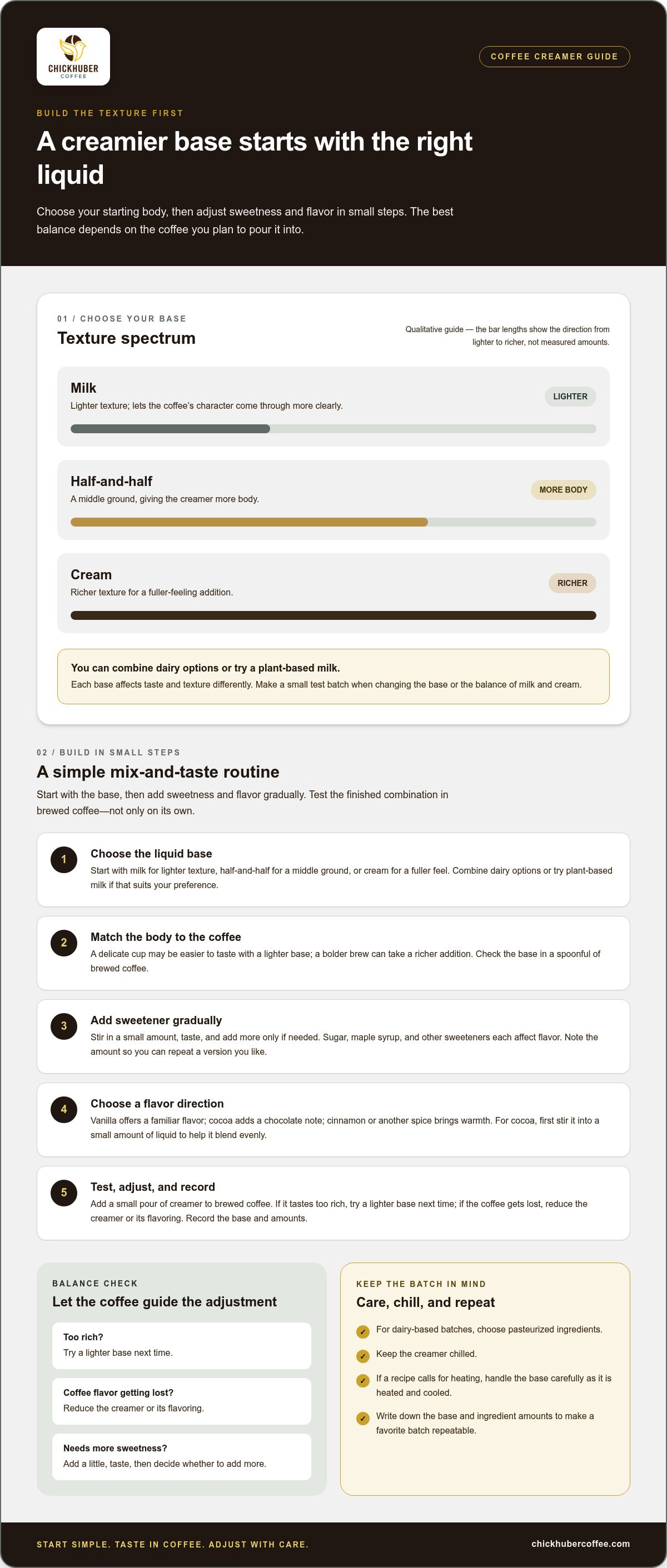
Changing the base changes the richness: milk generally makes a lighter creamer, half-and-half gives it more body, and cream creates a richer texture.
- Choose your liquid base. Start with milk for a lighter result, half-and-half for a middle ground, or cream for a fuller feel. You can combine dairy options or try a plant-based milk. Since each base affects taste and texture differently, make a small test batch before preparing more.
- Decide how much body you want. Consider the coffee you’ll add it to. A delicate cup may be easier to taste with a lighter base, while a bolder brew can take a richer addition. Start with the base that sounds right, then test it in a spoonful of brewed coffee rather than judging it on its own.
- Add sweetener gradually. Stir a small amount into the base, taste, and add more only if needed. Sugar, maple syrup, and other sweeteners can each affect the flavor, so adjust slowly rather than trying to fix an overly sweet batch later. Measure the sweetener and note the amount alongside the batch size so you can repeat the recipe.
- Choose a flavor direction. Vanilla extract offers a familiar flavor. Cocoa adds a chocolate note, while cinnamon or another spice brings warmth. Mix well, then taste again. For a powdery ingredient such as cocoa, stir it into a small amount of liquid first to help it blend evenly into the full batch.
- Test the combination in coffee. Add a small pour of creamer to brewed coffee and check the balance. If the cup tastes too rich, try a lighter base next time. If the coffee’s flavor is getting lost, reduce the creamer or its flavoring. Record the base and amounts so you can repeat the version you like.
For dairy-based batches, choose pasteurized ingredients and keep the creamer chilled. The CDC explains key food safety guidelines for dairy, including why pasteurized milk is the safer choice. Handle the base with care, especially if a recipe calls for heating and cooling before mixing.
Make a small test batch when switching from dairy to plant-based milk or changing the balance of milk and cream. The change can affect more than thickness; it can shift how sweet or intense the added flavor seems in coffee. To explore different coffee profiles alongside your base experiments, browse Chickhuber’s carefully sourced coffees.
Six Homemade Coffee Creamer Flavors to Match Your Mood
Use these homemade coffee creamer recipes as starting points, not fixed rules. Each makes about one cup using one cup of your preferred plain creamer base. Adjust the sweetness to taste, starting with less if you want the coffee’s flavor to lead. Each variation includes a pairing cue to help match its intensity to the cup.
Classic and warm-spice creamer recipes
Start here for familiar flavors with a clear profile. Vanilla stays smooth and flexible, cinnamon brings a warm edge, and chai layers several spices for a more aromatic result. Pair them with coffee that has enough character to balance the flavor without competing with it.
- Vanilla, creamy and gently sweet: Stir 1 teaspoon vanilla extract and 1 to 2 teaspoons maple syrup into 1 cup of base. Begin with less syrup, taste, then add more if you like. Pair it with a smooth, balanced coffee that lets the vanilla come through.
- Cinnamon, warm-spiced: Whisk ¼ teaspoon ground cinnamon and 1 teaspoon maple syrup into 1 cup of base. Ground cinnamon may settle, so stir or shake before serving. Try it with a bold coffee that can hold its own beside the spice.
- Chai spice, aromatic and warming: Warm ¼ cup of the base and whisk in ¼ teaspoon cinnamon, a pinch each of ground ginger and cardamom, and a tiny pinch of ground cloves and black pepper. Let it steep briefly, cool, strain if needed, then stir it into the remaining ¾ cup of base. Pair with a smooth coffee to keep the spice blend in balance.
Chocolate, caramel, and nut-inspired creamer recipes
These variations bring more intensity and sweetness. Blend cocoa carefully to avoid dry pockets, and remember that caramel sauce already contributes sweetness. The hazelnut version uses actual nut butter, so it contains tree nuts. Choose a coffee that complements the creamer or contrasts with it.
- Cocoa, chocolate-forward: Make a smooth paste with 1 tablespoon unsweetened cocoa powder and 1 tablespoon warm base. Whisk in 1 cup base and 1 to 2 teaspoons maple syrup until blended. A bold coffee makes a strong partner for this deeper flavor.
- Caramel-style, sweet and rich: Stir 1 tablespoon caramel sauce into 1 cup base, then taste before adding any extra sweetener. For a less sweet cup, start with half the sauce. Pair with a smooth coffee, or use a bolder brew to balance the caramel’s sweetness.
- Hazelnut-style, creamy and nutty: Whisk 1 tablespoon smooth hazelnut butter into 1 cup base until fully combined. Add 1 teaspoon maple syrup if desired. This contains tree nuts. Try it with a bold coffee for contrast or a smoother cup for a rounded, dessert-like profile.
Keep the first batch modest. Taste each creamer in brewed coffee, not just from a spoon, then adjust the flavor or sweetness for that specific cup.
How to Make, Adjust, and Store Homemade Coffee Creamer
Use the same simple loop for each batch: mix, taste, adjust, chill, and label. This routine helps you identify what needs changing before you make more, whether the issue is sweetness, flavor strength, or body. Start with a small amount and test it in brewed coffee. A creamer that tastes balanced on its own may taste different in the cup.
- Mix gradually. Combine your chosen base and flavorings in a clean bowl or container. If using cocoa or spices, whisk them first with a small amount of liquid to break up clumps, then blend that mixture into the rest. Add sweetener sparingly.
- Taste it in coffee. Stir a little creamer into a small cup of brewed coffee. This gives you a more useful read on the final balance than tasting the creamer alone.
- Adjust one thing at a time. If it needs more sweetness, add a little sweetener and mix again. For stronger flavor, add a small amount of the relevant extract or spice. If the creamer feels too thick, blend in a little more of the same base. Make one change, retaste, then decide what comes next.
- Chill and label. Transfer the finished batch to a clean, sealed container and refrigerate it promptly. Label it with the flavor and preparation date so you can identify the batch and track how long it has been stored.
Prevent separation and adjust the texture
Some ingredients naturally settle or separate during storage. Give the container a gentle shake or stir before pouring, and see whether the texture returns to an even consistency. Gradual mixing helps distribute sweeteners and powdered flavorings. If you change the base or increase a flavor’s concentration, test the adjustment in a small amount first. This helps prevent a strong or unfamiliar ingredient from taking over the full batch.
Handle and store each batch thoughtfully
Keep dairy-based creamer in a sealed container in a refrigerator set to 40°F (4°C) or colder. Don’t leave dairy out at room temperature for more than two hours; refrigerate it sooner after preparation or serving. For guidance on choosing pasteurized dairy, consult the CDC’s food safety guidance for dairy. Ingredients and preparation methods vary, so don’t assume one storage period applies to every homemade recipe. Follow applicable food-safety guidance for the ingredients you use, and discard the batch if you notice an off smell, unusual appearance, or other signs of spoilage. When in doubt, don’t taste it to check.
Keep the process repeatable, not complicated. Write down ingredient changes and how the creamer tastes in coffee, then use those notes to guide your next batch. Ready to test a new pairing? Explore Chickhuber Coffee’s carefully sourced coffees and find a cup to match your next creamer experiment.
Pair Homemade Creamer with Coffee That Brings Out Its Flavor
The same creamer can taste different in two cups. A smooth coffee may let vanilla or cinnamon stay gentle and clear, while a bold, more intense cup can stand up to chocolate, caramel, or stronger spice. Neither pairing is the only right choice. Use the guide below as a starting point, then adjust to your taste.
Match creamer flavor to your coffee
Think about balance. A sweet creamer can soften the coffee’s sharper edges, while a bold brew may keep that sweetness from dominating. For spiced creamers, choose a coffee that complements the spices or gives them room to stand out. Start with a small pour, taste, and build from there.
| Creamer flavor | Coffee direction | Serving style |
|---|---|---|
| Vanilla | Smooth and balanced, so the gentle flavor remains noticeable | Hot or iced, with a modest pour to start |
| Cinnamon or chai spice | A cup with enough character to complement warm spices | Hot, stirred well so the spices distribute |
| Cocoa | A bold-tasting cup if you want contrast with chocolate | Hot, or chilled for a richer-tasting combination |
| Caramel-style | A coffee with a more pronounced taste to balance the sweetness | Hot or iced, adding creamer gradually |
| Hazelnut-style | Smooth for a rounded pairing, or bold for more contrast | Hot or chilled, according to your preference |
Make the coffee itself part of the recipe
Before adding creamer, taste the brewed coffee on its own. Notice whether it tastes mild or assertive, then decide whether your creamer should soften it or add another layer. Stir in a little, taste again, and add more only if the cup needs it. This lets you tune sweetness and richness without losing the coffee’s character.
For a bolder coffee to test against chocolate or caramel-style creamer, explore Chickhuber’s 6 Bean Blend guide. Keep the pairing flexible: the amount of creamer and your own taste matter as much as the coffee choice.
Chilled coffee calls for its own tasting test. Cold brew can taste different from hot coffee, so start with a small amount of creamer and adjust. Use the cold brew brewing guide to explore a chilled-coffee option for your homemade recipe.
If you want flavor in the coffee itself, Chickhuber’s flavored coffees use high-quality natural flavoring oils and have no added sugar or calories. Treat them as coffee, not creamer, and choose a homemade addition that complements rather than crowds their flavor. Explore Chickhuber Coffee to find a coffee to pair with your next homemade batch.
Make Your Next Cup Your Own
Turn your next coffee break into a small flavor experiment. Pick one of the homemade coffee creamer recipes, keep the first batch simple, and note what you’d change after tasting it in your usual brew. A little curiosity can lead to a signature pairing that feels distinctly yours, whether you prefer a softer finish or a bolder flavor.
Then change one variable at a time: the coffee, the creamer’s flavor, or the amount you pour. Chickhuber Coffee’s carefully sourced beans are roasted to order, giving you a coffee foundation to explore. Prefer flavor in the brew itself? Its flavored coffees use high-quality natural flavoring oils and have no added sugar or calories, offering another route to a flavorful cup.
Explore Chickhuber Coffee and find a bold, smooth brew for your next creamer recipe. Choose a coffee, make the first pour, and keep experimenting until the pairing clicks. Your best cup starts with the next one.
Frequently Asked Questions
Can you freeze homemade coffee creamer?
Yes, homemade coffee creamer can be frozen, but thawing may change its texture, especially in dairy-based mixtures. Fat and liquid can separate or look grainy, and stirring may not fully restore the original consistency. Freeze a small portion first to see how your particular recipe responds. Thaw it in the refrigerator, then shake or stir thoroughly before adding it to coffee.
How do you stop homemade coffee creamer from curdling in coffee?
You may be able to reduce curdling by adding creamer gradually and stirring, but no method works for every cup. A temperature difference between hot coffee and cold creamer, along with the coffee’s acidity, can affect how dairy behaves. Test a small splash first. If it curdles, try letting the coffee cool slightly before adding creamer, or experiment with a different base.
Can you make homemade coffee creamer without sweetened condensed milk?
Yes. Many homemade coffee creamer recipes use milk, cream, or another liquid as the base, with sweetener and flavoring added separately. Start with a small amount of sweetener, mix well, then taste before adding more. For example, vanilla extract can flavor a base without requiring a premade sweetened ingredient. The final texture and taste depend on the ingredients and proportions you choose.
Can I use oat milk to make homemade coffee creamer?
Yes, oat milk can serve as a non-dairy creamer base. Expect the finished mixture to differ in richness and texture from one made with dairy, and remember that oat milk varieties may behave differently in hot coffee. Try a small batch before making more. Taste it in the coffee you plan to serve, then adjust the flavor and sweetness to match that cup.
How do you make homemade coffee creamer thicker?
Choose a richer base, such as cream or half-and-half, to give the creamer a fuller texture. Make the change gradually and test a small amount in coffee before adjusting the whole batch. A thickener isn’t required for every recipe, and it can create a different mouthfeel or affect how smoothly the creamer blends. Start with the base, then decide whether more body is really needed.
What is the difference between coffee creamer and half-and-half?
Half-and-half is a dairy ingredient made from milk and cream; coffee creamer is a broader term for additions used to flavor or soften coffee. A homemade creamer recipe may use half-and-half as its base, then add ingredients such as vanilla or sweetener. Recipes vary, so check the ingredient list if dairy or another dietary consideration matters to you.
How much homemade creamer should I add to coffee?
Start with a small splash, stir, and taste before pouring in more. The right amount depends on the coffee’s strength and volume, how sweet the creamer is, and your own preference. Adjust one cup at a time rather than changing the full batch to suit a single serving. That way, the rest stays flexible for a different brew or a lighter pour.