

Common Coffee Brewing Mistakes to Avoid: Stop Sabotaging Your Daily Fuel
Your morning coffee is a tactical asset, not a casual beverage. If you're settling for a bitter, weak cup, you're sabotaging your own peak performance. With coffee futures surging to 314.60 USd/Lbs this July 2026, every wasted gram of your premium roast is a hit to your bottom line and your focus. You've likely encountered those common coffee brewing mistakes to avoid that lead to inconsistent extraction and mid-morning energy crashes. It's frustrating to invest in quality beans only to get mediocre results that leave you feeling drained by noon.
We believe your fuel should be as sharp as your ambition. You deserve a cup that powers your hustle instead of slowing it down. This guide will help you master the tactical art of brewing and eliminate the errors standing between you and a perfect cup of high-performance coffee. We'll break down the essential variables, including the latest 2026 SCA water standards and precise temperature control between 195 and 205 degrees Fahrenheit. It's time to build a repeatable, high-performance routine that delivers maximum flavor and mental clarity every single day.
Key Takeaways
- Identify the sweet spot between sour and bitter extraction to maximize your morning momentum and focus.
- Implement the 1:16 golden ratio to stop eyeballing your measurements and start achieving consistent, high-performance results.
- Master tactical grinding techniques and discover the common coffee brewing mistakes to avoid that lead to muddy, inconsistent flavor.
- Optimize your thermal strike zone and water purity to ensure your liquid gold is extracted with surgical precision.
- Guard your beans against oxidation and keep your equipment clean to eliminate the flat taste and metallic afterglow of rancid oils.
The Foundation: Why Your Current Brew is Killing Your Productivity
Stop treating your morning cup as a casual ritual. It's not just a beverage. It's high-octane cognitive fuel. If you're drinking mediocre brew, you're building a foundation of failure for your entire day. Poorly extracted coffee leads to erratic energy levels and foggy focus. You need to master the tactical art of extraction to unlock peak mental clarity. The "Perfect Extraction" is a precise sweet spot. It sits right between the sharp, unpleasant pucker of under-extraction and the dry, ashy bite of over-extraction. When you hit this target, you get the full complexity of your beans. You get the drive you need to dominate your tasks.
Success in the kitchen mirrors success in the boardroom. It requires three pillars: Precision, Quality, and Consistency. If you lack any of these, you're just guessing. Most people fail because they fall into common coffee brewing mistakes to avoid, treating their tools with apathy rather than intent. By understanding fundamental coffee preparation principles, you transform a messy habit into a streamlined system for success. Don't let a lack of discipline at 7:00 AM dictate your productivity at 2:00 PM. You're an innovator. Your fuel should reflect that.
The Cost of Inconsistency
Eyeballing your measurements is a recipe for disaster. One day you're wired; the next, you're dragging. This inconsistency destroys your energy baseline. It makes it impossible to track how caffeine actually affects your output. Beyond the mental fog, there's a heavy financial toll. Wasting premium specialty beans through sloppy technique is literal money down the drain. If you're using high-end blends like our 6 Bean Blend or Organic Honduras Coffee, you owe it to the craft to get it right. Your brain craves a repeatable ritual. It wants a predictable win every single morning to signal that it's time to work. Eliminate the guesswork. Build a routine that scales.
The "Bitter vs. Sour" Diagnostic
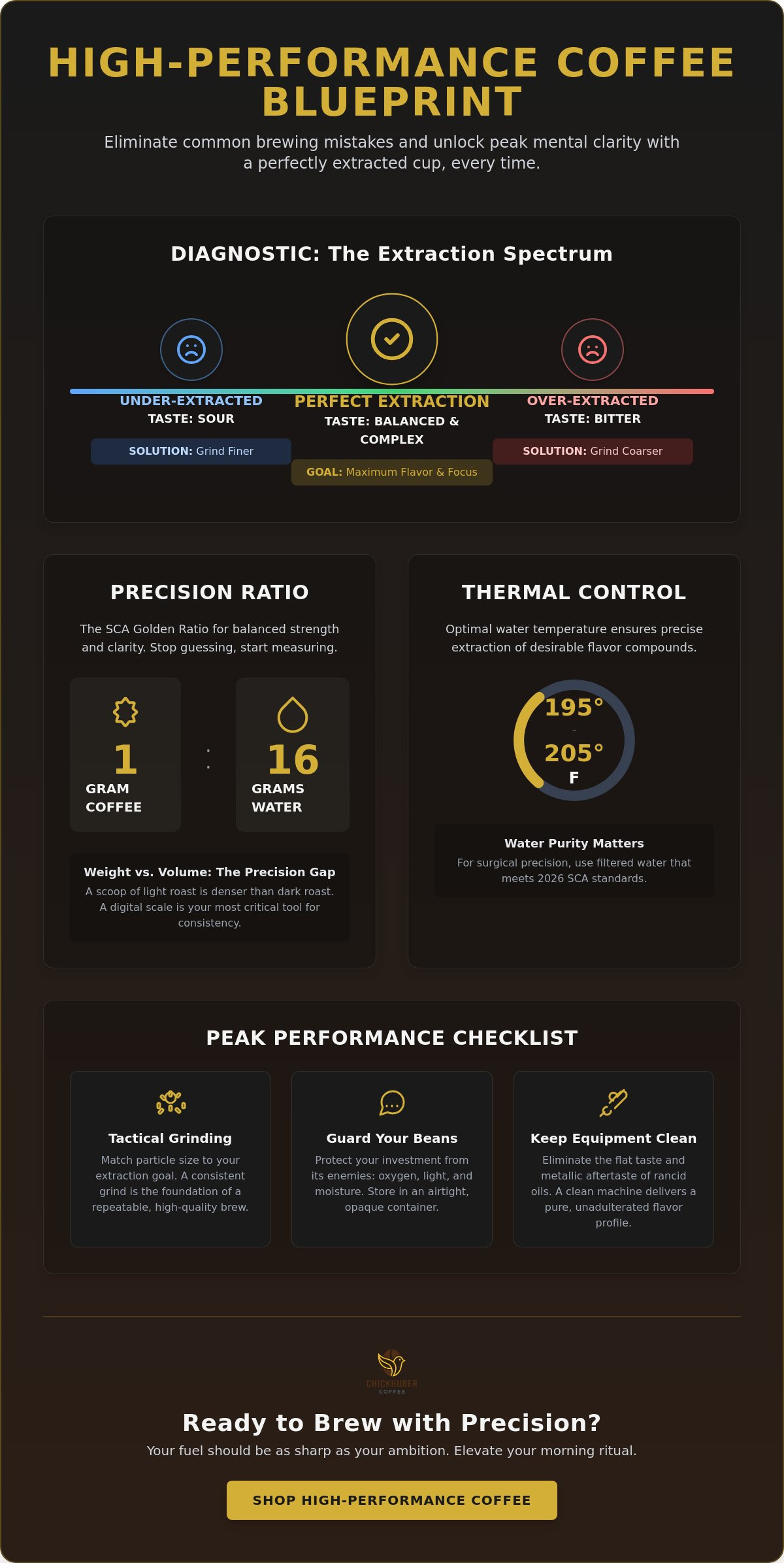
You can't fix what you can't identify. Bitterness is the direct result of over-extraction caused by excessive heat or prolonged contact time. Conversely, sourness indicates under-extraction, where the best flavors remain trapped inside the bean. This is one of the most common coffee brewing mistakes to avoid if you want to maintain your edge. Use this quick-fix guide to recalibrate your mission:
- If it's bitter: Grind coarser to slow down the flow and reduce surface area contact.
- If it's sour: Grind finer to increase extraction and pull out those hidden sugars.
It's a simple tactical adjustment that yields immediate results. Stop settling for "good enough." Start demanding excellence from your equipment and your ingredients. Your performance depends on it. When your extraction is dialed in, your focus follows suit.
Precision Ratios: Stop Eyeballing Your Cognitive Fuel
Stop guessing. Eyeballing your coffee is one of the most common coffee brewing mistakes to avoid if you value your time and output. You wouldn't guess the dosage of a performance-enhancing supplement. Don't guess your coffee. The tactical standard for elite extraction is the 1:16 ratio. For every one gram of coffee, use sixteen grams of water. This is the SCA Golden Ratio, and it's the benchmark for a reason. It balances strength with clarity. It ensures your fuel doesn't turn into a muddy mess of competing flavors. Precision matters. Results matter. When you eyeball it, you're leaving your energy levels to chance.
Complexity requires discipline. Our 6 Bean Blend is a powerhouse of flavor. If your ratio is off by even a few grams, those distinct notes of berry, chocolate, and citrus collide. They become a gray, indistinct sludge. You lose the value of the specialty beans. You lose the nuance that keeps your palate engaged during long work sessions. A digital scale is your most critical investment. It's the difference between a home kitchen and a high-performance lab. Without it, you're just playing with variables you can't control. High-performance habits are built on data, not feelings. Weigh your beans. Weigh your water. Win your morning.
Weight vs. Volume: The Precision Gap
Bean size and roast level change everything. A scoop of dark roast is physically larger but lighter than a scoop of light roast. If you use the same spoon for our Cowboy Blend as you do for a denser light roast, you're failing before you even start. The density gap creates a precision gap. Calculate your water weight based on your desired output. If you want 300g of coffee, divide by 16. You need 18.75g of beans. Simple. Direct. Effective. This math ensures your fuel is consistent every single day of the week.
Adjusting Ratios for Strength
Sometimes the day demands more intensity. Use a 1:15 ratio when you need a bolder, more aggressive productivity kick. It's a concentrated strike for high-stakes mornings. If you're looking for high-volume, all-day consumption, move to a 1:17 ratio for a smoother finish. Our Organic Honduras Coffee shines brightest at the standard 1:16 extraction. It's the perfect balance of sweetness and acidity for sustained focus. If you're ready to stop sabotaging your morning, grab a fresh bag and start weighing your success. Precision is the ultimate productivity hack.
Tactical Grinding: Matching Particle Size to Extraction Tactics
Grinding is the tactical bridge between the raw bean and your cognitive output. If you fail here, your previous precision with ratios won't save you. Surface area science dictates the speed at which water pulls flavor from your coffee. Think of it like kindling versus a heavy log. Small particles extract rapidly; large particles extract slowly. If your grind size doesn't match your specific brew method, you're just wasting high quality coffee beans on a flawed operation. Precision grinding ensures your fuel is optimized for peak mental performance. Don't let a sloppy grind profile undermine your morning momentum.
The blade grinder is the primary enemy of consistency. Using one is among the most common coffee brewing mistakes to avoid if you value clarity. Blade grinders don't actually grind; they shatter. They create a chaotic mix of "boulders and dust." This uneven profile leads to a muddy, inconsistent cup that tastes both burnt and hollow simultaneously. You can't achieve elite results with amateur tools. A burr grinder is a non-negotiable asset for anyone serious about their hustle. It provides the uniform particle size necessary to control the extraction timeline with surgical precision. Stop hacking your beans. Start grinding them with intent.
The Burr Grinder Advantage
Uniformity is the hallmark of a professional setup. Burr grinders use two revolving surfaces to crush beans into a specific, repeatable size. This eliminates micro-sediment and ensures every particle extracts at the exact same rate. You get a clean, vibrant cup that powers your focus without the grit. Investing in a burr grinder offers the highest ROI of any piece of equipment in your lab. It unlocks the true potential of your roast, ensuring you get every cent of value from your specialty blends. Stop settling for a muddy morning. Demand clarity in every sip.
Grind Profiles by Brew Method
Match your grind to your specific mission. Use a coarse grind, similar to sea salt, for a 12-hour cold brew steep. This prevents over-extraction during long contact times. For your daily driver, a medium grind like kosher salt is the target for the best coffee for drip coffee machine performance. If you're pulling espresso-style shots, go fine like table salt. This creates the resistance needed for high-pressure extraction. Master these profiles to eliminate common coffee brewing mistakes to avoid and take command of your daily fuel. Your productivity depends on the details.
Liquid Gold: Thermal Control and Water Purity
Your coffee is 98% water. If your water is mediocre, your coffee is mediocre. It's that simple. Using unfiltered tap water is one of the most common coffee brewing mistakes to avoid. You're pouring chlorine, heavy minerals, and municipal chemicals directly into your high-performance fuel. This sabotages the complex flavor profiles of your specialty beans. It turns a potential win into a bitter disappointment. Stop being lazy with your solvent. According to the 2026 SCA standards, you should aim for a Total Dissolved Solids (TDS) range between 75 and 250 ppm. Use a charcoal filter or high-quality bottled water to ensure your base is clean and ready for extraction.
Hit the thermal strike zone with surgical precision. You need water between 195°F and 205°F for optimal extraction. This isn't a suggestion; it's a non-negotiable requirement for elite brewing. If you use water at the boiling point of 212°F, you've committed the boiling point blunder. You're scorching the delicate compounds in your specialty roast. This creates a bitter, ashy profile that destroys your morning momentum. Conversely, water that's too cool won't pull the necessary energy from the grounds. Control your variables or suffer the consequences of a weak, under-extracted cup. Precision is the difference between fuel and failure.
Temperature and the Maillard Reaction
Water below 195°F fails to extract the sugars and oils that provide sweetness. You end up with a thin, sour, and unsatisfying cup that lacks body. Darker roasts, like our Cowboy Blend, thrive at the lower end of the spectrum around 195°F. This preserves the smoky depth without introducing harshness. If you don't have a temperature-control kettle, use the "Off-Boil" hack. Wait 30 seconds after the whistle blows before you pour. It's a simple fix for a massive problem. This small adjustment ensures you don't burn your beans before the day even starts.
Water Chemistry 101
Hard water makes your coffee taste dull and flat. Soft water can make it taste sharp and overly acidic. You need balance to unlock the true potential of your roast. Chlorine is a major flavor killer, especially when brewing our single origin sample packs. It masks the nuanced notes of stone fruit or cocoa with a chemical aftertaste. This is another of those common coffee brewing mistakes to avoid if you want a clean finish. Simple solution: If you wouldn't drink the water plain, don't brew your coffee with it. Treat your water with the same respect you treat your beans. Your palate and your productivity will thank you.
Ready to upgrade your morning? Stock up on premium roasts and apply these tactics for a better brew today.
The Clean Sweep: Maintenance and Storage for Peak Performance
Your brewing routine is a tactical operation. Don't let a lack of maintenance compromise your results at the finish line. Leaving beans in the hopper is a recipe for stale, flat fuel. This is one of those common coffee brewing mistakes to avoid that most professionals ignore until their coffee tastes like cardboard. Oxygen is the enemy. It attacks the organic compounds in your roast, stripping away the intensity and sharpness you need for peak performance. If you want fresh coffee beans to deliver their full potential, you must defend them from oxidation. Potency has a deadline. Stick to a 2-week window. Buy smaller quantities more frequently to ensure every cup is as sharp as the first one.
The Chemistry of Clean Equipment
Old coffee residue isn't just a cosmetic issue. It's a chemical liability. Built-up oils in your carafe or machine oxidize over time. They create a rancid, metallic, or even fishy aftertaste that ruins your morning momentum. You're effectively pouring high-end fuel into a dirty engine. Descaling is equally vital for your success. Mineral buildup prevents your machine from reaching the 195°F to 205°F thermal strike zone we established in previous sections. Without proper heat, you're back to under-extraction. Follow a tactical checklist: daily rinses for the carafe and a deep chemical clean for your brewing gear every week. Keep your equipment as clean as your focus.
Defending the Bean: Storage Tactics
Storage is about defense. Light and heat are the twin killers of flavor. The "Cool, Dark, and Airtight" rule is your standard operating procedure. Forget the clear glass jars. They look good on a shelf, but they let UV rays degrade your beans. The original bag with a one-way valve is your best ally. It lets gases escape without letting oxygen in. Never use the freezer. The moisture and odors in a freezer are the death of specialty roasts. They create condensation that ruins the cell structure of the bean. If you're using our 6 Bean Blend, you need to lock those complex aromatics in until the exact moment of the grind. This is how you eliminate the last of the common coffee brewing mistakes to avoid and keep your fuel at peak potency. Your productivity depends on the details. Master them.
Command Your Morning: Execute the Perfect Brew
Your journey to elite cognitive performance starts with the water in your kettle and the beans in your grinder. You've now mastered the tactical variables of the 1:16 ratio, precision burr grinding, and the non-negotiable 195 to 205 degree thermal strike zone. By implementing these shifts, you've successfully identified the common coffee brewing mistakes to avoid that keep most people trapped in a cycle of mid-morning crashes and diluted focus. Consistency is your new competitive advantage. Every cup is now a repeatable win for your productivity and your palate.
Don't let your hard work go to waste on inferior ingredients. We provide artisanal roasting for maximum potency and specialty-grade beans specifically selected for high-performance lifestyles. With fast national shipping, we ensure 2026 freshness arrives at your door before your current supply runs stale. It's time to stop settling for "good enough" and start demanding excellence from your equipment and your roast. Upgrade your morning with the 6 Bean Blend, the ultimate productivity fuel. You have the tools. You have the knowledge. Now, go execute your day with total clarity and intensity.
Frequently Asked Questions
Is it better to use a blade or burr grinder for home brewing?
A burr grinder is the only acceptable choice for anyone serious about their output. It uses revolving surfaces to crush beans into a uniform particle size, ensuring every grain extracts at the same rate. Blade grinders are too chaotic. They shatter beans into an uneven mix of boulders and dust, which leads to a muddy, inconsistent cup that ruins your morning focus. Professional results require professional tools.
What is the ideal water-to-coffee ratio for a standard drip machine?
The tactical standard for a clean, powerful brew is a 1:16 ratio. This means you use one gram of coffee for every sixteen grams of water. This balance provides enough intensity to fuel your hustle without the muddy flavors of over-concentration. Use a digital scale to hit this target every single morning. Precision is the ultimate productivity hack, so stop eyeballing and start weighing your success.
Can I use boiling water directly from the kettle on my coffee grounds?
Stop using water straight off the boil. Water at 212°F is far too aggressive and will scorch the delicate flavor compounds in your specialty roast. Let the kettle sit for thirty seconds to hit the 195°F to 205°F strike zone. This small tactical pause prevents a bitter cup and ensures your extraction is dialed in for maximum flavor and mental clarity.
How long do coffee beans stay fresh after the bag is opened?
Your freshness window is exactly fourteen days. Once you break the seal, oxygen immediately begins to degrade the oils and aromatics that provide your cognitive edge. Buy smaller quantities more often to ensure your fuel stays potent. Peak performance requires fresh ingredients, so don't let a half-empty bag sit in your cupboard for a month while it loses its power.
Why does my coffee taste bitter even when I use expensive beans?
Bitterness is a red flag for over-extraction. You're likely grinding too fine or your water is too hot, pulling out harsh compounds that shouldn't be there. These are common coffee brewing mistakes to avoid if you want to stop sabotaging your investment in specialty beans. Coarsen your grind and check your temperature to bring the flavor profile back into balance and reclaim your morning.
Is tap water okay for brewing coffee if it goes through a machine filter?
Tap water is rarely pure enough for elite brewing. Even with a basic machine filter, high mineral content or chlorine can distort the nuanced notes of your roast. If you wouldn't drink the water plain, don't use it for your coffee. Use a dedicated charcoal filter or high-quality bottled water to ensure your 98% water base is clean, neutral, and ready for extraction.
How often should I deep-clean my coffee maker to maintain flavor?
Rinse your carafe daily and perform a deep chemical clean every week. Residual oils go rancid quickly and will taint every fresh brew with a stale, metallic baseline that kills your momentum. Descaling your machine once a month is also essential to prevent mineral buildup from sabotaging your brewing temperature. Keep your gear as sharp and ready as your mindset.
What is the best way to store coffee to prevent it from going stale?
Stick to the "Cool, Dark, and Airtight" rule. Use the original bag with its one-way valve to keep oxygen out while allowing gases to escape. Storing beans in clear jars or the freezer are common coffee brewing mistakes to avoid if you want to maintain intensity. Moisture and light are the enemies of freshness. Keep your storage as disciplined as your work schedule.