

Coffee Tasting at Home: Master Your Palate
Your morning coffee is a high-performance tool, yet you're likely leaving its true power on the table. With 69% of Americans brewing at home daily, most are just going through the motions. You buy expensive beans but can't tell the difference between a bold blend and a single origin. It feels like a waste of resources. You want to identify that sharp citrus or rich chocolate note, but professional jargon gets in the way. Mastering coffee tasting at home is the solution. It's time to stop drinking on autopilot and start optimizing your fuel for mental clarity.
You'll learn to sharpen your senses and decode your brew like a pro. We'll break down the new SCA Coffee Value Assessment standards into actionable steps you can use today. This guide covers everything from selecting the right Organic Honduras beans to hosting a high-energy tasting session for your peers. We'll move through the essential gear, the mechanics of the slurp, and the secrets of the flavor wheel. Prepare to transform your daily ritual into a tactical advantage that keeps you sharp, focused, and ready to win.
Key Takeaways
- Transform your daily caffeine ritual into a high-octane productivity move that sharpens your mental clarity and focus.
- Eliminate the need for expensive gear and master coffee tasting at home using three simple kitchen essentials you already own.
- Execute a tactical, step-by-step evaluation process to identify bright acidity and heavy body in every cup you brew.
- Compare single origin sample packs side-by-side to decode the unique profiles of beans like Organic Honduras.
- Use the signature 6 Bean Blend as the ultimate benchmark for training your senses to recognize complex flavor profiles.
Why Coffee Tasting is Your Next Productivity Power Move
Stop drinking coffee. Start evaluating it. Most people treat their morning cup as a mindless ritual. They gulp down caffeine just to survive the first hour of work. This is a missed opportunity. Coffee tasting at home is a systematic sensory evaluation that transforms your daily fuel into a mental sharpening tool. Professionals call this process "cupping." It follows a standard coffee cupping procedure to isolate quality and identify specific characteristics. When you move from "drinking" to "evaluating," you train your brain to notice micro-details. This isn't just about flavor. It is about discipline. High-quality fuel leads to high-quality results. Better beans equal a better daily output. It is simple math for the high-performer.
The Science of Sensory Training
Your brain thrives on complexity. Identifying specific flavor notes builds new neural pathways. It forces your mind to engage with the present moment. You aren't just awake; you are alert. The connection between aroma and cognitive alertness is scientifically documented. A sharp scent of citrus or a deep note of dark chocolate triggers immediate mental readiness. A disciplined tasting routine beats a mindless caffeine fix every time. It builds a bridge between your physical senses and your mental grind. You become more observant. You become more precise. You become faster. By practicing coffee tasting at home, you turn a basic necessity into a tactical advantage. Focus. Clarity. Speed. These are the rewards of a trained palate.
Setting Your Performance Goal
Define your objective before you brew. Do you need raw energy, pure flavor, or layered complexity? Every bean serves a specific purpose in your arsenal. If you want single-origin purity, grab the Organic Honduras. If you need a benchmark for complexity, the 6 Bean Blend is your target. To find your baseline, start with a coffee variety pack. It provides the range you need to compare and contrast different profiles side-by-side. Consistency is the key to this grind. You cannot measure what you do not track. Treat your palate like a muscle. Train it daily. Push it to recognize subtle differences in body and acidity. This is how you optimize your fuel for peak performance. No fluff. No wasted motion. Just results.
The Essential Gear: Strip Away the Fluff
Elite performance doesn't require elite equipment. It requires elite focus. Many competitors want you to buy branded glasses and specialized kits. Ignore them. They are selling fluff. You are buying results. To master coffee tasting at home, you only need the "Big Three": uniform cups, deep spoons, and filtered water. This lean approach keeps the focus where it belongs. On the beans. On the flavor. On the fuel. Don't let gear become a barrier to entry. Your kitchen is already a laboratory. Use it. Execute. Win.
One tool is non-negotiable. Get a digital scale. Precision is the difference between a fluke and a repeatable success. You need to measure your grounds and water to the gram. If you don't measure, you don't know why your brew failed or succeeded. Control the variables. Own the outcome. Master the brew. A scale ensures that every evaluation is fair. It removes the guesswork that plagues most home brewers. Stop estimating. Start measuring. This is the only way to track your progress as you sharpen your palate.
The Minimalist Setup
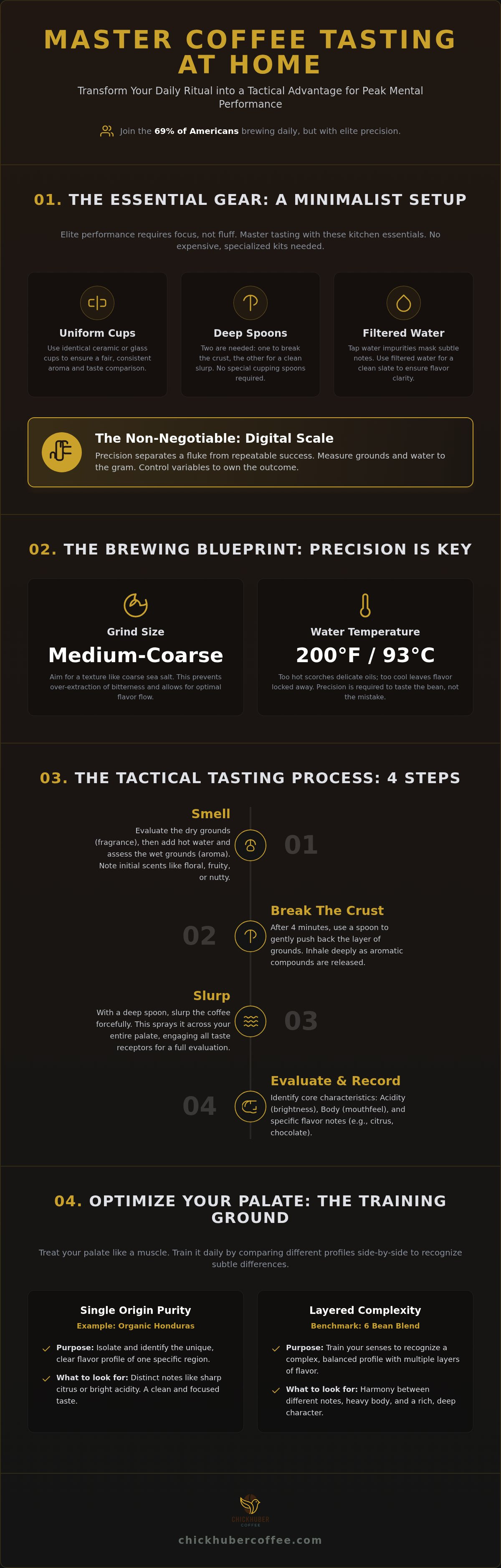
Standardize your vessels to ensure an even comparison. Use three identical ceramic mugs or heat-proof glasses. Different shapes change how you perceive aroma. Keep it uniform. Grab two deep spoons. One breaks the crust. The other delivers the slurp. You don't need professional cupping spoons to identify quality. Use what you have. Use fresh, filtered water. Chlorine and minerals found in tap water mask the subtle notes of a high-quality single origin sample pack. Clarity is everything. If the water is muddy, the flavor will be too.
Brewing for Evaluation
Grind size dictates extraction. Aim for a medium-coarse grind. Think coarse sea salt. This allows water to flow through without over-extracting bitterness. Heat your water to exactly 200°F. Too hot and you scorch the delicate oils. Too cool and the flavors stay locked inside. Consistency in temperature ensures you are tasting the bean, not the mistake. If you prefer a chilled approach to sensory training, check out the Cold Brew Masterclass for crafting high-performance fuel. Whether hot or cold, coffee tasting at home demands precision. Set the stage. Brew the beans. Prepare for impact.
The Tactical Tasting Process: Step-by-Step Execution
Execution is everything. You have the gear. You have the beans. Now, follow the protocol. Professional coffee tasting at home requires a disciplined sequence to extract maximum data from every bean. This is a tactical operation. Do not skip steps. Do not rush. Precision here ensures you identify the difference between a high-performance blend and a mediocre cup. Most people fail because they lack a system. You won't. Follow these five steps to master the grind.
- Step 1: The Dry Aroma. Shake the dry grounds in your cup. Inhale deeply. This is your first encounter with the bean's potential. Look for intensity. Look for freshness. Identify the initial scent before water changes the chemistry.
- Step 2: The Infusion. Pour your 200°F water over the grounds. Fill to the brim. Start your timer immediately. Wait exactly four minutes. This is the industry standard for optimal extraction.
- Step 3: Breaking the Crust. After four minutes, a layer of grounds will float on top. Use your spoon to push them down three times. Inhale the steam. This is the "break." It releases the most concentrated aroma of the entire process.
- Step 4: The Slurp. Dip your spoon. Bring it to your lips. Slurp with force. You want to turn the liquid into a fine mist that coats your entire mouth.
- Step 5: Cleanse and Repeat. Rinse your spoon in hot water and sip plain filtered water. Reset your palate before moving to the next sample.
Mastering the 'Slurp' Technique
The slurp isn't for manners. It is for science. Oxygen is the key to unlocking hidden flavor notes. When you slurp, you aerate the coffee. This carries volatile aromatic compounds to the back of your nose. It also coats your entire tongue instantly. You want to hit every taste bud simultaneously. Sweetness at the tip. Acidity on the sides. Bitterness at the back. Don't swallow too fast. Let the coffee sit. Common beginner mistakes include being too quiet or swallowing before the flavor registers. Be loud. Be aggressive. Be thorough. This is how you maximize coffee tasting at home.
Timing is Everything
Flavor is dynamic. It changes as the liquid cools. The 4-minute rule ensures the initial extraction is complete. But the evaluation doesn't end there. Take your first sip when it is hot. Take another when it is warm. Take a final sip when it is near room temperature. High-quality beans like Organic Honduras often reveal more sweetness as they cool. Flat, low-grade beans reveal defects as the temperature drops. Record your findings at every stage. This creates a complete profile of your fuel. Consistency in timing leads to consistency in results. Track the change. Own the data.
Decoding the Flavor Profile: Beyond Just 'Coffee Flavor'
"Coffee flavor" is a lazy descriptor. It lacks precision. It lacks data. When you practice coffee tasting at home, you must break the cup down into its core components. Stop using broad terms. Start using the four pillars of taste: acidity, body, finish, and sweetness. This is how you build a professional palate. This is how you identify the fuel that actually works for your lifestyle. Every sip is a data point. Collect them. Analyze them. Optimize your results.
Acidity is the spark in the cup. Is it bright like a fresh lemon or dull and flat like tap water? High-performance beans often feature a vibrant, citrus-like acidity that wakes up the senses. Body is the weight of the liquid on your tongue. Does it feel heavy and rich like cream, or thin and light like tea? The finish is the endurance of the flavor. A quality bean leaves a pleasant, lingering aftertaste long after you swallow. Sweetness is the natural sugar content. Look for notes of caramel, dark chocolate, or ripe fruit. If the coffee is bitter, you've likely over-extracted. If it's sweet, you've hit the mark.
The Four Pillars of Taste
Mastering acidity versus bitterness is your first hurdle. Bitterness is often a sign of poor brewing or low-grade beans. Acidity is a prized quality found in specialty coffee. Mouthfeel is equally vital. It is the textural experience of the brew. For example, The 6 Bean Blend offers a superior textural experience because it combines multiple origins to create a dense, layered body. Finally, link the aroma to the taste. The scents you identified during the dry aroma and the infusion should find their match on your palate. If you smell chocolate, look for it in the sweetness. This is how you achieve coffee tasting at home mastery.
Using the Flavor Wheel
The flavor wheel is your map. Start at the center with broad categories like "Nutty" or "Fruity." Once you have the baseline, move outward to specific notes. Is that fruity note more like a cherry or a lime? Don't overthink the process. If you taste it, it is real. Practice with high-contrast beans to accelerate your learning. Compare the bright, clean profile of Organic Honduras against the smooth, dessert-like notes of French Vanilla Flavored Coffee. The massive difference between these two will help you calibrate your senses faster. If you want to sharpen your palate quickly, order a single origin sample pack and start your tactical training today.
Optimize Your Palate with Single Origin Sample Packs
Stop wasting capital on full bags of coffee you haven't vetted. Most competitors want you to commit to a 12-ounce bag before you even know if it fuels your focus. That is inefficient. It is slow. It is a drain on your resources. coffee tasting at home reaches its peak when you leverage variety. Single origin sample packs are your tactical solution. They allow you to test multiple profiles without the clutter of half-used bags sitting in your pantry. You need speed. You need variety. You need results. This is the most efficient way to calibrate your senses and find your ultimate daily fuel.
Compare three distinct origins side-by-side to notice massive differences instantly. You will move from a vague "I like coffee" to a precise "I prefer high-altitude Central American beans." Use the Cowboy Blend as your bold benchmark. Its dark, intense profile serves as the perfect contrast to the bright, clean acidity of beans like the Organic Honduras. This side-by-side analysis exposes the truth about what you're drinking. One cup might offer mental clarity. Another might just be noise. Learn to tell the difference. Own your palate. Control your fuel.
The Strategic Advantage of Variety
Tasting five to seven different beans in a single session accelerates your learning curve. It forces your brain to categorize flavors in real-time. This intensity prevents sensory fatigue by keeping your mind engaged with new data points. Identify your productivity profile. Some beans keep you in the zone for hours. Others fade fast. Use these sessions to map out your workday fuel with surgical precision. You reduce waste. You save time. You optimize your output. Small batches are for testing. Bulk buys are for winners who know exactly what they want. Don't guess. Test. Refine. Execute.
Your Next Mission
Your training starts now. Order a single origin sample pack to begin your sensory evaluation. This is not a hobby. It is a performance upgrade. Log your results in a personal database or a simple notebook. Track the body. Note the acidity. Record the finish. This data becomes your roadmap to peak performance. Stop settling for generic caffeine. Start choosing the specific fuel that drives your grind every single morning. Success starts with a sharp palate and a sharper mind. Grab your Single Origin Sample Pack and start the grind!
Execute Your Sensory Performance Plan
You have the tactics. You have the protocol. Now, you need the fuel. Mastering coffee tasting at home isn't just about enjoying a better cup; it's about sharpening your mind for the daily grind. You've learned to strip away the fluff, master the tactical slurp, and decode complex flavor pillars like acidity and body. This disciplined approach ensures every gram of caffeine you consume works toward your peak performance. No more guessing. No more wasted beans. Just pure, calculated energy.
Don't settle for stale, generic grocery store options. Artisanal roasting and direct-to-consumer freshness are the only standards that matter for high-performers. Our no-fluff, high-octane blends provide the intensity you need to stay in the zone for hours. It's time to stop drinking on autopilot. Start evaluating. Start winning. Take the final step in your training and secure the right tools for the job.
Start your sensory training with our Single Origin Sample Packs and optimize your morning ritual today. Your peak performance is just one brew away. Stay focused. Stay sharp. Grind on.
Frequently Asked Questions
What is the best way to clean my palate between coffee samples?
Room temperature filtered water is the gold standard for resetting your senses. You need a neutral baseline to evaluate every sample with precision. Avoid sparkling water or flavored snacks that leave a lingering residue. Plain, unsalted crackers are an acceptable secondary tool if you need to clear a heavy finish from a dark roast. Keep it simple. Stay neutral. Reset for the next mission.
Do I need a special cupping spoon for a home coffee tasting?
You don't need a professional cupping spoon to achieve elite results. Use a deep, round soup spoon from your kitchen drawer. The goal is to hold enough liquid to create a powerful, aerated slurp. If it holds roughly 0.15 to 0.20 fluid ounces, it works. Focus on your technique rather than expensive silver-plated hardware. Results matter more than gear.
Can I do a coffee tasting with flavored coffees like French Vanilla?
You can absolutely include French Vanilla Flavored Coffee in your session to contrast with unflavored beans. Evaluate how the added notes interact with the natural acidity of the base bean. It is a great way to test your ability to distinguish between natural sweetness and added aromatics. Just ensure you clean your spoon thoroughly between samples to avoid cross-contamination. Test everything. Leave nothing to chance.
How many different coffees should I try in one tasting session?
Limit your coffee tasting at home to three to five distinct samples. Any more and you risk sensory fatigue, which leads to sloppy data and diminished focus. Start with a variety pack to get high-contrast profiles like a light roast and a dark Cowboy Blend. Quality evaluation requires intense concentration. Don't dilute your attention by overcomplicating the lineup. Keep it lean and effective.
What is the ideal water temperature for a tactical coffee tasting?
Heat your filtered water to exactly 200°F before pouring. This temperature is hot enough to extract the full flavor profile without scorching the delicate oils. Use a digital thermometer to verify the heat. Consistency in temperature is the only way to ensure your evaluation is fair and repeatable. Control the variables to own the outcome. Precision is the mark of a pro.
Should I add milk or sugar during a coffee tasting session?
Never add milk or sugar during the evaluation phase. These additives mask the acidity, body, and defects you are trying to identify. You are training your palate to recognize the raw material. If you don't taste the Organic Honduras black, you aren't actually evaluating the bean. Save the cream for your casual afternoon cup. Tasting is for data; drinking is for pleasure.
How long does a typical home coffee tasting session take?
A tactical coffee tasting at home session requires roughly 30 to 45 minutes of your time. This includes setup, the four-minute infusion, and tasting at three different temperature stages. It is a high-ROI activity that fits into a busy productivity schedule. Efficiency is key. Set the timer. Execute the protocol. Get back to the grind with a sharper mind.
What is the difference between aroma and flavor in coffee?
Aroma is the scent of the dry grounds and the steam from the brew. Flavor is the holistic experience that happens once the liquid hits your tongue. It combines your sense of smell with your taste buds' reaction to acidity, sweetness, and bitterness. You need both to build a complete profile. Smell the potential. Taste the reality. Master the connection between the two.