

Arabica vs Robusta Coffee Beans Difference: Fueling Your 2026 Performance
Your morning coffee is not a beverage. It's a biological upgrade for your brain. Most professionals settle for bitter sludge that leads to a crushing midday slump. They get lost in marketing jargon while their focus suffers. You need to master the arabica vs robusta coffee beans difference to engineer your peak performance. With Arabica futures climbing to 302.16 USd/Lbs this July 2026, choosing the wrong bean is a waste of both time and capital. You deserve a better return on your energy.
We know the frustration of a ruined morning routine. A bad cup kills momentum. This article promises a clear, technical framework for choosing your daily fuel based on flavor and caffeine needs. You'll learn why Arabica offers smooth complexity and why Robusta provides the necessary horsepower for a long grind. We'll break down why certain blends use both species to create the ultimate productivity tool. Get ready to buy your next bag with total confidence. It's time to stop guessing and start winning.
Key Takeaways
- Pinpoint the biological traits of each species to select the fuel that powers your specific daily goals.
- Master the arabica vs robusta coffee beans difference to optimize your caffeine intake and flavor experience for peak cognitive output.
- Unlock the power of tactical blending to achieve structural body, persistent crema, and a balanced cup.
- Weaponize technical metrics like altitude and roast freshness to stop wasting money on low-quality marketing fluff.
- Match your bean profile to your daily schedule to maintain high-intensity focus and avoid the midday crash.
The DNA of Your Daily Grind: Defining Arabica and Robusta
Coffee is not a generic commodity. It is a biological choice. Every time you brew, you select between two distinct species: Coffea Arabica and Coffea Canephora. This isn't just trivia. It is the foundation of your daily performance. The arabica vs robusta coffee beans difference dictates how you feel, how you focus, and how you finish your tasks. You need to know exactly what is in your cup to maintain your edge.
Arabica represents roughly 60 to 70 percent of the global coffee supply. It is the sophisticated choice for the discerning professional who demands quality in every sip. Robusta is the resilient powerhouse. It thrives in harsh conditions where more delicate plants would perish. While you are Defining Arabica and Robusta, focus on their primary roles in your routine. Arabica is for flavor; Robusta is for function. One provides the artistic nuance. The other provides the raw power. Mastering the arabica vs robusta coffee beans difference allows you to tailor your brew to your specific ambition.
Arabica: The Flavor Specialist
Arabica beans are the elite athletes of the coffee world. They grow at high altitudes, often above 1,000 meters. This thin air forces the cherries to mature slowly. Slow growth means more flavor. You get a bean packed with acidity, sweetness, and complex aromatics. It is the essential backbone of specialty coffee. These beans demand respect and delicate care throughout the entire supply chain.
- Expect vibrant notes of fruit, chocolate, and floral scents.
- Identify them by their oval shape and curved crease.
- Enjoy a smooth finish that doesn't overwhelm the palate.
If your workflow demands creative deep work, Arabica is your partner. It offers a sensory journey that keeps your mind sharp and engaged. It is the choice for those who view coffee as a ritual rather than just a chore.
Robusta: The High-Performance Engine
Robusta is the workhorse. It grows at lower altitudes and resists pests with natural ease. It contains more caffeine and less sugar than its counterpart. This creates a bolder, grain-like flavor profile that cuts through milk and sugar. It doesn't offer the subtle notes of a mountain-grown Arabica. Instead, it offers a heavy body and a thick, persistent crema. It is built for the grind.
- Choose this for high-octane espresso shots and intense mornings.
- Benefit from its structural body in traditional Italian-style blends.
- Identify it by its rounder shape and straight crease.
Robusta is the engine of the coffee world. It provides the raw horsepower needed for high-intensity tasks and long hours. It is unapologetic, intense, and exceptionally effective at delivering results. When you need to crush a deadline, you need the torque that only Robusta provides.
Flavor Profiles vs. Caffeine Kick: The Performance Breakdown
Stop treating flavor as a secondary luxury. It is a diagnostic tool for your brain. The chemical composition of your cup dictates your cognitive output. When you understand the arabica vs robusta coffee beans difference, you stop drinking coffee and start engineering focus. Arabica is the refined strategist. Robusta is the relentless grunt. Each has a specific role in your high-performance toolkit. Choose your weapon based on the mission at hand.
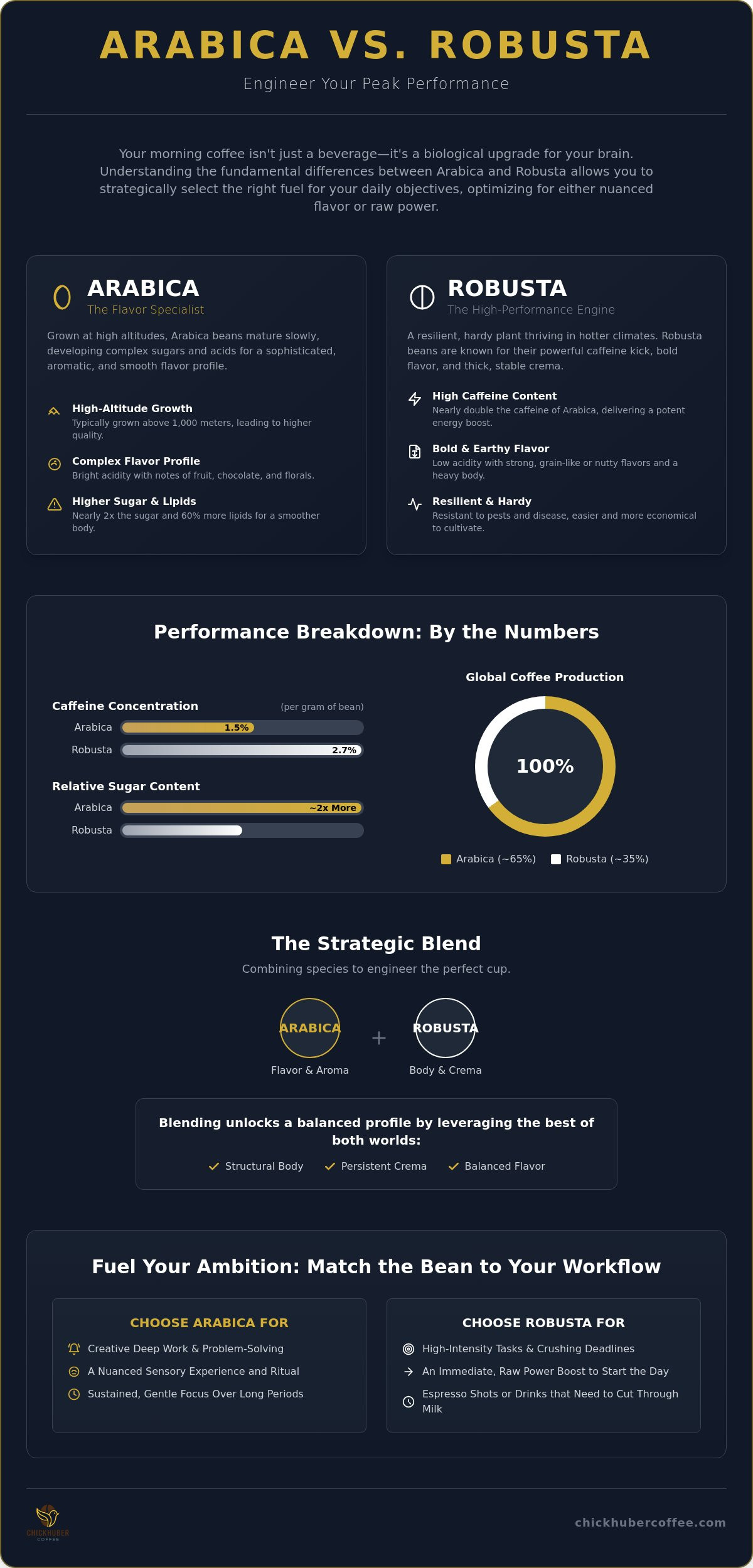
The numbers don't lie. Arabica contains 60% more lipids and nearly twice the sugar content of its counterpart. This creates a smooth, clean finish that prevents sensory fatigue during long sessions. Robusta counters with raw power. It packs a massive 2.7% caffeine concentration compared to Arabica's 1.5%. That is nearly double the stimulation in every gram of bean. It also leads the way in chlorogenic acids. These antioxidants provide a bitter punch but offer unique metabolic benefits that keep you in the fight longer. It is a trade-off between refinement and resilience.
Sensory Analysis: Sweetness vs. Earthiness
Arabica is defined by its "brightness." This high acidity acts as a sensory trigger. It wakes up your palate with notes of fruit, chocolate, and floral complexity. It is the perfect companion for creative deep work where you need a nuanced mental state. Robusta often suffers from a reputation for "burnt rubber" or "woody" flavors. This is usually the result of poor processing, not the bean itself. A high-quality Robusta provides an earthy, nutty foundation that anchors a blend and provides structural body.
Your choice of roast level is the final piece of the puzzle. It determines how these chemical compounds translate into your mug. Understanding how roasting affects flavor is critical for maximizing the potential of either species. Darker roasts can tame Robusta's intensity. Lighter roasts highlight Arabica's delicate sugars. If you want a perfect balance of both worlds, try our 6 Bean Blend to see how precision roasting bridges the gap between intensity and smoothness.
The Caffeine Gap: Managing Your Energy
Caffeine management is about timing and intent. Use Robusta for the 5 AM start. It delivers maximum stimulation with minimal liquid volume. It is a high-octane surge designed to break through morning brain fog and ignite your momentum. Nature designed this high caffeine content as a natural pesticide to protect the plant. You are using that same defensive chemical to power your professional offensive. It is pure horsepower for your central nervous system.
Switch to Arabica for the mid-day flow. You need sustained focus without the jitters. You need the clarity that comes from a balanced cup. The arabica vs robusta coffee beans difference is your secret weapon for energy regulation. Match the bean to your schedule. Match the fuel to the task. Stop settling for random results and start mastering your chemistry. Win the day.
Growing Conditions and Sustainability: Why the Price Gap Exists
Price is a performance metric. It reflects the intensity of the struggle required to produce excellence. The arabica vs robusta coffee beans difference starts deep in the soil and ends with the elevation of the farm. High altitudes demand more from the plant. They demand more from the farmer. You aren't just paying for a bean; you're paying for the survival of the fittest. Understanding this geography helps you invest your coffee budget where it actually impacts your focus.
Higher elevation produces a superior chemical profile. The extreme difficulty of high-altitude cultivation directly correlates to the price of high quality coffee beans. Arabica is a delicate specialist. It requires heights of 1,000 meters or more to thrive. This thin air and cooler temperature force the coffee cherry to mature slowly. Slow growth creates density. Density creates a concentrated explosion of flavor and nutrients. It is a grueling process that yields a premium result.
The Altitude Factor
Altitude acts as a natural filter for quality. Arabica plants are vulnerable to pests and disease at lower levels. They need the protection of the mountains. Robusta is the ultimate survivor. It thrives in humid, low-lying areas where Arabica would perish. It grows fast. It produces more fruit. It resists the "coffee rust" fungus with ease. This resilience makes it significantly cheaper to produce at scale. However, fast growth often results in a less complex flavor profile. In 2026, climate change is squeezing Arabica production into even higher, more expensive pockets of land. Robusta is becoming the industry's insurance policy for a stable supply.
Market Economics: Cost vs. Value
Don't fall for the price-equals-quality myth without checking the data. You pay more for single-origin Arabica because the labor is intense. Harvesting on steep volcanic slopes requires manual precision. You can't run a tractor at 2,000 meters. Organic farming in these regions adds another layer of cost but ensures your fuel is free from synthetic interference. It is a clean investment in your health and your hustle.
- Arabica: High altitude. Manual harvest. Premium price.
- Robusta: Low altitude. Machine harvest. Budget-friendly.
- Strategic Blends: The middle ground for high-performance value.
The "specialty" label is also evolving. Historically, only Arabica could earn this title. That is changing in 2026. We are seeing the rise of "Fine Robusta." These are beans grown with the same obsessive care as top-tier Arabica. They offer a clean, high-caffeine punch without the rubbery aftertaste of cheap fillers. Stop settling for low-grade sludge. Demand beans that have earned their place in your cup through the hardship of the climb.
The Strategic Blend: Why You Don’t Have to Choose Just One
Purity is an amateur's obsession. Professionals focus on results. In the world of high-performance fuel, tactical blending is the industry standard. You don't have to choose between flavor and power. You can have both. Understanding the arabica vs robusta coffee beans difference is the first step. The second step is learning how to fuse them into a superior product. Stop chasing 100% labels. Start chasing the perfect extraction. You are engineering a balanced cup that hits every performance metric required for your day.
Robusta is often dismissed as a filler by those who don't understand its utility. This is a strategic error. It is actually a secret weapon for structural integrity. It provides the heavy body and persistent crema that Arabica often lacks. If you have ever pulled a 100% Arabica espresso and found it thin or watery, you have seen the limitation of purity. A tactical dose of Robusta adds the mouthfeel required for a truly satisfying cup. Our 6 Bean Blend is a masterclass in this philosophy. It uses strategic origins to maximize both flavor complexity and the physical kick you need to win.
The "Crema" factor is more than just aesthetics. It is a carrier for aromatics. Robusta beans produce significantly more crema than Arabica due to their specific chemical composition. This foam acts as a blanket. It traps the delicate scents of the Arabica beans and delivers them directly to your senses. Without it, your espresso loses its impact. By mastering the arabica vs robusta coffee beans difference, you learn to use Robusta as the engine and Arabica as the navigation system.
Engineering the Perfect Espresso
The Italian tradition isn't built on snobbery. It is built on physics. Traditional roasters use 10 to 20 percent Robusta to stabilize the shot. This creates a thick, syrupy texture that coats the palate. It also makes the coffee more resilient across different brewing methods. This resilience is why Robusta is the unsung hero of the cold brew world. It provides a bold, chocolatey foundation that survives long extraction cycles without becoming overly acidic or weak.
Customizing Your Caffeine Intake
Control your chemistry. If your day involves creative deep work, you might mix single-origin Arabicas like our Organic Honduras. This prioritizes aromatic complexity and mental clarity. But when you face peak physical performance or a high-stakes deadline, reach for a high-Robusta blend. This is the "Cowboy Blend" philosophy. It is about boldness without compromise. It is about readiness. It is about fuel that matches your ambition. Stop settling for random results and start choosing your blend with intent.
Fuel Your Ambition: Choosing the Right Bean for Your Workflow
Stop drinking for the taste alone. Drink for the outcome. Your workflow demands specific fuel at specific times. If you haven't audited your beans lately, you're leaving performance on the table. Mastering the arabica vs robusta coffee beans difference is how you optimize your mental clarity and physical stamina. Your coffee is a functional tool. Treat it like one. Evaluate your current supply. Does it ignite your focus, or does it leave you reaching for a second cup of bitter sludge by noon? It is time to align your caffeine strategy with your 2026 goals.
Experimentation is the only path to a personalized sweet spot. Every professional has a unique biological response to caffeine and acidity. Don't guess. Test. Use single origin sample packs to benchmark how different species and origins affect your output. Record your results. Notice how a high-altitude Arabica sustains your creative flow versus how a bold Robusta blend powers you through a grueling physical session. This is data-driven drinking. It is the hallmark of a high-performer who refuses to settle for average results.
A Guide to Morning Selection
The 6:00 AM Power Move requires raw intensity. You need immediate alertness to break through the fog and claim the day. Choose high-caffeine blends that utilize Robusta's natural horsepower. This isn't about subtle floral notes. It's about a central nervous system surge that prepares you for battle. Save the nuanced experiences for later. Early morning is for momentum. It's for the grind. It's for the win.
The 10:00 AM Creative Session demands a different approach. Switch to a single-origin Arabica, like our Organic Honduras. This is the time for nuanced flavor and sustained focus. The higher sugar and lipid content of Arabica provides a smoother experience that won't distract your mind with harsh bitterness. Your brewing method should also dictate your choice. Use drip or pour-over for Arabica to let the acidity breathe. Reserve espresso for blends where Robusta can provide the necessary structural body and crema.
Taking Action: Upgrade Your Supply
Stop settling for grocery store dust. Those beans are often stale before they even hit the shelf. Freshness is your primary metric for success. In fact, the species matters less than the roast date when it comes to mental clarity. Stale oils cause inflammation and brain fog. Freshly roasted beans provide clean energy. Read your labels like a pro in 2026. Look for specific roast dates, clear altitude markers, and transparent species identification. If a brand hides behind vague "100% Coffee" labels, walk away. You deserve transparency. You deserve quality. You deserve fuel that matches your ambition.
Ready to upgrade? Grab a Single Origin Sample Pack and taste the difference.
Command Your Fuel. Own Your Output.
Your coffee is more than a beverage. It is a strategic asset for your 2026 performance. You now possess the technical framework to choose between refined flavor and raw horsepower. Arabica provides the creative clarity you need for deep work. Robusta delivers the high-octane surge required to crush your most demanding deadlines. Mastering the arabica vs robusta coffee beans difference ensures you never settle for a weak cup or a midday crash again. It's about precision. It's about results. It's about making every sip count toward your ultimate success.
True performance optimization extends beyond the cup to the food that fuels your ambition. To complement your tactical caffeine strategy with authentic, nutrient-dense meal solutions, learn more about Jolloful and their mission to bring Pan-African culinary excellence to the global stage.
Stop wasting your potential on grocery store dust. You deserve artisanal roasting designed for peak performance. Our direct-to-consumer model guarantees freshness that fuels your hustle without compromise. We've expertly crafted our blends specifically for the modern productivity lifestyle. Upgrade your daily grind with our signature 6 Bean Blend and experience the ultimate productivity tool. Don't let poor bean selection dictate your energy levels. Take control of your chemistry and dominate your schedule. The grind doesn't stop. Neither should you. Go out there and win.
Frequently Asked Questions
Is Arabica coffee better than Robusta?
Better is a metric of your specific intent, not just a label. Arabica is superior for flavor nuance and aromatic complexity, making it the choice for creative deep work and sensory rituals. Robusta is better for raw intensity and physical stamina. You don't choose the best bean; you choose the right tool for your specific workflow. High performers use both species strategically to dominate their daily schedule and maintain mental clarity.
Does Robusta have more caffeine than Arabica?
Yes, Robusta delivers nearly double the caffeine of Arabica. On average, Robusta beans pack a 2.7 percent caffeine concentration compared to Arabica’s 1.5 percent. This massive gap makes Robusta the ultimate engine for immediate alertness and high-octane surges. If your morning requires raw power to break through brain fog, Robusta provides the horsepower you need. It is nature’s most effective defensive chemical repurposed for your professional offensive.
Why is Robusta coffee often cheaper than Arabica?
Production efficiency dictates the lower price point. Robusta plants are resilient survivors that thrive at low altitudes and resist pests with natural ease. They produce higher yields and allow for mechanical harvesting on flat land. Arabica requires high-altitude cultivation and manual labor on steep, difficult slopes. You pay a premium for the hardship of the climb. Lower cost doesn't mean lower utility; it means a more streamlined and resilient supply chain.
Can I find high-quality Robusta coffee beans?
Yes, high-quality Robusta exists and is gaining serious traction in 2026. Known as Fine Robusta, these beans receive the same obsessive care and processing as top-tier specialty coffee. They offer a clean, nutty profile without the rubbery aftertaste found in budget fillers. When you master the arabica vs robusta coffee beans difference, you learn to seek out these premium grades. They provide the perfect foundation for a high-performance morning brew that doesn't compromise on quality.
Which bean is better for espresso, Arabica or Robusta?
A tactical blend is the professional choice for a superior espresso. Arabica provides the necessary acidity and sweetness, while Robusta delivers the structural body and thick, persistent crema. A 100 percent Arabica shot often feels thin and lacks the syrupy texture required for a satisfying extraction. Using a blend allows you to engineer a cup that hits every sensory and performance metric. It is about balance, intensity, and a finish that lasts through your next task.
What happens if I mix Arabica and Robusta beans?
Mixing these species creates a synergistic productivity tool. You combine Arabica’s sophisticated flavor notes with Robusta’s raw caffeine surge. This tactical fusion stabilizes your energy levels and provides a more resilient brewing profile across different methods. It is the secret behind the world’s most effective blends. By blending, you stop settling for one-dimensional results and start engineering a cup that supports both your palate and your professional ambition.
Does Arabica or Robusta have less acid?
Robusta typically has lower acidity than Arabica. While Arabica is prized for its bright, fruity phosphoric acids, these can sometimes be too intense for those with sensitive stomachs. Robusta offers a more neutral, earthy profile that feels softer on the palate in terms of sharp bite. Understanding the arabica vs robusta coffee beans difference helps you manage your digestive comfort without sacrificing your caffeine intake. Choose your fuel based on how your body responds to the chemistry.
How can I tell the difference between the beans just by looking at them?
Identify them by their shape and physical structure. Arabica beans are oval and elongated with a curved, S-shaped crease. Robusta beans are smaller, rounder, and feature a straight crease down the center. You can also spot the difference in the plant itself; Arabica is a delicate shrub, while Robusta is a hardy, tree-like plant. Visual recognition is the first step in auditing your supply. Know your beans before they ever hit the grinder to ensure peak quality.